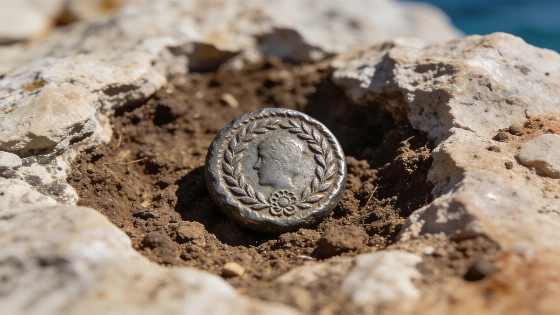
A lead bulla from a fortified settlement on Croatia's Lukovac islet carries a bishop's name, but no surviving record identifies Stefan or proves that he served the nearby diocese of Rab
A 22-by-19-millimeter lead disc was recovered from a defined archaeological layer at Lukovac, giving researchers a context often missing from seals acquired through the antiquities market. Its inscription identifies a bishop named Stefan, but his identity remains unknown.
The object may be among the oldest known episcopal seals from the eastern Adriatic. Researchers have provisionally dated it to the sixth or seventh century, when the settlement on the rocky islet was occupied. The investigations form part of the Polish-Croatian project "Topografia archeologiczna wyspy Rab," or "Archaeological Topography of Rab Island," which has been under way since 2019.
A document seal
Known as a bulla, the disc has a narrow channel for a cord. A sender would pass the cord through it, then clamp the lead around it with specialized sealing equipment. Opening the secured parcel would leave a trace. Prof. Fabian Welc, who leads the Polish part of the research at the Institute of Archaeology of Cardinal Stefan Wyszyński University, explained that this type of seal closed an official letter or legal act and confirmed the sender's identity, as described in a PAP-linked report.
One face bears STEPHANVS, the Latin form associated with Stefan, arranged across three lines. The other carries EPISC, an abbreviation of episcopus, or bishop. A wreath surrounds the lettering, with four-petaled rosettes above and below the name. The document the seal once secured has not survived.
The word bulla is now particularly associated with papal documents, but the inscription identifies the sender only as a bishop named Stefan. Researchers are examining whether he may have been connected with the nearby island of Rab; the seal itself does not establish that he served there.
Dating and context
The sixth- or seventh-century estimate draws on the seal's form and lettering, comparisons with other examples, and the archaeological layer where it was found. Italian seals from the same broad period, including examples associated with clergy, offer parallels. Researchers have not identified a direct eastern Adriatic equivalent, and the find has been described as potentially one of the region's oldest known episcopal seals.
The documented findspot adds useful evidence. Many seals reached museum or private collections through the antiquities market without records of their original location. At Lukovac, archaeologists can relate the bulla to a specific site and layer, although that context cannot by itself identify its sender or the document's destination. A separate Black Sea find illustrates a similar limit: an artifact can support competing interpretations without proving its purpose.
Stefan's identity
Stefan could have served Rab, whose surviving episcopal lists leave a considerable gap. Titianus is documented in the sixth century, while the next known bishop in the sequence, Peter I, appears in AD 986. The seal does not establish that Stefan held the see of Rab.
Other possibilities include an episcopal center at Osor or Krk. The place where a seal was found does not necessarily identify where its issuer lived: the document may have arrived on Lukovac from elsewhere.
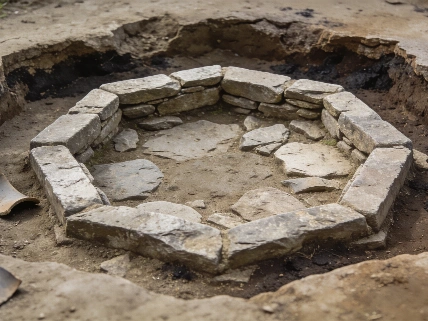
Archaeologists have identified a fortified settlement on the islet dating approximately from the sixth to eighth centuries, along with an early Christian church and a water cistern. A joint Polish-Croatian team began investigating the site in 2019 as part of the wider Rab archaeological-topography project. The seal records a connection to church administration, though it cannot show who received the document or what it contained.