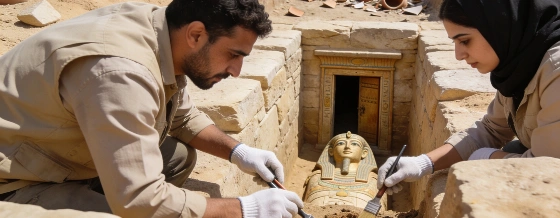
Archaeologists excavating the Bubasteion necropolis at Saqqara have identified the tomb of Sakhnetio-Btah, a high-ranking Old Kingdom official, alongside a network of burial shafts containing human remains and funerary objects from multiple periods
Archaeological work at the Bubasteion necropolis in Saqqara, Egypt, has revealed the tomb of Sakhnetio-Btah, an official from the Old Kingdom, together with an extensive system of burial shafts containing human remains and funerary artifacts. The discoveries, made during the first season of a new excavation west of the Bubasteion, provide evidence for the long-term use and adaptation of this area as a burial ground across different periods of ancient Egyptian history.
Excavation Context and Methods
The Egyptian archaeological mission, operating under the Ministry of Tourism and Antiquities, employed a combination of stratigraphic excavation, architectural documentation, and digital recording to investigate the site. The tomb of Sakhnetio-Btah was identified through its funerary chapel, which preserved a false door in its original position. In front of the false door, archaeologists recovered a complete set of alabaster ritual objects, including an offering table, purification basin, vessel, and mat. Hieroglyphic inscriptions on these objects and the false door recorded the name and titles of the tomb owner, confirming his association with the royal administration and priesthood during the Old Kingdom.
The excavation also documented a complex network of interconnected burial shafts. These shafts contained multiple human burials, decorated cartonnage, and a diverse assemblage of pottery and small finds. The stratigraphic relationships among the tomb, chapel, and shafts indicate repeated reuse and modification of the necropolis over time.
Funerary Assemblages and Human Remains
Among the most significant finds was the intact funerary assemblage within the chapel, which remained in its original archaeological context. The preservation of ritual objects in situ allows researchers to reconstruct aspects of Old Kingdom funerary practice, including the placement and function of offerings. The hieroglyphic inscriptions identified Sakhnetio-Btah as royal chamberlain, overseer of all the king's works, overseer of royal documents, keeper of royal secrets, priest of the goddess Maat, and overseer of the library, suggesting a senior administrative and religious role.
Elsewhere in the burial shafts, the team recovered more than 100 ushabti figurines, three stone burials in their original positions, a wooden falcon figure, and substantial quantities of funerary cartonnage. Human skeletal remains were present in several shafts, though preliminary analysis indicates that some areas had been disturbed or looted in antiquity. Archaeologists identified passages and disturbances consistent with ancient tomb robbing, but surviving material retains significant research value for understanding burial customs and site organization.
Reuse and Site Development
The evidence from Saqqara demonstrates that the necropolis was not a static landscape. The repeated reuse of tombs and burial shafts, as well as the presence of artifacts from later periods, reflects changing funerary practices and the ongoing significance of the site. The stratigraphic and architectural documentation undertaken by the mission enables researchers to trace the chronological development of the necropolis and to distinguish between Old Kingdom and later interventions.
Quantitative data from the excavation include the recovery of over 100 ushabti figurines, three undisturbed stone burials, and a complete set of ritual objects within the funerary chapel. The number and diversity of finds highlight the complexity of mortuary activity at Saqqara and provide a basis for comparative analysis with other Egyptian burial sites. Similar approaches to stratigraphic and contextual analysis have been used in other recent excavations, such as the investigation of medieval burials at Nonneseter Monastery in Bergen, which also relied on careful documentation of burial context and disturbance (see coverage of medieval burial excavations in Norway).
Ongoing Research and Future Prospects
The current phase of research at Saqqara remains preliminary, with further specialist analysis planned for the human remains, funerary assemblages, and architectural features. The mission is continuing to document and compare the new finds with material from other Egyptian sites, and additional excavation is expected to reveal further structures and burials beneath the sand. The results will be prepared for publication in a peer-reviewed scientific journal, and ongoing work will refine the chronology and interpretation of the necropolis.
The discoveries at Saqqara contribute to a growing body of evidence for the long-term use and transformation of Egypt's burial landscapes. The site's complex stratigraphy, repeated reuse, and diverse assemblages underscore the importance of careful contextual analysis in reconstructing ancient funerary practices and social organization.
Understanding the archaeological context of burials is essential for interpreting both the material culture and the human remains recovered from ancient cemeteries. Stratigraphy-the study of the sequence and relationship of archaeological layers-allows researchers to distinguish between primary burials, later intrusions, and post-depositional disturbances. Accurate documentation of context, including the position of artifacts and skeletal remains, is critical for reconstructing mortuary behavior and for assessing the impact of ancient and modern disturbance on the archaeological record. Without secure context, the interpretive value of even well-preserved objects or skeletons is greatly reduced.