More than 1,200 microgravity readings and ground-penetrating radar surveys have identified low-density anomalies beyond Tutankhamun's burial chamber. The findings are consistent with possible corridors and rooms, but neither the structures nor a connection to Nefertiti has been confirmed by excavation.
Possible corridors and chambers may lie just beyond Tutankhamun's burial chamber in Egypt's Valley of the Kings. The evidence comes from geophysical measurements rather than excavation and has revived the possibility that KV62 forms part of a larger royal funerary complex. A report published in Nature's coverage describes the result as strong evidence for a hidden complex while emphasizing that the interpretation remains unverified underground.
The study extends a debate that began in 2015, when British Egyptologist Nicholas Reeves proposed that the north wall of KV62's burial chamber might conceal a passage to an earlier royal burial associated with the Amarna period. His hypothesis was based partly on the tomb's plan, apparent changes in the wall paintings, and lines or cracks that he interpreted as possible traces of a sealed doorway. The historical proposal was discussed in an Ahram interview.
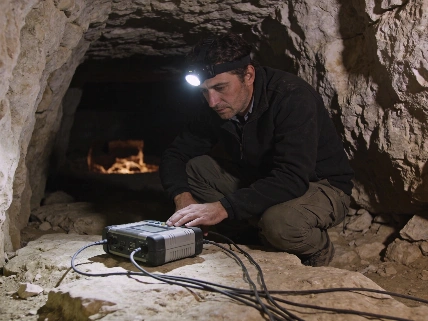
Researchers combined ground-penetrating radar with microgravity measurements around the tomb. Ground-penetrating radar detects changes in electromagnetic reflections from subsurface boundaries, while microgravity surveying measures minute variations in Earth's gravitational field. A void, a rubble-filled space, or a change in bedrock density can produce a measurable gravitational contrast, but the signal is indirect and does not reveal the interior of a feature.
The survey included more than 1,200 microgravity measurements across roughly 35 square meters surrounding the tomb, together with ground-based radar observations. Some anomalies appear to form low-density, right-angled structures aligned with the north wall of Tutankhamun's burial chamber. That geometry is compatible with artificial spaces, but compatibility is not confirmation: the available information places the interpretation close to the resolution limits of the method.
One proposed feature is a corridor approximately two meters wide that may extend away from the burial chamber and contain rubble. Another feature, provisionally identified as "anomaly 7," consists mainly of a low-density zone with a roughly square area of higher-density material. George Ballard has suggested that this pattern could represent a chamber containing objects, while stressing that the measurements cannot establish that interpretation.
The study materials do not provide a conventional archaeological identification of the features, nor do they establish statistical certainty through a reported excavation, material sample, p-value, or confidence interval. That absence is important: geophysical surveys generate models of subsurface contrasts, and several physical configurations can produce similar readings. As in other remote-sensing studies reported in journals such as Nature and Science, the decisive test is whether independent measurements and direct investigation reproduce the proposed geometry.
The apparent structures may also pre-date Tutankhamun's burial. That possibility matters because KV62 is unusually small for a royal burial and could have been adapted from an earlier complex after Tutankhamun died young. In this interpretation, the hidden spaces would not necessarily have been designed for Tutankhamun, and their existence would not by itself identify the individual for whom they were built.
The larger complex has often been linked to Queen Nefertiti's missing burial place. Yet the geophysical evidence does not identify the person for whom any hypothetical chambers were constructed. A sealed space could instead be a storeroom or another section of an earlier funerary complex, while flash flooding and geological instability in the Valley of the Kings could have altered or damaged underground spaces.
Earlier geophysical surveys produced conflicting results. Some appeared to indicate hidden spaces, while others found no convincing evidence. Ballard's explanation is that previous work may have been aimed at detecting a large empty chamber immediately behind the tomb wall and therefore could have overlooked a narrower corridor or a rubble-filled feature. Differences in instrument configuration, survey coverage, processing assumptions, and the physical state of the ground can all affect how a weak anomaly is interpreted.
The debate is therefore about structure before it is about identity. The measurements may indicate voids or altered-density zones, but they do not establish that Nefertiti was buried there, that the spaces are intact, or that they belong to one connected complex. The cautious position reported in independent coverage on 17-18 September 2026 is that new rooms and any association with Nefertiti remain unconfirmed until archaeological access is obtained.
Mamdouh Eldamaty, an archaeologist at Ain Shams University in Cairo and Egypt's former antiquities minister, has characterized the combined findings as strongly suggestive of a possible hidden complex. Christopher Gaffney, an archaeologist and ground-penetrating radar specialist at the University of Bradford, has described the research as fascinating while cautioning that the published information is insufficient for a definitive conclusion. Geophysicist Peter Styles of Keele University considered the microgravity evidence consistent with the presence of chambers but also called for more detailed data.
The distinction between anomaly and architecture is central. A geophysical signal is an indirect measurement produced by a physical contrast underground. It can guide archaeological investigation, but it does not provide the same evidence as an exposed wall, a documented doorway, or material recovered from a controlled excavation. The researchers' proposal to drill several small holes roughly seven to eight centimeters wide toward one of the strongest low-density anomalies would test the interpretation without immediately opening a large excavation.
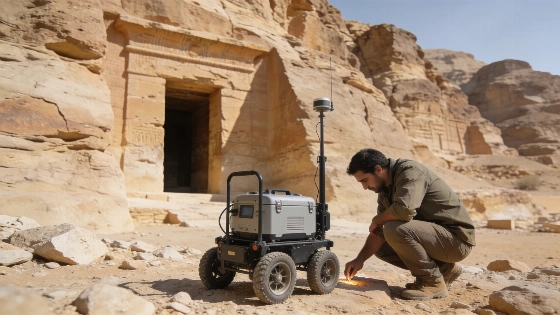
Remote-controlled miniature vehicles equipped with 360-degree cameras are being tested for possible use through those openings. Any drilling or excavation would require approval from Egypt's Supreme Council of Antiquities, and the team hopes exploratory work could begin as early as November if permission is granted. For comparison, the way non-invasive surveys can identify buried features without exposing them is also central to another archaeological survey involving fragile remains and structures.
The proposed investigation carries a clear evidentiary advantage: physical access could determine whether the anomalies correspond to corridors or chambers. It also carries interpretive risk. Even a confirmed room would answer the structural question without automatically resolving its date, function, contents, or association with Nefertiti. Archaeologists would still need stratigraphic observations, construction evidence, inscriptions, datable materials, and conservation documentation.
For now the strongest conclusion is limited but important. KV62 may be adjacent to previously undetected built spaces, and the latest measurements justify carefully controlled testing. They do not yet justify announcing the discovery of Nefertiti's tomb. That restraint is not a weakness in the story; it is the difference between detecting a subsurface signal and establishing an archaeological discovery.
Ground-penetrating radar and microgravity are indirect methods. Radar records reflected energy from boundaries below the ground while microgravity detects density contrasts, so both techniques can identify patterns consistent with voids without showing their interiors. Rubble, uneven bedrock, moisture, and other geological changes can produce signals that resemble architecture. Archaeologists therefore treat geophysical anomalies as targets for verification rather than as confirmed chambers, a standard that is especially important when a famous historical figure is used to interpret an uncertain result.