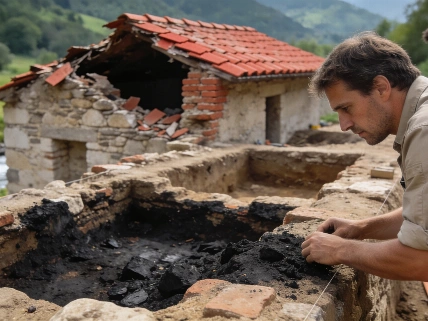
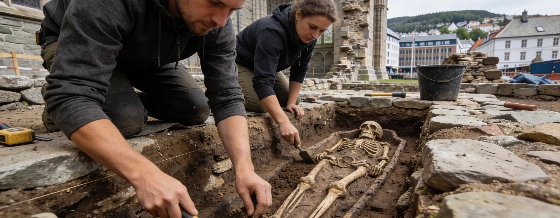
Archaeologists are excavating the choir of Nonneseter Monastery in Bergen, Norway, aiming to uncover medieval graves and artifacts that could shed light on the lives of the Benedictine community nearly 900 years ago
Archaeological investigations at Nonneseter Monastery in central Bergen are providing new evidence about burial practices and daily life within one of Norway's oldest monastic communities. The current excavation, led by the Norwegian Institute for Cultural Heritage Research (NIKU), focuses on the area once occupied by the choir of the medieval church-a location historically reserved for high-status burials during the Middle Ages.
Medieval Monastery Context
Nonneseter Monastery was likely established as a Benedictine convent in the first half of the 12th century CE. Over centuries, most of the original complex was lost beneath urban development, leaving only the western tower base and the choir chapel (Korkapellet) visible above ground. Recent redevelopment in the area, including the removal of later industrial buildings, has made it possible to reconnect these surviving medieval structures and to mark the original footprint of the church and monastic garden for public interpretation.
The current excavation is part of a broader urban renewal project coordinated by Bergen Municipality and Vestland County Council, which aims to create new public spaces and improve transport infrastructure. This work has enabled archaeologists to access areas previously obscured by modern construction, offering a rare opportunity to investigate the preserved remains of the monastery within the city center.
Burials and Material Evidence
Previous excavations near the site uncovered approximately 30 graves dating to the period when the monastery was active, with several burials located beneath the choir floor. Burial within the church, and especially in the choir, was typically reserved for clergy, benefactors, or individuals of elevated status. The current investigation extends toward the wall of the surviving choir chapel, an area considered among the most prestigious for interment.
Archaeologists are seeking to determine whether additional graves survive in this area and to recover associated artifacts. Finds from earlier work at Nonneseter include decorated floor tiles, coins, gaming pieces, writing implements, and textile tools such as needles and spindle whorls. These objects provide insight into both the appearance of the monastic interior and the daily activities of its inhabitants. The presence of personal items and small artifacts is particularly valuable, as such evidence is often absent from written records.
In addition to medieval material, the excavation has yielded more recent objects, such as a miniature toy iron, likely dating to a period when children lived or played near the former monastery. This illustrates the long-term continuity of occupation and use at the site, with layers of evidence reflecting changing patterns of life in Bergen over centuries.
Urban Archaeology and Preservation
The excavation at Nonneseter is notable for its urban context, where centuries of construction and redevelopment have both obscured and preserved archaeological deposits. The survival of graves and architectural remains beneath modern infrastructure highlights the challenges and opportunities of urban archaeology. Comparable projects, such as the investigation of a medieval chamber tomb in Russia containing elite burials and animal remains, demonstrate the diversity of mortuary practices across medieval Europe and the importance of context in interpreting burial evidence. For further reading on medieval burial discoveries, see this report on elite funerary contexts in Russia.
As the redevelopment of the Nonneseter area progresses, archaeologists are working to ensure that the surviving medieval structures are integrated into the modern cityscape and that new discoveries are documented before further construction. The project is expected to enhance public understanding of Bergen's medieval heritage while contributing to the broader study of monastic life and burial in northern Europe.
Interpreting the Evidence
While the recovery of graves and artifacts from Nonneseter Monastery provides valuable information about the community that lived and worshipped there, several limitations remain. The preservation of skeletal material is often affected by soil conditions and later disturbance, and not all burials may be recoverable. The identification of individuals, their social roles, and their relationships to the monastery relies on a combination of archaeological context, artifact association, and, where possible, scientific analysis such as ancient DNA or isotope studies. However, such analyses are constrained by preservation and ethical considerations, especially in urban settings where disturbance is common.
Interpretation of the material culture-such as decorated tiles, coins, and personal items-must also account for the possibility of reuse, loss, or later intrusion. The presence of non-medieval objects in the same stratigraphic layers as medieval remains underscores the complexity of urban archaeological sites and the need for careful stratigraphic recording and analysis.
Understanding burial practices in medieval monastic contexts requires attention to both the spatial organization of the church and the broader social and religious frameworks that governed access to prestigious burial locations. The evidence from Nonneseter contributes to a growing body of research on the diversity of medieval mortuary customs and the ways in which religious communities shaped, and were shaped by, their urban environments.
In archaeological research, the concept of stratigraphy is central to interpreting complex urban sites like Nonneseter Monastery. Stratigraphy refers to the layering of deposits over time, with each layer representing a distinct phase of activity or occupation. Careful excavation and recording of these layers allow archaeologists to reconstruct the sequence of events at a site, distinguish between medieval and later intrusions, and establish the relative chronology of burials, structures, and artifacts. In urban contexts, where construction and demolition have repeatedly altered the landscape, stratigraphic analysis is essential for understanding how different periods of activity are preserved and how evidence from multiple centuries can coexist within a single excavation area.