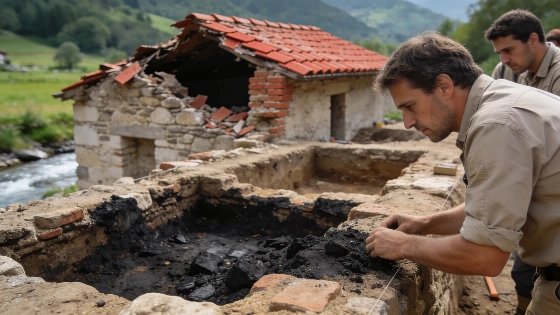
Excavations at Ligornetto in southern Switzerland have exposed a Roman complex destroyed by fire, with iron slag and bronze-working waste that may clarify the settlement's economic role.
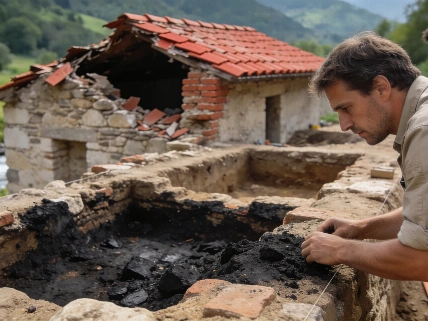
A third-century fire brought a substantial Roman building at Ligornetto to an abrupt end. Charcoal deposits, heavily blackened surfaces, and the collapse of its tiled roof preserve a destructive episode that now gives archaeologists important evidence for how the site was used. The fire is documented, but its cause remains unknown.
The excavation lies in the Stramonte area of Ligornetto in southern Switzerland's Mendrisiotto region. Archaeological work began in June 2026 ahead of residential construction and covers about 500 square meters between Via Mastri and a stream beside today's Via Passeggiata. The canton's archaeological authorities presented the discovery to local residents on 16 September, while fieldwork is expected to continue until autumn 2026. A current overview of the excavation is available in this Ticino excavation report.
The building was not a simple domestic unit. Archaeologists have identified at least six rooms in a structure about eight meters wide and at least 11 meters long, with its western end extending beyond the excavation boundary. A portico roughly three meters wide ran along the southern side, while two rear rooms measured approximately 16 and 20 square meters. Later alterations added partition walls and a platform built into the portico from reused bricks, indicating that the complex changed function or organization over time.
What remains most legible is the destruction layer. Heavy charcoal is associated with the blaze, and the brick roof collapsed as the building burned. Such deposits can preserve the sequence of a final event because burning, roof collapse, and later sediment accumulation may remain visibly separated in the stratigraphy. They do not, however, establish whether the fire was accidental, deliberate, or connected to a wider disturbance.
The structure's function is still unresolved. Investigators have not found hearths or other features normally expected in a primarily residential building, while surrounding deposits contain unusually large quantities of iron slag and waste linked to bronze working. That combination favors an economic or craft-related interpretation, although it does not identify a specific industry or prove that every stage of production took place inside the masonry building.
Iron slag is a by-product of metallurgical processes in which unwanted minerals and furnace residues separate from the metal. Its quantity and distribution can help distinguish localized repair or toolmaking from a broader production zone, but interpretation requires careful recording of contexts and, where available, laboratory characterization. No analytical results identifying ore sources, alloy recipes, furnace temperatures, or workshop scale have yet been reported for Ligornetto.
Behind the structure, postholes mark an area where lightweight buildings or temporary shelters may have stood. A narrow path made with reused bricks appears to have provided access and may also have marked the edge of a plot. These modest features matter because they connect the large masonry complex to a wider working landscape rather than treating it as an isolated monument.
The measurable outline is therefore important but incomplete: the investigation samples a 500-square-meter area, the building extends beyond the western limit, and the fire layer records the end of occupation rather than the entire history of the site. The excavation remains active, so the present interpretation is preliminary. Any future archaeometric work should be reported separately from the field observations, following the distinction between data and inference expected in journals such as Nature and PNAS.
The Roman phase was not the beginning of activity at Stramonte. The earliest remains date to the final decades BCE and include traces of wooden structures. During the second century CE, the ground was leveled and the masonry building was constructed, followed by modifications during the second and third centuries CE before the fire ended its use.
Ligornetto and the wider Mendrisiotto region belonged during Roman rule to the sphere of the important urban centers of Como and Milan. Inscriptions previously found at Stabio and Ligornetto connect local families with people who held significant political positions in those cities. The newly excavated site is also less than one kilometer from the Roman villa of San Pietro di Stabio.
The surrounding record extends beyond Rome's period. Evidence from the Iron Age through the Early Middle Ages includes settlements, funerary remains, places of worship, and numerous Lombard-period graves dating to the first half of the seventh century. As with the earlier excavation at Nizhny Novgorod's Mytny Market, the value lies in the relationship among layers and features rather than in a single spectacular object.
That broader context gives the Ligornetto building a more precise historical significance. It adds physical evidence for a Roman settlement where agricultural work and metalworking operated around a substantial but not yet fully understood structure. The excavation does not reveal a lost city or solve the fire's cause; it shows instead how carefully documented deposits can distinguish architecture, production, and destruction within one changing landscape.
Stratigraphy is central to that distinction because archaeologists interpret deposits in their physical sequence rather than treating every object as part of one moment. The charcoal and collapsed roof belong to the building's final destruction layer, while earlier wooden structures and later modifications belong to different phases. Until the remaining area is excavated and those relationships are documented, the evidence supports a Roman craft-linked settlement destroyed by fire but not a definitive explanation of why it burned.