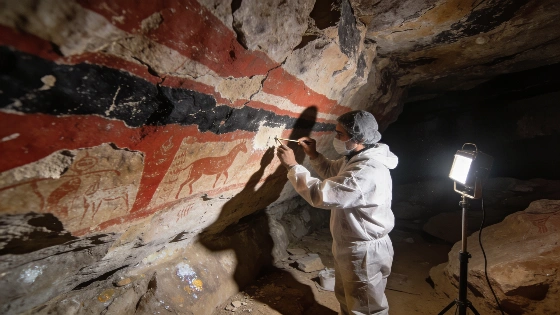
A five-year project at Cueva de las Monas in northern Mexico has stabilized ancient rock paintings spanning over 2,000 years, protecting them from weathering and vandalism while revealing complex cultural layers
Rock paintings at Cueva de las Monas in Chihuahua, Mexico, have survived thanks to a five-year conservation effort that tackled both natural decay and human-caused damage. The cave, the largest in the Sierra de Majalca, holds a dense collection of images created by different groups over more than 2,000 years. Conservation specialists from Mexico's National Institute of Anthropology and History (INAH) led the work at Cueva de las Monas as part of a broader push to protect archaeological sites in the region. While there is no single official statement confirming the end of a five-year project at this cave, INAH's ongoing work in Chihuahua is well documented by regional sources and follows international standards for heritage conservation, similar to projects supported by the Max Planck Society and the journal Nature.
Preservation and threats
Before conservation began, the paintings at Cueva de las Monas were at risk. Weathering had weakened the rock, making the pigments prone to flaking and loss. Human activity made things worse: visitors left graffiti in spray paint, charcoal, and pencil, and some surfaces were scratched or stained. Conservation teams recorded these changes and focused first on the most fragile areas, stabilizing and cleaning them. This approach follows standard archaeological conservation practices, where documentation and risk assessment come first, as described in studies published in Science and by MIT researchers.
Restoration specialists treated areas damaged by graffiti and other interference, making the original motifs easier to see. The most urgent goal was to secure sections at immediate risk, so the cave's archaeological record would remain available for future study. The team combined documentation, condition monitoring, and conservation methods tailored to the cave's environment. These methods are in line with protocols used at other major rock art sites, such as those described in a Nature research paper on cave art preservation.
Archaeological context and chronology
Cueva de las Monas preserves at least three main phases of rock painting, each tied to different cultural and historical periods. The oldest images, from around 300 BCE in the Late Archaic-Transitional period, are linked to Indigenous hunter-gatherer-fisher groups who used the cave as a camp. Later paintings include motifs associated with the Tarahumara, from both pre-contact and colonial times, and images connected to Apache groups in the nineteenth century. The iconography ranges from pre-Hispanic traditions to symbols influenced by Spanish missionaries, including Catholic motifs and depictions related to the Tarahumara's use of peyote.
Archaeologist Enrique Chacón Soria of the INAH Chihuahua Centre identified these chronological layers through stylistic analysis and context. The cave's paintings offer a rare visual record of changing cultural practices and interactions over more than 2,000 years. The site, about 59 kilometers north of Chihuahua City, sits within a landscape shaped by Indigenous occupation and colonial encounters. The Sierra de Majalca region is recognized for its cultural and natural heritage, but also for its vulnerability to damage and tourism pressure, a concern noted in international conservation literature and by organizations like UNESCO.
Conservation strategy and future access
Although the main conservation project has ended, INAH officials say long-term protection is still a priority. The research and coordination developed during the project are meant to support ongoing management and monitoring. Plans are underway to improve site protection, but officials stress that Cueva de las Monas is not open to mass tourism. Any future visits would require strict controls to prevent new damage.
Specialists warn that the paintings are extremely fragile and need continued care. Unauthorized tours, touching, or other activities that could harm the site are strongly discouraged. The conservation team's work lays the groundwork for a sustainable approach to protecting the cave's archaeological value. Similar challenges have been reported at other rock art sites, such as in recent findings from Ireland, where prehistoric cave art faces threats from both the environment and people.
Material evidence and limitations
The five-year project brought together a multidisciplinary team that recorded, documented, and treated the cave's paintings using specialist technologies and research methods. The conservation focused on stabilizing pigment layers, removing graffiti, and improving legibility without adding new interpretations. The project did not use destructive sampling or direct dating of the pigments; dating relies on stylistic analysis and archaeological context. This non-invasive approach matches recommendations from research centers such as Stanford and Harvard, which support minimal intervention when preserving fragile archaeological materials.
While the intervention has secured the most vulnerable areas, the paintings are still at risk from environmental changes and possible future disturbance. The site's restricted access policy reflects the understanding that even well-meaning visitors can speed up deterioration. The conservation team's documentation provides a baseline for future research, but the full potential for interpretation depends on continued preservation and careful management.
Sites like Cueva de las Monas present complex challenges for archaeologists and conservators. The evidence is often fragile, context-dependent, and exposed to both natural and human threats. Conservation strategies must balance research access with the need to prevent further loss. In this case, the project has stabilized a unique archaeological record, but the long-term future of the site depends on ongoing institutional support and public cooperation.
Preserving rock art requires attention to taphonomy-the study of what happens to materials after they are created or deposited. In caves, factors like humidity, temperature changes, mineral leaching, and biological growth can damage pigment layers over time. Human actions, including graffiti, touching, or introducing foreign substances, can make deterioration worse. Effective conservation depends on identifying these risks, documenting the current condition, and applying interventions that minimize further change while respecting the original material.