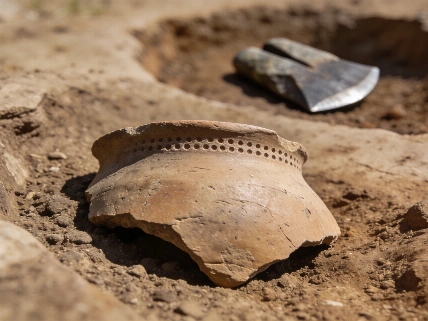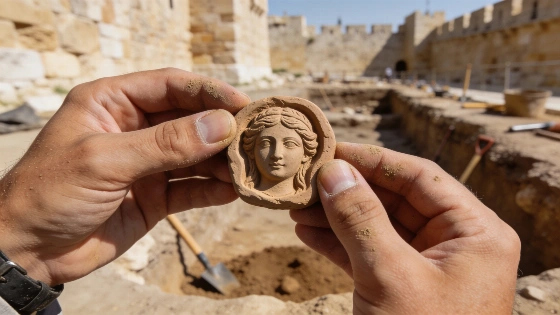
A re-examination of heated clay from three Israeli Natufian settlements identified 15 figurines and 139 likely figurative fragments. Birds dominate the finds, while fingerprints and pigment traces offer clues to how people made them
At three Israeli sites, researchers revisited collections of tens of thousands of heated-clay and sediment fragments once associated mainly with mineral-pigment production. Their reanalysis identified 154 objects linked to figurative modelling.
The assemblage includes 15 recognizable figurines and 139 cylindrical fragments interpreted as probable parts of figurative objects. Eleven of the figurines represent birds; the others depict animals or human forms. The finds come from Eynan-Mallaha in the Upper Jordan Valley, Hayonim Terrace in the Galilee and el-Wad Terrace on Mount Carmel. They date to approximately 15,000-11,650 calibrated years before present, spanning Early through Final Natufian contexts.
The study, Modelling symbols among the first-sedentary communities: Emergence of clay figurines in Epipaleolithic Southwest Asia, was led by Laurent Davin of The Hebrew University of Jerusalem and published in PLOS ONE. The authors describe the assemblage as the earliest evidence yet identified for a sustained figurative-clay tradition in Southwest Asia, among communities becoming increasingly sedentary before agriculture. The PLOS ONE study reports that bird modelling appears at both Hayonim Terrace and Eynan-Mallaha across multiple Natufian phases.
Evidence in the Clay
Some birds may represent waterfowl such as ducks or geese. Swans are another possibility, while other figures may depict birds of prey. Several have cylindrical necks and heads angled downward, a pose researchers suggest could reflect waterfowl courtship displays. The species identifications remain interpretations of small, stylized objects.
Two fragments have been interpreted as hoofed animals, including one that may show a mountain gazelle. Small impressions could mark places where perishable materials, perhaps twigs, were inserted as horns or antlers. If that reading is correct, the object would be among Southwest Asia's earliest known composite figurines, combining clay with materials that have not survived.
At Eynan-Mallaha, two figurines represent human forms: one shows an upper body with modelled arms, while another is a stylized face that may have carried decoration made from grasses, fibers, hair or feathers. Microscopy also revealed fingerprints and palm impressions, along with marks from shaping, smoothing, grooving and incision. On one human figurine, an adult fingerprint impression is overlain by a child's, a sequence described in study imagery as evidence of more than one generation handling the wet clay.
Color and Context
Traces of color survive on several objects. Ten of the 11 bird figurines show red coloring. One Early Natufian example carries an iron-rich clay slip known as an engobe, identified by the study as the earliest known evidence for this coloring technique in the regional context. An uncolored diagonal line appears to have been made with plant fiber used as a stencil.
The distribution of similar forms across the assemblage suggests an established figurative tradition rather than isolated experiments. A distinction between identified objects and interpreted fragments matters in other artifact studies too: a survey of Acheulean hand axes reported nearly 100 finds while leaving their precise age unresolved.
The Natufian communities lived as hunter-fisher-gatherers and were adopting more settled ways of life before fully agricultural societies developed in the Neolithic. The researchers describe the figurines and fragments as products of multigenerational communities of practice, with fingerprints offering physical traces of participation by adults and children.
All the examined objects had been heated in some manner, but the evidence does not establish that every object was deliberately fired. Fire-related traces were recorded on nine of the 15 figurines and on 42 cylindrical fragments, or 30 percent of the cylinders. The objects could have been intentionally fired, warmed near domestic fires or accidentally burned after deposition. Further analysis is intended to establish the temperatures they experienced.