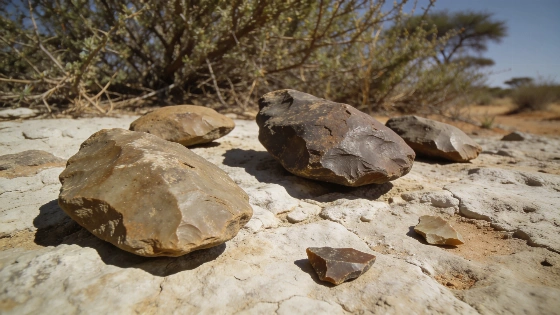
Roughly 40 hand axes came from one Okwa Valley site alongside stoneworking debris while the wider survey has yielded nearly 100. Their exact age is unknown so landscape evidence remains central to interpreting the finds
At one Okwa Valley site, about 40 hand axes lay among flakes and other debris left by stoneworking. Across the wider investigation, researchers have collected nearly 100 such tools. The Polish Press Agency's Science in Poland service reported the discovery on 8 November 2026, attributing the findings to archaeologists led by Prof. Radosław Masojć of the University of Wrocław.
The finds come from an arid and difficult-to-reach region extending along the Botswana-Namibia border. Researchers from the University of Wrocław identified several locations with tools associated with the Acheulean tradition, a technology that appeared in Africa around 1.7 million years ago and persisted in some regions until approximately 200,000 years ago. That broad chronology is also described in the Science in Poland report.
The broad age range describes the tradition. It does not date the Kalahari artifacts.
Evidence of production
Stoneworking debris gives archaeologists evidence beyond the finished tools. Flakes and fragments produced as larger blocks were reduced can help researchers reconstruct how hand axes were made. The material recovered alongside the approximately 40 axes at one site provides a substantial assemblage of both finished tools and manufacturing debris, although it does not by itself establish when the work took place.
A Terracotta Army fingerprint study likewise showed why archaeological traces need careful interpretation: repeated prints could not be treated as a census of workers. In the Okwa Valley, the nearly 100 axes are a count of collected artifacts, not a measure of how many hominins lived or worked there.
Acheulean hand axes are large stone tools commonly shaped by removing flakes from both sides of a stone blank. They are among the most recognizable artifacts of the Lower Paleolithic. Prof. Masojć has described large stone tools called hand axes as the tradition's most characteristic feature. The Acheulean is documented across much of Africa, with later examples also known from parts of Asia and Europe.
Landscape and access
The tools were found in a landscape that once differed sharply from the dry environment seen today. Researchers have identified traces of Pleistocene rivers and a former lake in the valley. The team recovered hand axes along the shore of one of these ancient bodies of water, placing the finds within a past environment that may have offered attractive locations for hominin activity.
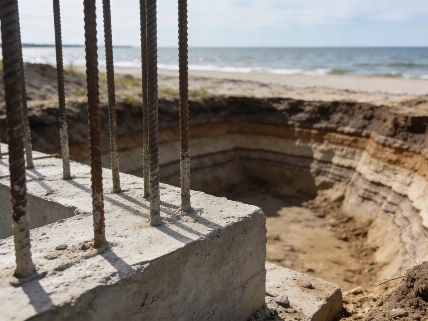
Excavations for calcrete have helped expose that setting. The calcium carbonate-cemented sediment is commonly used for road construction in Botswana, and its removal reveals deeper deposits that would otherwise remain hidden. Within these exposures, researchers identified traces of ancient waterways and lake sediments.
Fieldwork in the area is difficult. Dense bush covers much of this part of the Kalahari, limiting access to sites and making systematic surveys challenging. The Okwa Valley therefore remains comparatively poorly understood, despite evidence of ancient water and stone-tool activity.
Dating remains open
The hand axes are undergoing detailed analysis at the AGH University of Science and Technology in Kraków. Researchers plan to compare them with Acheulean examples from north of the Kalahari and from South Africa, while examining the surrounding sediments and environmental evidence. The exact age of the Okwa Valley artifacts remains unresolved; the 1.7-million-to-200,000-year chronology applies to the Acheulean tradition as a whole, not to these finds specifically.
The project brings together the University of Wrocław and the University of Botswana, alongside the Korea Institute of Geoscience and Mineral Resources and the Regional and Deposit Geology Department of the Polish Geological Institute-National Research Institute in Warsaw. Until the artifacts' age is established, their association with the Acheulean tradition and the valley's ancient waters provides the main context for interpreting the finds.