

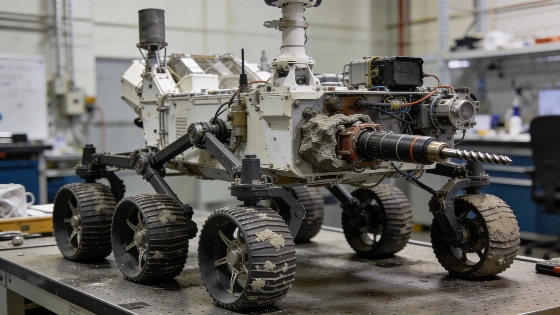
NASA has awarded Blue Origin a $94 million base contract to deliver the nuclear-powered PROMISE rover to the lunar South Pole, while new cargo and transport deals support planned Moon Base missions
On November 7, 2026, NASA announced a $94 million base contract for Blue Origin to deliver its six-wheeled, nuclear-powered PROMISE rover to the lunar South Pole. The award includes a $140 million performance-based option, bringing its potential total to $234 million. NASA is targeting a late-2028 launch.
A rover built for darkness
PROMISE stands for Polar Rover for Observation, Mapping, and In-Situ Exploration. NASA's Jet Propulsion Laboratory will manage the mission and build the rover using spare flight components and engineering test models from the Curiosity and Perseverance Mars rovers. NASA says adapting proven hardware and operating approaches can reduce cost and shorten integration and testing. The agency assessed the reused hardware for lunar conditions and determined it can tolerate the South Pole environment.
The rover is designed to work through long lunar nights and enter permanently shadowed regions where volatile resources such as water ice may persist. Its drill will extract regolith from about 3 feet (1 meter) below the surface to help characterize ice and other resources. Chemical-analysis spectrometers will examine the material, while temperature and radiation sensors measure the environment and visible-light cameras document the terrain. PROMISE will also test NASA's High Performance Spaceflight Computing system and demonstrate advanced autonomous navigation technology. NASA plans an 18-month surface mission.
NASA says PROMISE will characterize the lunar surface and subsurface, assess resource potential, and provide data for landing-site selection and future infrastructure and exploration activities. The Blue Origin award expands a task order announced in May 2026 for delivery of two lunar terrain vehicles, reported at $188 million with additional work available through options. Blue Origin plans to use its Blue Moon Mark 1 lander to deliver and deploy PROMISE as part of Moon Base Phase One.
Routes from Earth
NASA selected eight companies for the next phase of its Commercial Lunar Payload Services initiative: Blue Origin, Firefly Aerospace, Intuitive Machines, ispace-U.S., Lockheed Martin Space, Northrop Grumman Space Systems, SpaceX and Voyager Technologies. Under CLPS 2, the companies can compete for future lunar-delivery task orders through a multiple-award, indefinite-delivery/indefinite-quantity contract vehicle. The contract has a 10-year base ordering period, a five-year option period and a combined ceiling of $10 billion. Selection makes companies eligible to compete; it does not guarantee each one a mission or a set amount of revenue.
The current CLPS 1.0 contract has risen from $2.6 billion to $4.2 billion to support initial Phase One objectives. It remains in place through November 2028, with an additional five-year period to complete awarded deliveries through November 2033.
NASA also awarded six task orders worth about $1.3 billion combined under its Venture-Class Acquisition of Dedicated and Rideshare (VADR) contract. Arrow Science and Technology, Blue Origin and Impulse Space will integrate and transport Moon Base cargo. The 10-year VADR contract has a $5 billion maximum value across all contracts.
VADR missions will test communications and navigation between Earth orbit and the Moon, and assess whether an orbital transfer vehicle can place a CLPS lander in its intended orbit. One mission type includes delivery of CAPSTONE 02 to deep space for tests of proximity maneuvers and communications. Another would send MoonFall drones to survey areas beyond the reach of traditional rovers. A further mission type will test navigation across multiple cislunar orbits and demonstrate commercial cargo transfers.
Some flights are planned on Blue Origin's New Glenn, Relativity Space's Terran R and SpaceX's Falcon 9. Blue Origin, Firefly Aerospace, Impulse Space and Quantum Space are slated to provide in-space transportation vehicles. Separately, SpaceX received a task order to launch communications satellites aboard a Starship to cislunar space in 2028.
Earlier student trajectory analysis used public flight-path data to examine possible fuel-measurement windows for Intuitive Machines' IM-3 lander, a separate challenge in planning lunar transport.
Power on the surface
NASA plans to buy commercial components for a Mini-Communications and Solar Tower, or miniCAST. Honeybee Robotics, a Blue Origin company, received an award for energy storage capability. Redwire will provide power generation, while Yank Technologies, Inc., will support wireless power transfer.
Engineers at NASA's Marshall Space Flight Center in Huntsville, Alabama, will assemble and test the components before delivery to the Moon. NASA expects work to begin within months, starting with separate components rather than a fully integrated system.
Planning the next phase
NASA anticipates issuing a separate solicitation for integrated power systems in early 2027. The agency also plans a directed call under its Next Space Technologies for Exploration Partnerships, or NextSTEP-3 B, solicitation to address high-priority data gaps in Moon Base planning. Possible work includes small spacecraft missions, payloads on future flights or purchases of data gathered by commercial partners.







