A design review at NASA's Glenn Research Center settled key choices for the 2028 mission, including reactor spacing and deep-space communications, while several power-system details remain under study
The reactor can operate closer to the spacecraft's main body after NASA and U.S. Department of Energy specialists determined that revised shielding could maintain radiation protection. That change is among the design choices now set for SR-1 Freedom.
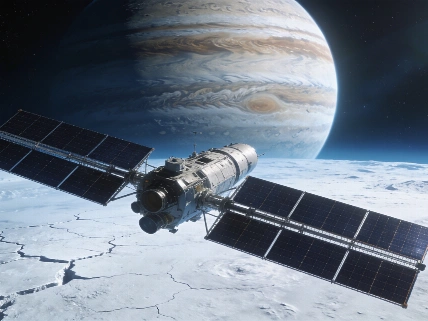
The spacecraft is intended to demonstrate nuclear-electric propulsion in deep space and is planned as the first fission-powered spacecraft to travel beyond Earth orbit. Unlike chemical propulsion, nuclear-electric propulsion converts heat from a fission reactor into electricity to power electric propulsion systems. NASA is developing the technology for high-power missions where solar arrays become less effective, including destinations beyond Jupiter.
Spacecraft architecture
At an October review at NASA's Glenn Research Center in Cleveland, specialists from NASA and DOE met with industry experts to assess the mission design. The review moved SR-1 from an early concept toward a more defined spacecraft architecture, though several technical choices remain open.
One settled change replaces the longer boom shown in early illustrations with a shorter structure between the reactor and the spacecraft's main body, called the Power and Propulsion Element. NASA expects the shorter boom to reduce weight and simplify assembly. The element was originally planned for the Gateway lunar station; NASA's Moon Base User's Guide describes SR-1 Freedom as a nuclear-electric propulsion demonstration repurposing that Gateway component.
NASA Administrator Jared Isaacman introduced the concept at the agency's March 24, 2026, Ignition event. NASA set a December 2028 launch target for the mission. Program planning materials describe a reactor output of more than 20 kilowatts-electric and an operational lifetime of about one year. NASA and the Department of Energy are working through the agency's Space Reactors Division, which is also responsible for Lunar Reactor-1.
Power and Mars delivery
SR-1 will use nuclear and solar power on its journey to Mars. It is designed to deliver SkyFall, a capsule carrying three Ingenuity-class helicopters. The aircraft are intended to study Martian geology and climate history. Their planned work also includes surveying potential human landing sites, searching for subsurface water and relaying navigation data for later missions.
After leaving Earth orbit, the spacecraft is expected to activate its reactor and gradually increase power. The reactor will run for an initial period before shutting down as SR-1 gathers and transmits performance data. Solar arrays will then supply power during the cruise to Mars. After SkyFall is delivered to Martian orbit, SR-1 is planned to restart the reactor and collect further performance data.
NASA's published SkyFall schedule calls for the payload to separate onto an independent trajectory in October 2029, followed by a Mars gravity-assist flyby. The agency projects arrival and landing in September 2030. The helicopters are planned to carry cameras, ground-penetrating radar and radios. NASA describes the aircraft as the first designed to explore another planet with scientific tools.
Teams are still assessing how many radiator panels the spacecraft needs. They are also evaluating the nuclear module's output power and how long the reactor should operate. NASA is updating the Power and Propulsion Element's communications system, including larger X-band antenna dishes for sending data back to Earth across deep space.
Heat rejection system
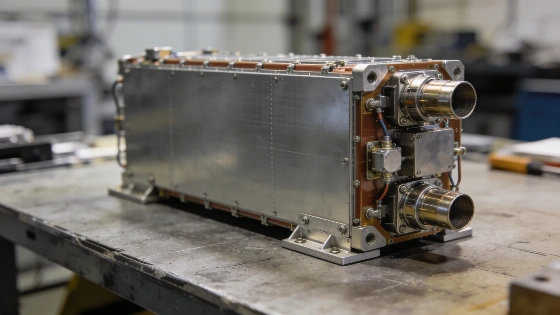
NASA awarded a $39.3 million contract to Johns Hopkins University's Applied Physics Laboratory to develop the heat rejection system for the nuclear power module. The system is designed to remove excess heat so the module can operate safely and efficiently. The lab is working with Advanced Cooling Technologies on heat pipe and composite radiator technologies.
The contract action falls under the Aerospace Research, Development, and Engineering Support II contract. The team will design, build, test and evaluate the system, then produce hardware for flight. The award adds to the work on the planned fission power module described in earlier SR-1 reporting.
NASA says the heat rejection system will support a demonstration of nuclear-electric propulsion in space. The agency presents SR-1 as an early step toward sustained space nuclear missions, with the program intended to build industrial readiness, a nuclear-qualified workforce and flight-proven hardware for future missions. The mission remains targeted for launch in December 2028.