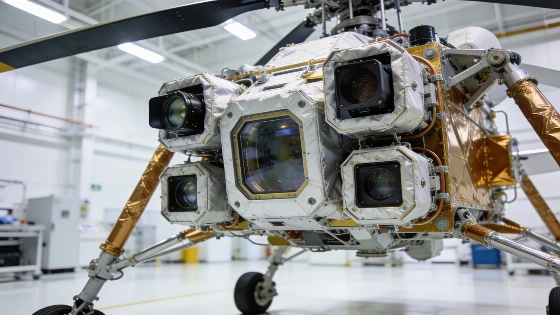
Dragonfly's seven-camera science suite has been installed and tested at APL, including wide-angle and microscopic imagers. The overlapping views will help scientists study Titan's terrain and assess potential sampling sites
A test panorama taken at Johns Hopkins Applied Physics Laboratory on Nov. 9 shows the cleanroom through Dragonfly's newly installed cameras. The images came from three wide-angle views stitched together, and their yellow tint reflects how the cameras register light differently from human eyes.
Imaging on the lander
The scene is a ground test, not a view of Titan. By mid-November, all seven DragonCam science cameras had been installed in insulated housings, tested and integrated into the rotorcraft. Each will look through a window in a foam enclosure designed to protect the instruments and Dragonfly's interior from Titan's cryogenic environment, where temperatures reach minus 290 degrees Fahrenheit.
DragonCam, supplied by Malin Space Science Systems, combines microscopic and panoramic cameras to image terrain, document landforms and surface processes, scout landing areas from the air, and provide context for samples. NASA's mission planning documents describe the cameras as part of a mobile science laboratory. Dragonfly is a nuclear-powered octocopter managed by Johns Hopkins APL to explore Titan, Saturn's largest moon. Gemini XII photographs helped build support for Earth-observation satellites; Dragonfly's cameras are designed to examine Titan's landscape from the ground and during flight.
Terrain and sampling
Two forward-facing cameras overlap their views to provide a stereoscopic perspective. Two side-mounted wide-angle cameras add panoramic coverage, while a pair of downward-facing cameras will help the team assess whether a landing area is safe for deploying DrACO, the Drill for Acquisition of Complex Organics, and the seismometer.
A high-resolution microscopic imager will examine millimeter-sized sand grains near DrACO's drill site. DrACO will collect surface material for analysis by DraMS, a mass spectrometer. Dragonfly's other instruments include systems to study Titan's elemental composition, atmospheric conditions, seismicity, and surface and subsurface properties. Together, the images will provide geological context for samples collected at multiple sites, helping researchers relate material from the sampling locations to Titan's broader landscape.
Light through Titan's night
An LED array built at APL spans wavelengths from infrared to ultraviolet. Its illumination can help characterize the color of surface materials and support inferences about their composition. During Titan's nearly eight-Earth-day night, ultraviolet light may also reveal organic molecules that fluoresce.
Dragonfly has two additional navigation cameras, also built by Malin Space Science Systems; those were installed during the summer. Other instrument packages are scheduled for delivery, integration and testing over the next several months. NASA's planned launch-readiness target is July 2028, with SpaceX's Falcon Heavy identified as the launch vehicle. The approximately 6.5-year cruise includes one Earth gravity assist, and NASA plans for the spacecraft to arrive at Titan in 2034.
NASA's Office of Inspector General has identified development challenges involving the flight system, lander and DragonCam. Its report states that these issues were the primary unfavorable drivers in the project's performance scores. Dragonfly is a New Frontiers-class mission selected to investigate Titan's chemically rich organic environment.
Stereoscopic imaging uses overlapping views of the same scene taken from different positions. The small differences between those views provide depth information, helping distinguish the shape and distance of terrain features.