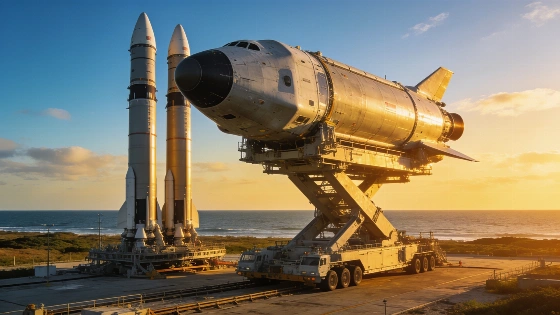
A planned Falcon 9 launch will send the third Cygnus XL to the International Space Station with about 11,000 pounds of research and crew supplies. Its cargo includes investigations of muscle loss and cancer alongside radiation sensing and plant growth
After arrival at the International Space Station, astronauts are expected to use Canadarm2 to capture the spacecraft. Ground controllers will then guide it to the Earth-facing port of the Unity module for unloading.
The planned cargo flight is NASA's Northrop Grumman Commercial Resupply Services 25 mission, also known commercially as NG-25. It will be the third flight of Cygnus XL, the larger, higher-capacity version of Northrop Grumman's solar-powered spacecraft. NASA has scheduled the launch for no earlier than 10:47 a.m. Eastern time on Sunday, November 29, 2026.
Flight and cargo
Cygnus XL is slated to launch aboard a SpaceX Falcon 9 from Space Launch Complex 40 at Cape Canaveral Space Force Station in Florida. NASA says the spacecraft will carry approximately 11,000 pounds of science investigations, supplies, and equipment to the station. The spacecraft is named for NASA astronaut James "Jim" A. Lovell Jr., who flew Gemini VII, Gemini XII, Apollo 8, and Apollo 13. NASA's launch advisory outlines research into cancer and osteoarthritis drug delivery, cancer spread, muscle loss, radiation sensing, and food production for future long-duration missions.
Falcon 9 also appears in a separate crew-flight story: this Crew-13 report described preparations for a Dragon mission to the station.
Research aboard
The ISS National Laboratory says more than 35 sponsored payloads are scheduled to fly on the mission. Cardinal Muscle 2.0, a project involving the Palo Alto Veterans Institute for Research and Stanford University, will use engineered human muscle tissue in microgravity to investigate potential treatments for sarcopenia, an age-related condition involving progressive muscle loss and weakness. The study will test whether Food and Drug Administration-approved drugs used for other conditions could help prevent or reduce muscle loss. Muscle atrophy and strength loss can develop more rapidly in microgravity without exercise, while sharing features with age-related decline on Earth.
DNA Nano B will manufacture DNA-inspired nanoparticles intended to carry medicine into dense tissues such as cartilage and solid tumors. Researchers are testing whether microgravity can support more uniform particle assembly; the results could inform targeted treatments for cancer and osteoarthritis.
Encapsulate-1 will grow copies of patients' tumor samples to examine how cancer cells move and interact. Researchers aim to develop a diagnostic tool that could help predict metastasis risk months or years in advance. Other cancer-related work includes Redpoint Oncology's evaluation of antibody-drug conjugates, a class of medicines designed to target cancer cells. Nikon investigations include engineered cardiac tissue and kidney spheroids for research into drug responses.
A separate investigation called ARES will test a radiation monitor designed for crew living areas and future exploration missions. NASA identifies the Active Radiation Environment Sensor as a technology intended to support future Artemis and lunar missions.
The OHALO III plant-growth facility will test water delivery and space-efficient crop production for long-duration missions. Its mostly automated system uses water recovery and air exchange technologies to grow different crops. The cargo also includes work by the Wake Forest Institute for Regenerative Medicine to advance the maturation of bioprinted liver tissue containing blood vessels.
Technology and supplies
The cargo also includes JOining demonstrations IN-Space (JOINS), a planned test of autonomous robotic welding inside the Bishop Airlock. It will compare laser beam welding with friction stir welding on aluminum and stainless steel. In-space joining could allow large structures to be assembled after launch, without being limited to the dimensions of a launch vehicle.
Other hardware includes replacement blankets and covers for crew quarters, plus covers for hatch seals in the U.S. segment. The flight will also carry a modified pretreat hose for the Universal Waste Management System toilet, spacewalk tools for the Alpha Magnetic Spectrometer, and batteries for Anomaly Gas Analyzer sensors.
Microgravity is a research condition used across several of these investigations. Muscle loss can progress more rapidly there without exercise, while nanoparticle assembly may become more uniform. These effects offer ways to study potential treatments and manufacturing methods; they do not establish that a candidate treatment will work in patients.