The November 17 agenda assigned NASA experts talks on hydrology, El Niño, aircraft simulation and high-performance computing; the schedule is a listing, not confirmation that the sessions took place
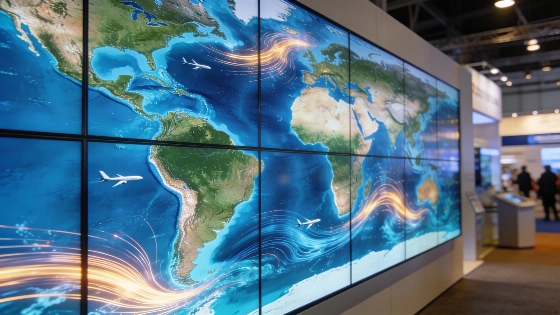
The agenda lists Tuesday, November 17, 2026, as the program date and directs visitors to NASA's Exhibit Hall Booth #525. It is a schedule of planned Hyperwall presentations, spanning Earth science, aerodynamics, launch vehicles, human spaceflight and computing.
Water and climate
At 10:30 AM, Sujay Kumar was listed for High Resolution Hydrology Simulations and Agentic Super Intelligence Interfaces for Mapping Water Availability and Extremes. Kumar works with the Hydrological Sciences Laboratory at NASA's Goddard Space Flight Center. In a 2026 Water Resources Research paper, O. Skulovich and Kumar examined the temporal consistency of satellite-based and modeled soil-moisture products and the implications for drought monitoring and trend detection. NASA's Hydrological Sciences Laboratory also lists Kumar on its Land Information System Data Assimilation Team, which received a NASA 610HBG Scientific Achievement award; Yonghwan Kwon led the team, alongside Pang-Wei Liu, Rajat Bindlish and Kumar.
The agenda places a global climate presentation later in the day: Bill Putman's Inside the 2025-26 Record El Niño: An Interactive Global Journey is listed for 11:30 PM, as printed in the schedule.
Flight and mission systems
Jared Duensing's 11:00 AM session, Scale-Resolving CFD Methods for Predicting Aircraft "Edge of the Flight Envelope" Performance, addresses aircraft simulation. At 1:00PM, Marian Nemec is listed for X-59 Simulations and Dragonfly. NASA's earlier event programming also featured X-59 appearances near Kennedy Space Center, covered in an earlier expo report.
NASA's Launch Ascent and Vehicle Aerodynamics (LAVA) computational-fluid-dynamics system has been applied to aircraft design. In a June 12, 2025, NASA Ames seminar, an engineering example showed LAVA reducing drag and eliminating shocks across a wing while meeting lift and pitching-moment constraints, as described in NASA seminar material. Earlier NASA work used LAVA and Star-CCM+ to develop aerodynamic databases for the X-57 Maxwell electric aircraft, with results produced on the Pleiades supercomputer; a separate technical record specifies that the presented results used LAVA on the Mod. III geometry.
The afternoon schedule includes Nguyen Ly's 2:00 PM talk, Unsteady Aerodynamic and Acoustics Characterizations of Launch Vehicles Using LAVA, followed at 2:30 PM by Aaron Brandis's HPC-Enabled Pathways to Certification for Next-Generation Missions. Jeff Triplett's 4:00 PM presentation is titled Supporting Human Spaceflight with the Flight Sciences Lab.
At 4:30 PM, Michael Barad is listed for A Wider State, Not Wider Arithmetic
FP32 Speed with FP64 Accuracy for Scale-Resolving CFD on GPUs, with LAVA Cartesian. Aaron Burkhead's 5:00 PM session is CFD Simulations and Aerodynamic Database Generation Supporting NASA's Artemis Program. NASA Langley's 2026 aeronautics portfolio, dated September 14, includes vehicle-design CFD tools FUN3D and OVERFLOW alongside work involving X-59, Dragonfly, Artemis, Falcon simulations and high-performance computing.
Computing at NASA
Rohit Lal's 1:30 PM presentation is Surya and SuryaV2 (Beyond 3 Million Tokens: A Multi-Model Foundation Model for Full-Resolution Heliophysics). Later entries turn to NASA computing infrastructure: Kevin Murphy is listed at 3:00 PM for NASA's High-End Computing: Making the Impossible Possible, and Chris Tanner at 3:30 PM for Modular Supercomputing Data Centers at NASA.
The final scheduled presentation is Matt McClure's Super Intelligence for Science at 5:30 PM. NASA's broader Hyperwall programming has also included water science: a United Nations Framework Convention on Climate Change program document lists NASA presentations titled "Water in the Earth System" and "The Weight of Water: Applications of NASA's GRACE Satellite Mission for Hydrology and Water Resources."
One day after the scheduled Hyperwall date, on November 18, 2026, NASA took ownership of the X-59 from Lockheed Martin Skunk Works. NASA's Quesst mission is designed to demonstrate supersonic flight without loud sonic booms. Project manager Cathy Bahm described the transfer as a consequential flight-test milestone, saying, "To someone outside the flight test, this might seem like a subtle change." NASA announced the milestone in its X-59 update.