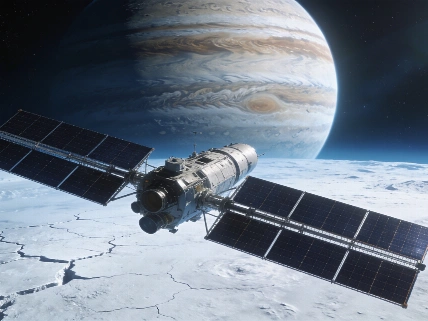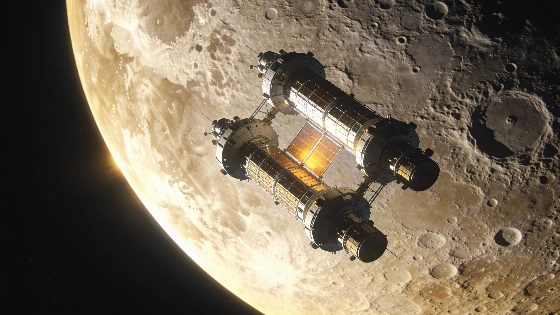
A thruster shutdown sent the spacecraft into safe mode during orbit insertion, but ESA reported BepiColombo safe in a stable Mercury orbit. Its two orbiters are due to separate in December before science operations begin in April 2027
The thrusters stopped firing before the orbit-insertion manoeuvre was complete, and the spacecraft entered safe mode. The European Space Agency (ESA) later reported that BepiColombo was safe in a stable orbit around Mercury. The insertion began at 18:24 UTC on 21 November 2026. After telemetry was recovered through ESA's Estrack New Norcia antenna, the mission team traced the premature interruption to a software issue involving attitude guidance and thruster control, and began investigating with engineers at ESA's European Space Operations Centre (ESOC), Airbus and JAXA. ESA reported that the burn achieved around 77% of its planned total velocity change before ending early.
Capture after the glitch
The composite spacecraft entered orbit on 21 November. At the time, ESA's Mercury Planetary Orbiter (MPO) and JAXA's Mercury Magnetospheric Orbiter (Mio) were still joined together, with Mio protected inside a sunshield. Four thrusters on the MPO slowed the stacked spacecraft as it approached Mercury's south pole. ESA said it remained safely captured by the planet's gravity despite the incomplete burn. The ESA mission update attributed the interruption to software controlling attitude guidance and thruster operations.
ESA said it was the first spacecraft to enter orbit around another planet using weak stability capture. The method brings a spacecraft in at a lower speed than is typical for planetary missions; previously, it had been used only by some spacecraft travelling to Earth's moon.
The arrival followed a series of gravity-assist flybys. The fourth, on 4 September 2024, passed about 165 km above Mercury and captured images of large impact craters. Two more flybys followed in December 2024 and on 8 January 2025. The Mercury Transfer Module separated from the spacecraft stack on 3 September 2026, beginning the arrival phase.
Two orbiters at work
BepiColombo is Europe's first mission to Mercury and carries two science orbiters. The European Space Agency's Mercury Planetary Orbiter (MPO) will use 11 instruments to survey the surface and internal composition. The Japan Aerospace Exploration Agency's Mercury Magnetospheric Orbiter (Mio) will use five instruments to study the planet's magnetosphere.
The mission aims to investigate Mercury's composition, geophysics, atmosphere, magnetosphere and history. It is only the second spacecraft mission to visit the planet: NASA's MESSENGER launched in 2004 and operated until 2015. NASA's wider human-spaceflight work is covered in a Johnson Space Center report.
Some instruments began collecting data and calibration measurements before arrival. The Mercury Imaging X-ray Spectrometer (MIX) imaged the Crab Nebula, allowing scientists to examine how the source spread across MIXS's detector and assess the instrument's angular resolution-the sharpness with which it can distinguish surface features.
Steps toward science
Despite the software glitch, the MPO and Mio are scheduled to separate by 10 December. ESA's operations plan describes their eventual polar science orbits: approximately 400 × 1,508 km for the MPO and 400 × 11,824 km for Mio. The protective sunshield MOSIF is then due to detach six days after separation. Further manoeuvres will place the orbiters in their final orbits, as outlined in ESA's BepiColombo operations plan.
The science phase is scheduled to begin on 6 April 2027, and the mission is planned to operate until 2029. Geraint Jones, ESA's lead project scientist for BepiColombo, said the mission's science team was looking forward to studying Mercury's interior, surface and surrounding space.