

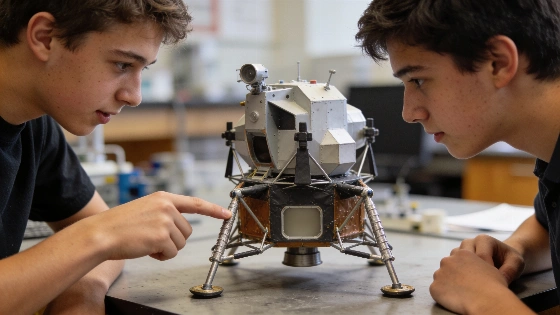
A high-school team used public IM-1 and IM-2 trajectory records to model when acoustic tank measurements could work on Intuitive Machines' IM-3 lander, with results shaped by uncertain mass and flight-path inputs
A spacecraft can carry fuel that its instruments cannot weigh directly once it is in microgravity. High-school interns used public mission data to model when acoustic measurements might estimate the propellant aboard Intuitive Machines' IM-3 lunar lander, Trinity, during its planned journey to the Moon. IM-3 is part of NASA's Commercial Lunar Payload Services program, which contracts commercial companies to deliver robotic payloads to the lunar surface.
Listening to the tanks
The method, Modal Propellant Gauging (MPG), estimates fuel mass from the acoustic response of a propellant tank. In microgravity, liquid fuel clings to tank walls instead of settling into a level that can be measured in the usual way, and it can shift during spacecraft maneuvers. MPG has been used in several spaceflight experiments and is planned for demonstration on IM-3, a Nova-C lander mission targeting the Reiner Gamma region.
During summer 2026, the NASA STEM (Science, Technology, Engineering, and Mathematics) Improvement in Earth Science (SEES) Internship Program's Mission Architecture Tool for Research, Integration, and eXploration (MATRIX) team modeled when the method might return reliable readings. The work was mentored by Dr. Kevin Crosby, who developed MPG with colleagues at NASA at Carthage College in Kenosha, Wisconsin.
The team also built an interactive dashboard. Users can vary engine settings and spacecraft properties, then adjust orbital parameters to examine how those changes affect propellant margins and landing-zone availability. The dashboard presents modeled scenarios rather than an official IM-3 flight plan.
Reconstructing the flight
A complete IM-3 trajectory is not public, so the interns developed a reconstruction algorithm from published IM-1 and IM-2 flight data. For IM-2, they compared the spacecraft's reconstructed path with a model of its motion without engine thrust. That comparison helped identify engine burns and estimate the associated changes in velocity.
The model work combined computational fluid dynamics (CFD) simulations of fuel slosh with Monte Carlo simulations, which sample a range of possible inputs to estimate possible propellant states. The MATRIX team used publicly available mission information from Intuitive Machines and trajectory records from NASA's Jet Propulsion Laboratory Navigation and Ancillary Information Facility (NAIF).
Science Report has covered a separate measurement approach in an ultraviolet wing test, where pressure-sensitive paint and cameras mapped changing aerodynamic loads. The lunar analysis instead uses tank acoustics to estimate fuel mass.
Where readings may fit
The team's analysis identified potential reliable gauging windows during Lunar Orbit Insertion (LOI) and Powered Descent, with some possible opportunities during Descent Orbit Insertion. NASA's description of the findings says the spacecraft's starting mass had the greatest effect on how long each measurement window might last. These are model results, not readings collected during IM-3 operations.
The team also identified candidate launch opportunities for 2027 and modeled the distribution of possible landing sites near Reiner Gamma. Trinity is planned to land in that lunar region. Recent reporting has placed IM-3's launch in the first quarter of 2027; the mission remains a future key stage, and MPG has not yet been demonstrated on the flight.
Intuitive Machines' first two Nova-C missions provide the flight history behind the team's reconstruction: IM-1 launched in 2024 and IM-2 in 2025. Both landers transmitted mission data before tipping over on the lunar surface. The interns briefed the company's propulsion group and presented their research at the SEES Annual Symposium and the Wisconsin Space Grant Consortium Annual Conference. A further presentation is scheduled for the American Geophysical Union (AGU) Annual Meeting in San Francisco in December 2026. The SEES program serves 11th and 12th grade students, and the MATRIX analysis connects that training to propellant-management challenges relevant to in-space refueling and sustained lunar exploration.
In microgravity, liquid fuel does not collect at the bottom of a tank as it does under Earth's gravity. MPG uses the tank's acoustic behavior to infer how much propellant remains, so its estimates depend on how well the model represents the tank, fuel motion, and spacecraft conditions. The MATRIX results identify candidate times for taking measurements; they do not establish how accurately MPG will perform on IM-3.







