

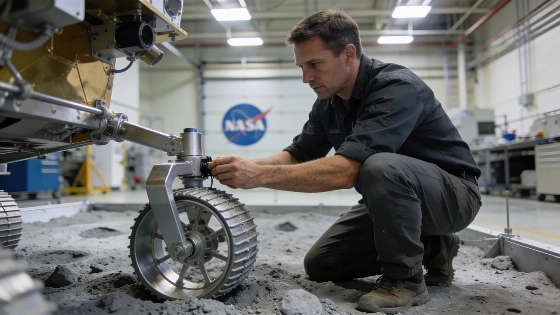
At NASA Langley Research Center, Richard Spolzino tracks measurements still missing from lunar and Mars planning and helps turn those gaps into priorities for missions and commercial partners.
NASA's return to the Moon depends on more than rockets and landers: engineers still lack basic measurements. At NASA's Langley Research Center in Hampton, Virginia, aerospace engineer Richard Spolzino works on Moon Base mission architecture and systems interoperability, documenting unknowns before they become operational problems. The approach reflects a broader principle shared across NASA and ESA, as well as major research institutions: a mission requirement matters only when it connects a measurable physical property to an explicit engineering decision.
- The Missing Measurements
Spolzino's central tool is the data gap: a formal record of what NASA does not know and why that information matters. It assesses what existing evidence fails to provide, then specifies the measurable result that would close the gap. The structure does not treat uncertainty as a statistical finding with a p-value or confidence interval; it is an engineering-control method for defining what must be measured, which instrument should do it and what operational consequence follows.
Lunar regolith provides a straightforward example. The surface material may look like dust, but its response to loading depends on grain size and density. Cohesion matters too. These properties determine how much weight a rover can carry and how safely it can travel. They also determine whether a habitat foundation can support the structure above it. Bearing capacity and shear strength affect landing-site selection and wheel design, with consequences for mobility margins and construction planning. They are not isolated laboratory details. The same systems perspective appears in planetary materials research at institutions such as MIT and in peer-reviewed work published by Nature.
The catalog is growing. Spolzino's team began with roughly 25 published data gaps last year and is on track to reach 60 by the end of this year. Those figures describe documented knowledge needs, not discoveries about the Moon. They should not be read as a survey sample or as evidence that every gap has equal scientific or operational priority.
- From Gaps to Payloads
The structure is already influencing mission decisions. During preparations for the Griffin-1 mission by Voyager Technologies, formerly Astrobotic, the payload was already locked in, so the team did not select the instruments. Instead, it helped prioritize which results should be transmitted first through a communications pipeline that cannot carry every desired measurement at once.
That constraint matters scientifically. A mission can collect more information than it can immediately return, so the order of transmission affects which questions receive answers first. Telemetry is a resource-allocation problem: bandwidth is limited, visibility is intermittent, and onboard storage and power use impose further constraints. Recent commercial lunar missions have also highlighted recurring risks involving landing and communications. That reinforces why teams sometimes need to prioritize data instead of transmitting it all.
Griffin Mission One illustrates the practical stakes. Earlier descriptions linked the Griffin lander to the cancelled NASA VIPER-related mission concept, while current mission summaries identify at least Astrolab's FLIP rover and Astrobotic's CubeRover among the planned payloads. Independent reporting puts the intended delivered payload above 500 kilograms, or more than 1,100 pounds. The payloads are aimed at the lunar south-polar region and include scientific and technical instruments.
The schedule has also moved. As of October 2, 2026, one launch tracker listed a shift from November 30 to December 31, while other reporting described the mission as flying no earlier than December. An earlier September expectation had placed Griffin-1 no earlier than November. The changes underline the need for mission planning to remain useful as hardware and launch windows evolve, while integration schedules shift. The updated schedule was reported in a launch-status briefing and in regional spaceflight coverage.
His team has also evaluated proposed spectrometers and sample-collection tools against the published data gaps. It has assessed technology demonstrations as well. Proposals that match a documented need can move forward as genuine candidates, while instruments with no clear connection to an identified requirement receive less support. Leadership now asks companies proposing new instruments to show how their designs map onto those gaps.
The same logic applies to infrastructure beyond a single landing. NASA's planning for resource production depends on connections between machines: a lunar oxygen plant would interact with rovers that deliver feedstock and with processing systems that supply users. An earlier lunar agriculture report illustrates the same systems-level problem through controlled crop production and resource recycling, rather than through one standalone device.
- A Systems Engineer's Route
Spolzino reached aerospace through several changes of direction. He began college as a history major, then switched to physics at Santa Clara University. He considered astrophysics, too. Work at Lick Observatory studying interstellar dust polarization showed him that research could be fascinating without making observational astronomy his long-term path.
After graduation, he entered the path toward Navy Officer Candidate School with the goal of flying jets. When that route did not continue, he joined a graduate program at the University of Houston that combined aerospace engineering with space architecture. In that setting, architecture meant the relationships between systems, not the design of a single habitat.
That systems perspective also shaped his decision to join NASA. The agency was not a lifelong destination for him; the attraction was the chance to work on problems that crossed technical boundaries and reached senior decisions about lunar exploration. He argues that NASA can give early-career employees room to take on work beyond a narrow job description.
- NASA's Unfinished Map
Spolzino's experience has also altered his view of NASA's reputation. The agency does not possess a ready-made answer to every engineering question simply because it has decades of flight experience. Maintaining that standard takes continuous work: people must identify missing information and connect it to decisions. NASA's commercial lunar model has increasingly placed individual CLPS flights within a broader lunar architecture, instead of treating each landing as an isolated demonstration.
That is a less glamorous account of lunar exploration than the launch itself, but it is closer to how complex missions succeed. A rover's route and a habitat's foundation can depend on properties that have not yet been measured well enough. So can the order in which data returns. The data-gap process exposes those weaknesses before hardware commits a mission to them.
For students considering NASA, Spolzino's advice is similarly practical. Projects and demonstrated results can matter more than credentials alone, while clubs or hands-on work give applicants something concrete to show. His own path from history to physics, followed by systems engineering, supports that argument without requiring a fixed childhood plan.
A data gap is not proof that a mission is unready, nor does publishing one guarantee that a partner will close it. It draws a disciplined boundary between what planners can assume and what measurements can support. That boundary is where NASA's lunar ambitions need the most rigor: returning to the Moon will require more than reaching the surface. Teams must know which unknowns to resolve before building the next system.
In mission planning, a measurement is useful only when its meaning and delivery path are defined. A data gap records that chain: it links an unknown physical property to an operational consequence, then identifies a target an instrument can address. This is why the method matters. It separates a compelling technology demonstration from one that answers a documented engineering need. Spolzino's work shows that NASA's most consequential lunar decisions may begin with admitting what is not yet known.







