NASA, the Canadian Space Agency, and the German Aerospace Center are coordinating preparatory work on an Earth-based lunar agriculture demonstrator designed to test crop production and resource recycling for longer missions.
Growing food beyond Earth is moving from a broad mission requirement toward a defined ground test. NASA, the Canadian Space Agency, and the German Aerospace Center, or DLR, have signed a joint statement of intent to coordinate preparatory work on an Earth-based demonstrator for lunar agriculture. The Canadian agency describes the effort as preparation for a terrestrial test facility that will examine crop-production technologies, resource-recycling systems, and operational concepts for future lunar habitats.
The Canadian agency announcement makes an important limitation clear: the project is not a lunar farm, a deployed payload, or an operating space system. It concerns the preparation of an Earth-based test environment intended to imitate aspects of a lunar agricultural setting and to establish how plants and supporting hardware might work together before any comparable system is considered for the Moon.
The Lunar Agriculture Module-Ground Test Demonstrator is intended to develop technologies for raising crops inside atmospheres and controlled environments resembling those expected during missions at Moon Base. Its immediate purpose is not to claim that lunar farming has been demonstrated, but to create a setting in which crop growth, water handling, nutrient recovery, and automated food-production concepts can be evaluated under defined conditions.
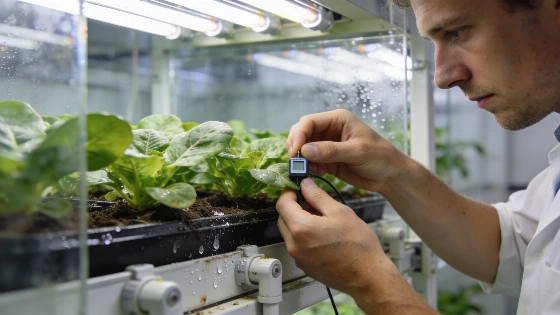
The joint statement is dated September 30, 2026. NASA's supplied image shows horticulture scientist Blake Costine adjusting moisture sensors during the Advanced Plant Imaging project at Kennedy Space Center on April 17, 2023. That work used hyperspectral cameras and moisture sensors, illustrating how plant health and growing conditions can be monitored with measurements beyond ordinary visual inspection.
Hyperspectral imaging records plant reflectance across multiple wavelengths, while moisture sensors provide information about the water conditions around the crop. In a controlled test facility, such measurements could help investigators relate environmental settings to plant responses. The announcement does not provide a crop list, sample size, test duration, chamber specifications, yield values, or statistical results, so it cannot yet establish how productive or reliable the proposed system would be.
Plants would offer more than fresh food for crews operating far from Earth. The Canadian Space Agency links space agriculture with water and nutrient recycling, energy management, and automated crop production. Crops could also absorb carbon dioxide and release oxygen, making plant systems relevant to life-support planning as missions become longer and resupply becomes less straightforward.
These functions would not make plants a complete substitute for spacecraft hardware. They would instead add biological processes to a larger environmental-control system. Water recovery, nutrient management, lighting, atmospheric control, waste processing, and automation would all need to operate together. The engineering question is therefore not simply whether a plant can grow, but whether the surrounding system can sustain growth while using acceptable amounts of energy, water, labor, and equipment.
Whole-food nutrition and greater dietary variety are also explicit objectives. That does not mean crops would replace stored provisions or solve every life-support problem. It means biological production could supplement packaged food and provide environmental services alongside the hardware already required to sustain astronauts. NASA has separately identified crop production as an important research task for the Crew-13 mission aboard the International Space Station in 2026, reflecting the agency's continued interest in plants for longer-duration spaceflight.
NASA and its partners describe Moon Base as infrastructure intended to support an enduring human presence near the Moon's South Pole. The stated program links that construction effort to scientific and technological work and to preparation for later human missions to Mars. Crop research therefore sits at the intersection of biology and mission architecture: plants must be studied as living organisms and as components of a controlled spacecraft environment.
The work also fits within NASA's wider preparation for future space missions, which includes efforts such as the student technology challenge. That comparison should not blur their purposes. The lunar agriculture demonstrator is specifically aimed at crop growth, environmental control, resource recycling, and plant performance under mission-relevant conditions.
Research priorities in this area overlap with questions familiar from controlled-environment biology reported in journals such as Nature: how organisms respond to changing physical conditions, how measurements can reveal stress before visible damage appears, and how biological processes can be integrated into engineered systems. The lunar application adds constraints that terrestrial agriculture usually does not face, including limited resupply, tightly managed energy, and the need for high levels of automation.
A ground demonstrator can examine plant growth, moisture management, imaging, and environmental control on Earth, but the announcement does not report results from the planned system. It gives no crop list, test duration, chamber specifications, yield measurements, or performance comparison with terrestrial agriculture. Those omissions prevent a judgment about how much food such a system could provide or how efficiently it might support a crew.
The same limit applies to the broader claim of supporting longer missions. Crops could contribute oxygen, carbon-dioxide removal, water recycling, and nutrition, but the announcement does not quantify any of those contributions. The practical value will depend on how reliably the plants grow and how their needs interact with the rest of a lunar habitat.
What has been signed is a coordinated intent to prepare an Earth-based test, not evidence that lunar agriculture has been demonstrated. That is still a meaningful engineering choice: NASA, CSA, and DLR are treating food production and life support as linked systems that require controlled experiments before they can be trusted beyond Earth.
In this context, a controlled environment means that variables such as atmosphere, moisture, lighting, nutrients, and other growing conditions can be managed rather than left to open surroundings. Plant imaging adds another layer by using recorded light across multiple wavelengths to assess health, while sensors track conditions that may not be apparent from appearance alone. The value of the proposed work will therefore come from measured plant responses under specified conditions, not from the existence of a crop chamber by itself. Those results will determine how far lunar agriculture can move from preparation toward dependable mission hardware.