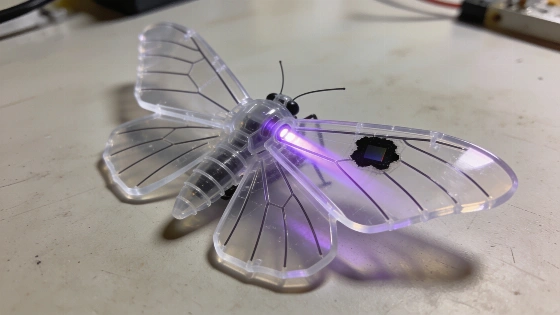
A PETG moth prototype circulated reactive chemicals through wing microchannels, forming conductive polypyrrole where UV light struck. Its impedance shift triggered wing movement or an LED, though researchers still controlled placement and delivery
Ultraviolet exposure turned a patch of the robot's transparent wing black and lowered its electrical impedance. An onboard microcontroller detected the change, showing that chemical reactions inside the machine could create a working sensor after manufacture. Before the sensor formed, the robot had no corresponding UV response.
The team printed the moth-shaped body from polyethylene terephthalate glycol (PETG). Each wing covered 86 square centimeters and contained vein-like channels about a millimeter wide. Smaller gaps in the plastic formed microchannels that let liquid penetrate roughly 10 micrometers into the material. A pump moved about 3 milliliters of chemical mixture through the body. The network acted as an artificial circulatory system, carrying sensor-building ingredients through the wings rather than simply coating their surfaces.
The design takes cues from insect circulation. Researchers from the University of Tartu in Estonia and the Italian Institute of Technology chose the blue underwing (Catocala fraxini) as a model because its relatively flat wings made it easier to arrange the robot's channels in a single plane. The circulating fluid contained pyrrole, a light-activated initiator and cellulose acetate propionate (CAP), a cellulose-based additive.
When UV light struck a selected area for about one minute, pyrrole became polypyrrole, an electrically conductive polymer that visibly darkened the previously translucent wing. A stencil let the team set the sensor's shape and position with reported precision of about 0.3 millimeters. Under UV exposure, the formed material's resistance briefly fell, changing its electrical impedance. The microcontroller used that signal to trigger wing movement with shape-memory wire or flash an LED, completing a sensing-and-response loop.
"You can, of course, use a ready-made photodiode, but you'd have to know quite precisely where to put it. That can be difficult to know beforehand as robots go into more dangerous and complicated environments. Growing the receptor on site means the environment itself can pattern the robot, based on what is actually happening at that time," lead researcher Kadri-Ann Pankratov, a PhD student at the University of Tartu, said. In Tech Xplore's report, Pankratov described the broader goal as giving robots a circulatory system that can transport molecular building blocks and form needed hardware in place.
The sensor's response strengthened after repeated UV exposure. The team attributes this to residual pyrrole continuing to polymerize and alter the material's electrical properties, which they interpret as a form of material memory. The sensors remained functional after more than four months in storage.
This remains a proof of concept. The reaction is irreversible, and researchers controlled when the chemicals entered the robot and used a stencil to determine where the sensor formed. The robot did not decide for itself that it needed a sensor or how to make one. A separate effort has focused on infrastructure for developing and deploying robots, as described in Amazon's physical AI platform; this study instead tests whether a robot can form hardware within its body.
The researchers say the same circulation network could carry other chemicals to form materials such as corrosion protection or electromagnetic shielding. They also hope to investigate reversible chemical systems. The study, titled "Robot moth gained an extra sense via generative vascular embodiment," was published in Advanced Science.