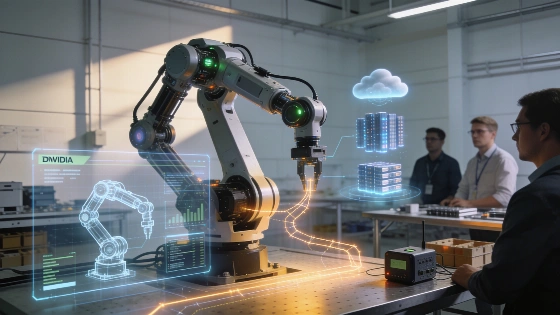
AWS has introduced the open-source Physical AI Toolchain, combining cloud infrastructure with NVIDIA software to help companies generate data, train models, simulate robots and deploy them at the edge while making clear that the platform is not itself a ready-made robot or safety certification.
Amazon is using experience from more than one million robots across its network to promote a new development stack for machines that must act in the physical world. AWS officially introduced the Physical AI Toolchain on 7 October 2026 as a set of reusable reference architectures, Infrastructure as Code and deployment automation for the development lifecycle. The company says the open-source stack can connect data generation, model training, simulation, edge deployment and operational feedback in one workflow.
The announcement matters because a robot cannot rely on fluent output or a controlled software test. It must interpret sensor data, make decisions under changing conditions and apply force to objects without damaging equipment or endangering people. AWS presents the toolchain as a way to reduce the engineering work between a model built in the cloud and a machine operating in a warehouse or factory. The architecture is described in greater detail in the official AWS announcement.
Physical AI sits at the intersection of machine learning, robotics, control theory and systems engineering. Unlike a purely digital model, an embodied system is constrained by latency, sensor uncertainty, actuator limits, friction, battery capacity and the geometry of its surroundings. These constraints explain why a high score in a benchmark or a successful simulation run cannot by itself establish safe performance in an unfamiliar workplace. The same distinction separates laboratory robotics at institutions such as MIT from validated industrial deployment.
The platform is organized around a development cycle rather than a single model. Synthetic data generation creates additional training scenarios without recording every situation in the physical world. Models can then learn from human demonstrations and simulated practice before developers test their behavior in virtual environments. Optimized models are sent to edge hardware for real-time decisions, and data from deployed machines can return to training pipelines for further refinement.
AWS identifies NVIDIA Cosmos for generating synthetic environments, Isaac Sim for physical simulation, Isaac Lab for reinforcement learning and Isaac GR00T for vision-language-action training. The workflow is orchestrated through NVIDIA OSMO, while AWS describes its own reference architectures and deployment automation as the layer that makes experiments more reproducible across projects. Reproducibility is important in robotics because changing a sensor, robot morphology or simulator configuration can alter the behavior being evaluated.
AWS combines Amazon SageMaker for model training with Amazon EC2 GPU instances for simulation and AWS IoT Greengrass for edge deployment. Amazon Bedrock AgentCore is included for orchestration. The NVIDIA side includes Isaac Sim, Isaac Lab, Isaac GR00T and Cosmos. Companies can use the full stack or select components for existing projects, which positions the offering as modular infrastructure rather than a universal autonomous machine.
In scientific robotics, the relevant question is not only whether an agent completes a task, but how performance changes when lighting, object shape, surface friction, sensor noise or timing depart from the training distribution. Research communities associated with NASA and CERN routinely distinguish instrument capability from validated measurement; the same discipline is needed when evaluating physical AI systems. The AWS announcement does not provide a peer-reviewed protocol, sample size, confidence interval, p-value or independent laboratory evaluation for the toolchain.
The reported scale is operational experience rather than a performance benchmark. Amazon says its network includes more than one million robots, but the available announcements do not provide a success rate, failure rate, number of human interventions or comparative measurement for systems developed with the new toolchain. The figure therefore describes the scale of Amazon's robotic operations, not demonstrated accuracy, training speed, cost reduction or reliability attributable to Physical AI Toolchain.
The distinction is important. A virtual robot may succeed while friction, lighting, sensor noise, object variation or mechanical differences undermine the same behavior on physical hardware. Simulation can expose some failures safely, but it cannot by itself establish that a machine will recognize every unusual object, avoid every obstacle or recover from an unexpected event. Findings reported in Nature and other peer-reviewed venues commonly separate controlled evaluation from generalization; AWS has not presented such a comparative evaluation for this product announcement.
The toolchain includes fleet-management capabilities for provisioning, securing and updating machines as deployments expand. That could reduce the burden of maintaining software across a large fleet. It does not remove the need for validation at the point of use, nor does it turn a development environment into a safety certification system. Safety cases still require evidence about specific hardware, tasks, environments, failure modes and human-robot interaction.
Amazon says its own robotics operations have revealed practical problems in coordinating fleets and maintaining software across deployed hardware. The company is also highlighting developers using the stack: NEURA Robotics is working on cognitive humanoid robots; RLWRLD is building foundation models for dexterous manipulation; and Config has developed a pipeline for collecting and expanding robot-action training data.
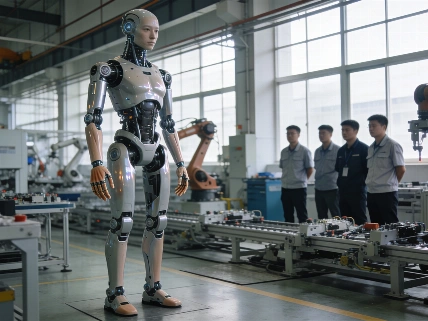
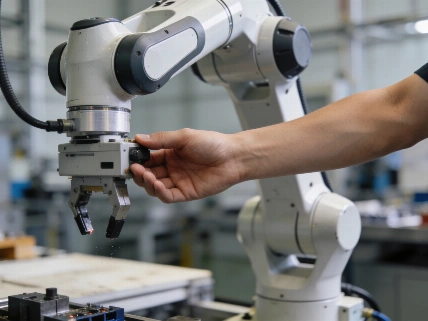
Those examples indicate the range of intended applications rather than independent proof of capability. An adaptive robotic arm on an assembly line has a narrower operating problem than a humanoid system handling unfamiliar objects in spaces designed for people. Both require reliable sensing and control, but their failure modes, test protocols and validation requirements are not interchangeable.
The comparison with lower-cost research platforms such as Berkeley's platform also clarifies what AWS is offering. The Physical AI Toolchain is infrastructure for building and managing embodied systems rather than a new robot whose capabilities can be judged from a single demonstration.
Physical AI describes a move from systems that generate text or images toward machines that sense and manipulate the world. In practice, that means combining machine-learning models with simulation environments, sensors, actuators, edge computing and fleet operations. The difficult part is not only training a model. It is proving that the complete system behaves acceptably when conditions depart from the training distribution and that failures are detected before they create unacceptable risk.
The available information does not describe a peer-reviewed study, an independent audit or a controlled field evaluation of the toolchain. It is an AWS product announcement supported by the company's account of its robotics operations and named development partners. No results are reported from a laboratory affiliated with NASA, MIT, Stanford or the Max Planck Society, and no clinical-style statistical analysis is applicable to the operational claim about one million robots. That status should temper claims that the stack has solved sim-to-real transfer or made humanoid robotics dependable.
A useful development pipeline can still have industry value. Shared architectures may make it easier to repeat experiments, compare software configurations and send updates across fleets, while orchestration can help teams manage compute-intensive training and simulation. The same scale can also spread a flawed model or unsafe behavior more quickly if validation is weak. Amazon's announcement therefore signals a serious infrastructure push rather than proof that physical AI is ready for unrestricted deployment.
The technology will earn that confidence only when companies publish repeatable real-world evaluations showing how often machines fail, how humans intervene, how performance varies across hardware and environments, and how failures are contained. Until those measurements are available, the most defensible description is that AWS has assembled an open-source, modular development framework linking cloud resources with NVIDIA's physical-AI software-not that it has delivered a universally reliable autonomous robot.