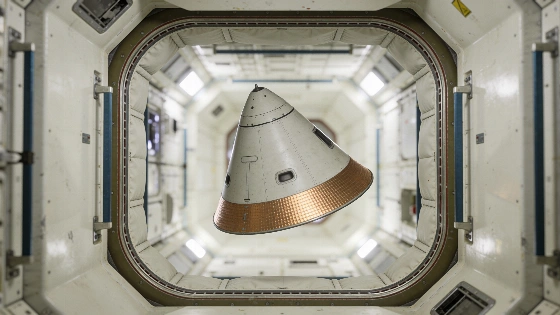
NASA is using a departing cargo spacecraft to test 12 experimental reentry capsules and compare heat shield materials for future missions to the Moon, Mars, and other planetary destinations.
Twelve small capsules are turning a cargo spacecraft's final descent into a flight test of technologies meant to protect future spacecraft and crews. The KREPE-3 experiment is flying aboard Northrop Grumman's Cygnus XL CRS-24, which was scheduled to leave the International Space Station on October 9, 2026, after delivering more than 11,000 pounds, or approximately 5,000 kilograms, of cargo, research experiments, and supplies.
NASA planned to cover the spacecraft's departure from the station but not broadcast its later destructive atmospheric entry. The Cygnus XL was to be released by the Canadarm2 robotic arm at 12:45 p.m. EDT, or 16:45 UTC, after roughly six months in orbit. NASA described a controlled deorbit over an uninhabited ocean region, with destructive reentry planned for October 12, while an independent mission schedule cited an expected atmospheric entry on October 11. The timing reflects the distinction between the spacecraft's departure, its deorbit maneuver, and the subsequent breakup and burn-up. Further mission details were summarized in an official NASA mission update.
CRS-24 is Northrop Grumman's 24th commercial cargo mission for NASA and the second operational flight of the Cygnus XL configuration. The vehicle is not designed to remain intact during atmospheric return; instead, it is deliberately destroyed along with unwanted cargo. That planned end of mission provides an opportunity to place small experimental probes inside a spacecraft already scheduled for disposal.
The capsules were packed inside the spacecraft with waste before departure and then activated for their return. Each carries sensors for temperature, pressure, motion, magnetic field, and light. When the vehicle reaches its planned reentry path, the capsules will eject and transmit measurements through satellite signals while their experimental heat shields face intense aerodynamic heating, deceleration, and rapidly changing atmospheric conditions.
This is not a crewed flight or a completed qualification of any single heat shield. It is a comparatively low-cost way to obtain flight measurements from a vehicle already scheduled to return to Earth, allowing researchers to compare materials and shapes under real reentry conditions rather than relying only on laboratory tests or computer models.
The payload includes established ceramic tile technology associated with the Space Shuttle alongside newer designs. One capsule carries a three-dimensional printed heat shield developed through the Additive Manufacturing of Thermal Protective Systems project at NASA's Johnson Space Center in Houston and Oak Ridge National Laboratory. Additive manufacturing can support complex geometries and rapid design iteration, but the flight measurements are needed to assess how printed structures respond to the combined thermal and mechanical loads of reentry.
NASA Ames Research Center is contributing Materials Engineered for Re-entry using Innovative Needling Operations, known as MERINO. These coverings combine layers of carbon and phenolic fibers stitched together like felt. Their flexibility and production method could make them less expensive and faster to manufacture than traditional protective materials. Mars missions are a particularly relevant application because the planet's thinner atmosphere produces a different entry environment and may permit lighter protection than an Earth return system.
Another capsule will combine MERINO with other components in the Kentucky Instrumented Conical Hypersonic Experiment. Its dual-cone structure uses a tungsten tip, a forward cone layered with carbon and heat-resistant plastic fibers, and an aft cone wrapped in MERINO. The purpose is to compare computer predictions with measurements from an actual hypersonic flight, including the relationship between surface heating, pressure, and the vehicle's motion.
KREPE-3 is testing more than material chemistry. One capsule follows the shape of the protective aeroshell planned for NASA's Dragonfly mission to Saturn's moon Titan. It uses Phenolic Impregnated Carbon Ablator, a material developed at NASA Ames that has also flown on Stardust, Mars Science Laboratory, and Mars 2020 missions. The capsule will examine the design's dynamic stability during reentry, an important factor because small changes in orientation can alter heating and aerodynamic forces.
A separate capsule will test Adaptable Deployable Entry and Placement Technology. The deployable heat shield resembles an umbrella: it expands the surface area presented to the atmosphere and slows descent. At full scale, the design could be folded for launch and then deployed to carry payloads larger than the rockets that send them into flight. Its value depends on reliable deployment, structural stability, and predictable aerodynamic behavior under conditions that cannot be reproduced completely in a conventional laboratory test.
Other capsules supplied by domestic and international partners will test additional materials and sensors. One contribution from the University of Stuttgart in Germany is a heat-flux sensor designed to measure how heat moves across a surface during reentry. The combined payload therefore examines thermal protection, vehicle shape, sensor performance, and the accuracy of modeling methods in one flight opportunity.
The experiment is a collaboration involving the University of Kentucky, the state of Kentucky, NASA's Established Program to Stimulate Competitive Research, several NASA centers, and federal and commercial partners. University of Kentucky students designed the capsules, giving the project an education role as well as an engineering one. KREPE-3 is described as the third mission in the Kentucky Reentry Probe Experiment series.
Its scientific value will depend on the data returned from the descent. Temperature and pressure readings can show how each configuration behaves in flight, while motion and light measurements can help researchers interpret the capsule's trajectory and surrounding environment. Magnetic-field observations add another environmental measurement, although they do not directly determine whether a thermal protection system is suitable for human spaceflight.
The experiment also connects with NASA's broader interest in fabrication for difficult planetary environments. An earlier materials report examined biodegradable plastic mixed with simulated Moon and Mars dust; KREPE-3 addresses a different engineering problem by measuring how protective structures behave during the return through an atmosphere.
NASA's strongest case here is practical rather than rhetorical: KREPE-3 places several candidate technologies on one flight and gives researchers comparable reentry measurements. That makes the experiment a useful screening step for future thermal protection systems, while the hard limit is equally clear: only direct flight data can show which designs withstand the conditions they were built to face. As in other NASA engineering programs, the measurements are intended to reduce uncertainty in models rather than replace qualification testing.
Heat shields work by managing the conversion of a spacecraft's motion into heat as it compresses the atmosphere and interacts with fast-moving gas. Ablative materials gradually lose mass, carrying energy away as they decompose, while ceramic and textile-based systems are designed to tolerate or redistribute heat through their structure. The KREPE-3 sensors will not produce a single universal score for every future mission because the result depends on the capsule's shape, material layers, trajectory, and atmospheric conditions.
The measurements will instead test specific designs against the models used to predict reentry, which is exactly why this cargo spacecraft's final descent is scientifically useful. Results from the 12 probes may guide later ground tests and larger demonstrations for cargo or crewed vehicles, but they will not by themselves establish that any material is ready for a human-rated spacecraft or a planetary mission.