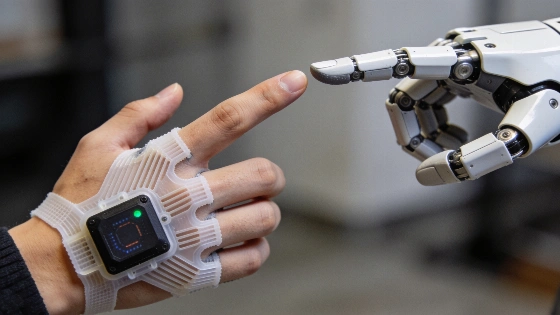
X-Hinges places sensors at moving joints and separates them from signal-carrying pathways in 3D-printed designs. Researchers demonstrated the approach with a glove that relays hand movements to a robotic hand.
At each moving joint, a sensor converts bending into an electrical signal that electronics can read. X-Hinges is a design system developed by researchers at the Massachusetts Institute of Technology's Computer Science and Artificial Intelligence Laboratory (CSAIL) and Tianjin University to build those sensors and their conductive pathways into 3D-printed objects. The associated research paper is titled "X-Hinges: 3D-Printed Self-Sensing Compliant Mechanisms for Continuous and Multi-DOF Motion Sensing."
The distinction between the two components is basic. Sensors register physical changes such as bending or compression; conductive pathways carry their signals to processing electronics. If both use the same conductive material, their electrical responses can interfere, making it harder to tell which section moved. X-Hinges uses two materials: a sensing filament selected to produce a strong signal when a structure bends or strains, and separate wire-like conductive elements designed to carry signals without interfering with those measurements. Both are embedded during fabrication rather than attached after printing.
The software lets users assemble objects from cylinders, rectangles, thin outlines, and custom shapes, then specify which parts should move. Designers can define motion along as many as three axes: compression or squeezing, vertical bending, and lateral bending. X-Hinges places sensors at joints or other flexible regions and generates the structure needed to capture the selected movements. Lead author Xiang Chang, a Tianjin University PhD student and visiting researcher at MIT CSAIL, described the system as enabling a printed item to move "from three angles."
A glove prototype records finger-joint bending and sends the resulting data to a robotic hand, which reproduces the wearer's movements. MIT says the glove stretches to accommodate different hand sizes. The researchers presented it as a way to transfer human hand movements to a robot; the demonstration does not establish reliable grasping across different tasks or settings.
Other prototypes included a foldable lamp that changes brightness when pinched, a tactile device that identifies objects placed on it, and a shark-shaped controller whose moving tail works like a joystick. MIT described the demonstrations as spanning household objects, object-detection systems, toys, and small robots. In one example, the tactile device identified a banana from its sensor data.
These examples are research prototypes. A separate challenge is calibration: small differences in how electrical components are arranged during printing can make nominally identical objects produce different readings. The researchers developed a computer-vision system to recalibrate sensor outputs and improve consistency between devices. They hope to integrate recalibration into future versions, but no performance figures are given for the current approach.
The work concerns sensing and interaction at the object level, a different problem from deploying a complete robot in a workplace. For comparison, factory logistics trials involve testing humanoid robots in an industrial setting; X-Hinges instead provides a way for printed objects to register movement. The two developments do not establish the same capabilities.
A sensor measures a physical change and produces a signal; it does not make an object self-aware. A conductive pathway transports that signal, while separate electronics interpret it and trigger a response. The accuracy of the resulting interaction depends on the sensor readings and their calibration, as well as on how the connected device is designed to act. The research and prototypes are described in MIT's project announcement.