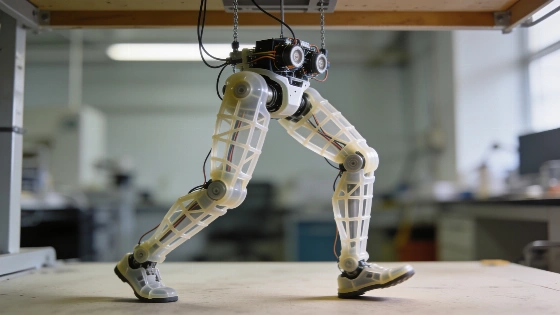
University of Tokyo researchers shaped one flexible plastic into components with different mechanical behavior. Motors and cables drive the legs, but demonstrations still rely on suspension to support the robot
During demonstrations, an external suspension system carried part of the robot's weight and limited torso motion. Preset wire-length commands moved the legs through coordinated steps, but the tests did not establish unsupported balance or independent walking. The prototype demonstrated alternating steps of about 0.4 meters and 0.8 meters, with movement intervals of approximately 1.6 and 2.4 seconds, respectively.
A University of Tokyo team developed the approximately 95-centimeter-tall robotic legs from thermoplastic polyurethane (TPU). The system includes a pelvis, femur, tibia, foot, three joints and six printed muscle structures. Shunnosuke Yoshimura, Kento Kawaharazuka and Kei Okada are associated with the work, reported in Advanced Intelligent Systems on September 11. As Humanoids Daily reported, the design uses one flexible plastic whose mechanical behavior changes with its printed geometry.
Varying lattice density, strut thickness and pattern lets the same TPU flex or resist movement to different degrees. Softer regions provide passive, muscle-like elasticity; denser structures act more like tendons, while patterned components constrain joints and the printed soles cushion impact. Reported motion ranges include 90 degrees of hip flexion, 30 degrees of hip extension, 30 degrees of hip abduction, 105 degrees of knee flexion and 15 degrees of ankle plantar flexion.
The printed structures do not contract like biological muscle. Electric motors mounted near the pelvic frame pull wires routed through Bowden cables, moving the legs while keeping heavier motors higher on the body and reducing the mass carried by the lower limbs. The TPU components deform passively as the motors and cables provide the pulling force.
Each printed muscle structure takes about 20-40 hours to produce. In reported component tests, muscle, tendon and joint samples endured 999 loading cycles without rupture. Tendon-like structures nevertheless became nearly twice as soft, with most of the change occurring during the first 100 cycles. Cable friction and changes in the TPU's response under repeated loading add challenges for controlling movement over time.
A report on Figure robots similarly noted that walking footage did not establish production rates or delivery totals. The Tokyo prototype has demonstrated supported stepping; independent walking remains an engineering challenge.