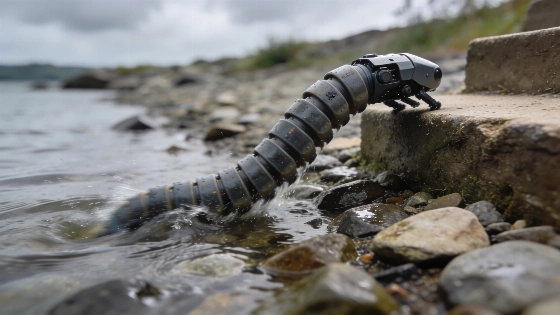
NYU's WorMa prototype moves 300 grams of water between its head and tail to change traction on slopes and steps and improve swimming without switching its basic undulating motion
A 50-centimeter robot can clear a 15-centimeter step and move from rocky ground into water by shifting its own mass rather than changing its body or gait. The prototype is called WorMa, and its key mechanism is simple: a pump moves water between flexible latex reservoirs at the head and tail.
The work, reported in the journal Advanced Robotics Research, describes a laboratory demonstration of locomotion across land and water rather than a field-ready autonomous machine. There is currently no evidence of serial production, independent deployment, or real-world operation. The reported trials show how ballast can alter physical interaction with terrain, but they do not establish long-term reliability, unattended operation, or performance across uncontrolled environments.
Researchers at New York University's Tandon School of Engineering built WorMa as a robot with five rigid segments and four joints. It is about 20 inches (50 centimeters) long and weighs slightly more than 2.2 pounds (1 kilogram). A pump transfers approximately 10.6 ounces (300 grams) of water between two reservoirs positioned at the front and rear-roughly one-third of the robot's total mass.
When water moves toward the head, the front contact points press more firmly against the surface. That changes the robot's center of mass and increases available traction on an incline. In testing, the head-heavy configuration allowed WorMa to climb a slope of up to 19.5 degrees; it was the only tested arrangement that overcame the steepest incline. The configuration also reduced transport cost by at least 33 percent compared with the alternatives tested.
The approach avoids adding a separate mechanical system for every surface. That economy is the important engineering idea: the robot changes the forces produced by its existing body instead of adopting a new locomotion mode for each obstacle. In the broader robotics literature, this kind of physical adaptation complements perception-heavy approaches discussed across Nature's robotics research, but it does not replace sensing or autonomous decision-making.
Water requires the opposite distribution. Moving the ballast toward the tail improved swimming speed by up to 26 percent and operating efficiency by 52 percent compared with a head-heavy arrangement. These figures describe laboratory comparisons between reported test configurations, not a general performance guarantee for open-water missions.
Steps required a sequence of weight shifts. WorMa approached with water in the head to preserve traction, then transferred the water rearward so the front section rose while the tail pushed toward the obstacle. After the head contacted the step edge, the pump moved water forward again to help the robot anchor and continue upward.
Using that sequence, the prototype cleared steps up to 6 inches (15 centimeters) high. The team also reported that a head-heavy configuration helped the robot pull itself from water onto a slope, while the other tested arrangements could not generate enough traction for the transition.
The course combined flat ground, a step, a slope, and open water. WorMa adjusted its mass distribution for each section while retaining the same basic undulatory movement pattern. For readers tracking the broader robotics field, the design sits closer to a specialized physical-control study than to the coordinated construction systems described in an earlier robot report: it demonstrates adaptive locomotion, not a general-purpose robotic workforce. Its use of movable ballast also reflects a broader engineering principle familiar from research programs at MIT and NASA, where changing a system's physical configuration can reduce the burden placed on software control; no direct connection between those programs and WorMa is implied here.
The available reporting does not identify the number of trials, a failure rate, an independent replication, confidence intervals, p-values, or a formal comparison with wheeled or legged robots. It also does not describe a perception system that autonomously recognizes rocks, steps, slopes, or water. Those omissions matter because a robot that can use a preselected ballast configuration is not the same as one that can reliably sense terrain and choose the correct response without supervision.
The researchers are working on faster pumps and sensor-based control that could let WorMa detect changes in terrain and redistribute its mass automatically. That remains a development direction, not a demonstrated capability in the reported course. The current evidence supports a narrower claim: water can serve as movable ballast for tuning traction and swimming behavior in a compact worm-like robot.
Nana Obayashi, an assistant professor at Tandon, identifies environmental monitoring and infrastructure inspection as possible uses because such missions may cross dry ground, obstacles, and water. Those applications would require more than successful obstacle clearance. They would need repeatable operation, robust sensing, recovery from pump or actuator failures, and clear human oversight, none of which is established by the reported measurements.
Mass redistribution is a form of physical control rather than machine intelligence. Sensor fusion would combine measurements from several sensors into an estimate of the robot's surroundings, but no such demonstrated perception pipeline is described here. WorMa's result is therefore best read as a useful prototype test: it shows that one adjustable mass system can support several locomotion conditions, while leaving the harder questions of reliable detection, autonomous decision-making, statistical reproducibility, and field deployment unresolved.