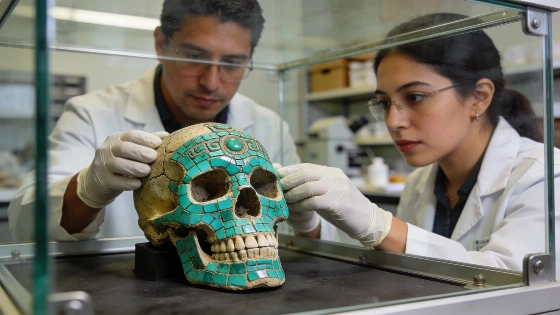
A rare pre-Hispanic human skull with a turquoise mosaic, linked to the Mixtec tradition, has been repatriated to Mexico after decades in a Dutch museum. Scientific analysis confirms its pre-Hispanic origin, but its precise archaeological context remains uncertain
A pre-Hispanic human skull decorated with a turquoise mosaic, believed to be associated with the Mixtec cultural tradition, has been returned to Mexico after spending approximately sixty years in the Wereldmuseum in Leiden, the Netherlands. The skull is now under the care of Mexico's National Institute of Anthropology and History (INAH), where it is being registered, digitally documented, and assessed for future research and exhibition.
Collection History and Repatriation
The turquoise-mosaic skull entered the Dutch museum's collection in 1962 through the art market, lacking secure archaeological provenance or detailed documentation of its original discovery. In late 2023, discussions between the Wereldmuseum and the Mexican Embassy in the Netherlands led to formal notification of Mexican authorities. The Ministries of Foreign Affairs and Culture in Mexico coordinated with the Dutch Ministry of Education, Culture and Science, finalizing the object's return in December 2024. The skull arrived in Mexico in May 2025 and was transferred to INAH specialists for safekeeping and analysis.
The repatriation was the result of sustained efforts by Mexican institutions and civil society groups, including the Nohivi Ñuu Savi collective, which advocated for the return of the object. INAH has since inventoried the skull and produced its first three-dimensional digital record. The Yucu Saa Community Museum in Villa de Tututepec, Oaxaca, has expressed interest in housing and displaying the artifact, and discussions are ongoing to ensure appropriate conservation and exhibition conditions.
Material Evidence and Scientific Analysis
The skull is notable for its elaborate mosaic, with small turquoise tesserae forming a schematic snake motif across the frontal bone. Additional materials include shell elements around the brow and eyes, jadeite in the left eye socket, and rock crystal for the serpent's eye. The technique is consistent with Mesoamerican craftsmanship from the Late Postclassic period (circa 1200-1521 CE), particularly in regions corresponding to present-day Puebla and Oaxaca. However, the lack of secure archaeological context limits the ability to assign a precise origin or function to the object.
Scientific investigations undertaken by the Dutch museum in collaboration with the French Center for Research and Restoration of Museums in 2011 and 2012 included isotope analysis, X-ray fluorescence, and osteobiographical studies. These analyses determined that the skull belonged to a male individual aged approximately 25 to 40 years at death. The materials used in the mosaic were confirmed as pre-Hispanic, though traces of modern adhesives suggest some tesserae may have been rearranged or reused prior to the museum's acquisition. INAH has since implemented additional conservation measures, including specialist packaging and the creation of a three-dimensional digital model.
Uncertainties and Future Research
Despite the confirmation of pre-Hispanic materials and techniques, the absence of secure archaeological provenance means that the skull's original context, cultural significance, and the circumstances of its deposition remain unknown. Researchers at INAH have proposed further studies, including radiocarbon dating and ancient DNA analysis, to refine the chronology and investigate the biological profile of the individual. Potential sampling from teeth or the temporal bone could yield genetic information, though destructive analysis would require careful ethical consideration and institutional approval.
Comparative examples, such as the decorated skull from Tomb 7 at Monte Albán, suggest that such ornamentation may have been intended to honor individuals of particular status, but direct parallels cannot be established without contextual evidence. The possibility that the skull was part of a funerary offering or ritual display remains plausible but unproven. The artifact's return to Mexico is expected to facilitate new research and community engagement, while also raising broader questions about the interpretation and stewardship of unprovenanced human remains in museum collections.
Ethical and Community Perspectives
The repatriation of the Mixtec turquoise-mosaic skull highlights ongoing debates about the ethical responsibilities of museums, the rights of descendant communities, and the challenges of interpreting objects acquired without secure provenance. INAH's collaboration with local institutions and community representatives aims to ensure that the artifact is preserved, studied, and potentially exhibited in a manner that respects both scientific and cultural values. The case also reflects a wider trend in heritage management, as seen in other recent returns of culturally significant objects, such as the recovery of medieval stone crosses from Norway described in a recent Science Report article.
For now, the skull remains under INAH's protection, with future research expected to clarify aspects of its chronology, biological identity, and cultural significance. The outcome will depend on the balance between scientific inquiry, conservation priorities, and the perspectives of the communities most closely connected to the artifact's heritage.
Archaeological provenance refers to the documented origin and context of an artifact or human remain, including its discovery location, stratigraphic association, and relationship to other finds. Secure provenance is essential for interpreting the function, chronology, and cultural meaning of archaeological material. Objects acquired through the art market or lacking excavation records, like the Mixtec turquoise-mosaic skull, present significant challenges for research and ethical stewardship. Without reliable provenance, interpretations remain provisional, and the potential for reconstructing past lifeways or social practices is limited. The issue underscores the importance of transparent documentation and responsible collection management in archaeology and museum practice.