
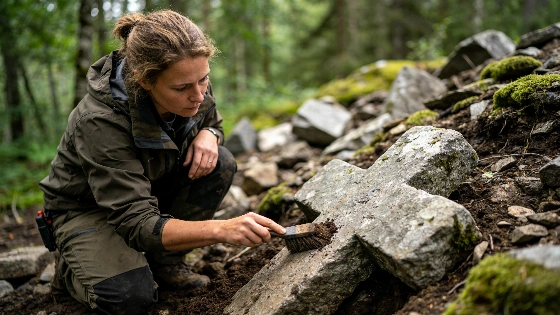
Archaeologists working at Hyllestad in western Norway recovered seven medieval stone crosses from a quarry waste heap, providing new evidence for local craftsmanship and religious change during the 11th to 13th centuries
Archaeological excavations at the Hyllestad quarry in western Norway have revealed seven medieval stone crosses, offering new insight into the region's role in religious and technological change during the Middle Ages. The discovery was made during a 2008 investigation focused on the site's history as a major center for millstone production from the Viking Age through the 20th century. Instead of only finding evidence of millstone manufacture, researchers identified fragments of large stone crosses discarded in a medieval spoil heap, shifting the focus of the excavation to the production of monumental Christian symbols.
Excavation Context and Material Evidence
The Hyllestad quarry is known for its extensive production of millstones, which were widely exported across northern Europe. During the excavation, archaeologists recovered fragments from seven stone crosses, some of which were relatively small and may have been intended for churchyards, while others were monumental in scale. The largest surviving fragment measures 1.2 meters in length, and the original cross is estimated to have stood between two and three meters high before breaking and being discarded. The crosses were found within a spoil heap left by medieval stonecutters, indicating that the site was not only a center for utilitarian stonework but also for the creation of religious monuments.
Charcoal samples collected from the spoil heap allowed the team to date quarry activity to between the 11th and 13th centuries CE. Beneath the waste, evidence of an even older phase of quarrying was identified, with preserved chisel marks in the bedrock suggesting earlier stone extraction. The direct association of the crosses with the quarry waste provides rare evidence for the location of their production, rather than just their use or final placement.
Craftsmanship and Cultural Significance
Freestanding stone crosses are a distinctive feature of western Norway, particularly within the historic Gulating region, which was central to the country's Christianization. Around 60 such crosses are known to have existed in the area, with nearly half believed to have originated from Hyllestad. Unlike mass-produced millstones, the stone crosses were likely made to order, possibly commissioned by local elites or even royal patrons. Their production coincided with Norway's transition from pagan beliefs to Christianity, and their prominent placement in the landscape would have served as visible markers of the new faith.
Comparative analysis suggests that the Hyllestad crosses display a higher standard of craftsmanship than many other examples along Norway's west coast. The established stone industry in the region provided local artisans with both the technical skills and logistical capacity to produce and transport large, finished monuments. Some researchers have proposed that the design of these crosses was influenced by traditions from Ireland and the British Isles, where monumental stone crosses with Norse artistic elements were already established by the Viking Age. This interpretation is supported by stylistic similarities and the known movement of people and ideas across the North Atlantic during this period.
Dating and Interpretation
The dating of the Hyllestad crosses relies primarily on radiocarbon analysis of charcoal from the spoil heap, placing their production between the 11th and 13th centuries CE. This period aligns with the broader process of Christianization in Norway and the construction of church infrastructure. The presence of an older quarry phase beneath the medieval waste indicates that stone extraction at Hyllestad began earlier, but the production of monumental crosses appears to be a medieval development. The evidence does not establish who commissioned the crosses or their precise destinations, but their size and craftsmanship suggest they were intended for prominent display.
While some historians have argued for German influence on Norwegian stone cross design, the evidence from Hyllestad supports a stronger connection to the British Isles. The blending of pagan and Christian symbolism in the crosses' decoration reflects the complex cultural dynamics of the period. The discovery of the production site itself is significant, as it allows researchers to connect surviving crosses in the landscape to their place of origin and to reconstruct aspects of medieval craft organization and religious practice.
Comparative Context and Ongoing Research
The Hyllestad find adds to a growing body of evidence for specialized craft production and religious transformation in medieval Scandinavia. Similar investigations elsewhere, such as the excavation of a communal tomb at Qattarah Necropolis in Al Ain, UAE, have used isotope and ancient DNA analysis to clarify population origins and burial practices, as discussed in this recent Science Report article. In the case of Hyllestad, the focus remains on material evidence and contextual dating, with ongoing research examining the distribution, stylistic variation, and cultural significance of stone crosses across western Norway.
Although the discovery was made nearly two decades ago, the Hyllestad crosses continue to inform research on medieval stoneworking, religious change, and the movement of artistic traditions. New studies are expected to further illuminate the relationship between local craft industries and the broader processes of Christianization and cultural exchange in the North Atlantic world.
Understanding the archaeological context of artifact production is essential for interpreting both the function and meaning of material culture. In the case of the Hyllestad stone crosses, the association with a quarry waste heap provides direct evidence for their manufacture, rather than just their use or deposition. This context allows archaeologists to reconstruct aspects of medieval craft organization, technological skill, and the social role of monumental religious symbols. The identification of production sites, combined with dating methods such as radiocarbon analysis, strengthens the link between surviving artifacts and their historical setting, while also highlighting the limitations of interpretation when provenance is uncertain or incomplete.