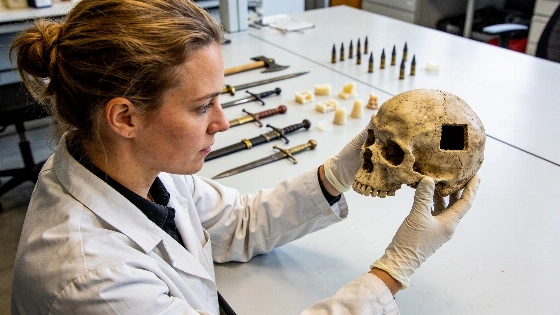
A new forensic analysis of 14th-century skeletons from the Battle of Visby in Sweden has identified spiked clubs as the likely cause of distinctive square cranial injuries, challenging assumptions about medieval militia training and combat methods
Recent research into the skeletal remains from the 1361 Battle of Visby on the Swedish island of Gotland has provided new insight into the weapons and tactics used during one of medieval Scandinavia's most studied conflicts. A multidisciplinary team led by biological anthropologists at Uppsala University has re-examined skulls from a mass grave, focusing on a series of square-shaped cranial injuries that have puzzled archaeologists since the site's first excavation in the early 20th century.
Battlefield Context and Skeletal Evidence
The Battle of Visby, fought in July 1361, resulted in the deaths of an estimated 1,800 Gotlandic defenders and around 300 Danish soldiers. The fallen were interred in mass graves near the battlefield, many still wearing their armor. The preservation of these remains, including over 1,100 skeletons, has allowed for detailed osteological analysis. Several skulls display distinctive square perforations, previously attributed to arrowheads or lance tips, but lacking direct evidence for these weapons at the wound sites.
To address the origin of these injuries, researchers constructed experimental models using cow bones covered in ballistic gelatine and replica medieval armor. These models were subjected to controlled strikes with various reconstructed weapons, including axes, crossbows, and spiked clubs. Motion-capture technology recorded the force and trajectory of each blow, allowing for precise comparison with the trauma observed on the Visby skeletons.
Experimental Archaeology and Weapon Identification
The experimental results indicated that neither axes nor crossbow bolts produced injuries matching the square holes seen in the human remains. In contrast, a replica spiked club-known as a knout-created damage closely resembling the square cranial defects. The pattern and severity of the trauma suggest that these weapons were used deliberately to incapacitate or kill, often as a final blow after initial injuries from other weapons.
Analysis of the trauma sequence on several skulls revealed evidence for coordinated group attacks. In some cases, an initial wound from an axe was interrupted by a subsequent strike from a spiked club, implying that multiple combatants targeted the same individual in rapid succession. This finding challenges the traditional view that the Gotlandic defenders were poorly trained or equipped, instead indicating familiarity with complex combat techniques and group tactics.
Reassessing Medieval Combat and Militia Training
The study's findings contribute to a growing body of evidence that medieval militias, even those not part of standing armies, could possess significant combat training and tactical coordination. The use of experimental archaeology, combined with forensic analysis of skeletal trauma, has allowed researchers to reconstruct aspects of battlefield behavior that are rarely preserved in written sources. The research remains unpublished in a peer-reviewed journal, but was presented at the 25th European Paleopathology Association meeting in Berlin.
These results also highlight the value of interdisciplinary approaches in bioarchaeology, drawing on expertise in conflict archaeology, ancient DNA, and material culture. Similar collaborative methods have been applied to other medieval contexts, such as the analysis of burial practices and grave goods at sites like Aspendos, where archaeologists recently examined a Classical-period sarcophagus and its contents to explore social roles and identity.
Limitations and Ongoing Questions
While the experimental evidence strongly supports the identification of spiked clubs as the source of the square cranial injuries, some uncertainties remain. The precise distribution of these weapons among the combatants, their manufacture, and their prevalence in other medieval conflicts are not fully established. Additionally, the research relies on comparative models and preserved trauma, which may not capture the full range of battlefield injuries or the diversity of weapons used.
Further analysis of the Visby mass graves, including ancient DNA and isotopic studies, may provide additional context regarding the origins, health, and social status of the individuals involved. The ongoing integration of experimental, osteological, and historical data continues to refine our understanding of medieval warfare and the lived experiences of those who fought and died in such conflicts.
Perimortem trauma refers to injuries that occurred at or around the time of death, often distinguishable from postmortem damage by the absence of healing and the characteristics of bone fracture. In archaeological contexts, identifying perimortem trauma requires careful analysis of fracture edges, bone color, and associated taphonomic changes. Experimental archaeology can help clarify the mechanisms behind specific injury patterns, but interpretation remains limited by preservation, sample size, and the complexity of past events. Understanding the distinction between perimortem and postmortem changes is essential for reconstructing the circumstances of ancient deaths and the nature of past violence.