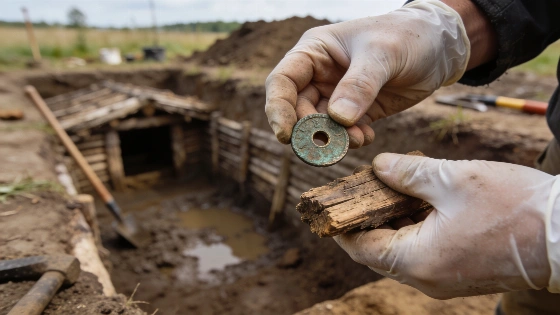
Excavations at Galgenbichl in South Tyrol have revealed more than 30 houses dating from approximately 800 to 500 BCE, together with craft evidence, animal remains and infant burials that differ from the cremation practices documented at nearby Windschnur.
An infant burial ground found inside an Iron Age village is among the discoveries reshaping the archaeological picture of Galgenbichl in South Tyrol. The settlement contains the remains of more than 30 houses and dates from approximately 800 to 500 BCE, making it the first Iron Age settlement of comparable scale to be systematically investigated in the province, according to South Tyrol's archaeological authorities.
The funerary evidence is especially important because it differs from the cremation evidence documented at the nearby Iron Age cemetery of Windschnur. At Galgenbichl, infants were placed directly within the settlement rather than being represented by the cremation remains recorded at the neighboring cemetery. This spatial and ritual contrast strengthens the possibility that very young children received funerary treatment distinct from that given to older members of the community, although it does not by itself explain the beliefs or social rules behind the practice.
The relationship between the settlement and Windschnur gives the wider Rasen-Antholz area unusual interpretive value. Together, the village and cemetery provide two complementary archaeological contexts: one focused on houses, production and daily activities, and the other on formal mortuary behavior. Regional reporting describes this combination as one of the most important bodies of evidence for the Early Iron Age in the Alpine region, while provincial officials have emphasized the site's growing importance for archaeological research.
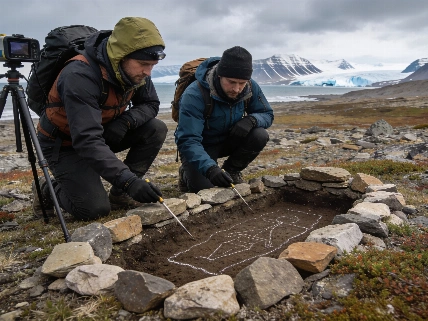
Archaeologists began excavating at Galgenbichl in Niederrasen in February 2026, ahead of construction of a new access road serving Antholz and Olang. The work is now approaching completion. The excavation was therefore driven by modern infrastructure rather than by a long-planned investigation of a visible ancient town, but construction-led archaeology can preserve information that would otherwise remain unknown or be damaged by development. The provincial account of the project is summarized in an official excavation report.
According to the available reports, the settlement's chronology is presented as an archaeological range rather than a single precise year. The published material does not identify a radiocarbon program, a laboratory affiliation, a sample size or a statistical model for the 800-500 BCE date. It is therefore most accurate to treat the range as contextual archaeological dating based on the association of structures, layers and artifacts, not as a claim that every house, tool and burial was directly dated in a laboratory.
As with the Montbellant excavation, the immediate trigger was modern construction rather than a long-planned investigation of a visible ancient town. That pattern matters because settlement archaeology often depends on what infrastructure work exposes before remains are covered, altered or destroyed. It also means that the final interpretation must account for excavation boundaries and the possibility that the surviving trenches represent only part of the ancient settlement.
The excavated material moves the site beyond a map of house foundations. Ceramics, tools, animal bones, millstones and evidence of metalworking point to domestic production and food processing within the community. Tools associated with weaving and spinning indicate textile work, while bronze-working evidence records a craft activity that required specialized knowledge and access to suitable materials. These findings do not prove that every household carried out every activity, but they show that the settlement supported a mixture of domestic and specialized production.
The numerical scale is clear: more than 30 houses have been identified across a settlement occupied between about 800 and 500 BCE, while cattle bones were particularly common among the animal remains. Archaeologists interpret the frequency of cattle bones as potentially consistent with a relatively prosperous standard of living, but animal-bone abundance alone cannot establish wealth for every household or reconstruct the complete diet. A stronger demographic and economic assessment would require published counts by species, anatomical representation, age and sex, together with information about recovery methods and the areas sampled.
Galgenbichl also appears to have participated in contacts extending beyond the immediate Alpine landscape. Its position in the Puster Valley is associated with links to communities in the Venetian area of northeastern Italy. The evidence indicates contact, not necessarily large-scale migration or the movement of an entire population: objects, manufacturing techniques and stylistic traditions can circulate without proving that people relocated. Future compositional analyses of metals, ceramics or other materials could help distinguish local manufacture from imported objects, but such laboratory results are not identified in the currently reported findings.
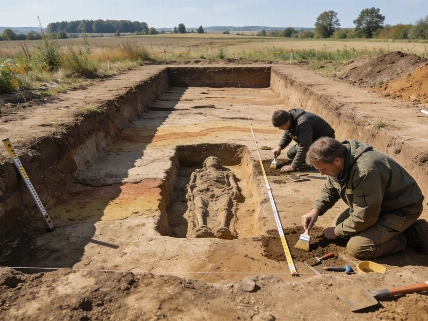
The infant graves provide the clearest evidence for social difference within the settlement's mortuary record. A small burial ground contained infants who were buried rather than cremated, while cremation was used at the nearby Windschnur cemetery. The contrast may reflect an age-specific funerary tradition, a distinction between household and cemetery practices, or another cultural rule. At present, the published reports do not provide a complete number of infant burials, osteological age ranges, biological sex estimates or chemical analyses, so broader claims about the community's treatment of children remain provisional.
Infant mortality forms an important demographic context, but regional or comparative estimates must not be converted into a direct mortality rate for Galgenbichl. The reported figure of approximately 20 to 35 percent concerns the possible proportion of children who may not have survived their first year in comparable ancient populations; it is not a count of deaths recovered from this settlement. In bioarchaeological work, such estimates are affected by preservation, burial selection, excavation coverage and the likelihood that very young infants are underrepresented in the archaeological record.
The burial evidence also needs to be kept separate from claims about emotion or social status. Direct burial inside the village shows where and how these infants were placed. It does not by itself establish their individual identities, the circumstances of death, the emotional response of relatives or whether they occupied a particular social category beyond the apparent distinction in age and funerary treatment. Researchers would need securely documented contexts, osteological study and, where preservation allows, additional evidence such as radiocarbon dating, stable-isotope analysis or ancient DNA to address some of those questions.
This cautious approach is consistent with standards used in major research communities such as the Max Planck Society and with the evidence-first reporting expected in journals such as Nature. Those institutions are useful methodological comparisons, not indications that they conducted the Galgenbichl excavation. No p-values, confidence intervals or peer-reviewed statistical tests have been reported for the discovery so far, and no lead researcher is identified in the supplied accounts. The central results should therefore be described as an archaeological field discovery and preliminary interpretation rather than as a completed demographic or laboratory study.
Galgenbichl is consequently valuable less because it offers a single dramatic explanation than because several evidence streams can be studied together: architecture, household objects, craft production, animal remains and mortuary practice. The settlement can support a more grounded reconstruction of daily life in the Puster Valley, while its association with Windschnur makes it possible to compare village activity with cemetery behavior. Even so, one settlement and one excavation cannot provide a complete picture of the entire Early Iron Age population.
In archaeology, contextual dating means assigning remains to a period through their association with site layers, structures, artifact types or related evidence rather than claiming that every object has been directly dated in a laboratory. That distinction matters at Galgenbichl because 800-500 BCE is a broad chronological window. The houses, tools and burials can be compared within that framework, but the available evidence does not establish when each building was occupied or whether every burial and craft activity was exactly contemporary.
The settlement's significance lies in the strength of its combined context. More than 30 houses, production evidence, animal remains and infant burials make Galgenbichl an unusually substantial record of Alpine Iron Age life, while the nearby Windschnur cemetery adds a contrasting mortuary dataset. As the excavation concludes, detailed plans, inventories, osteological reports and laboratory analyses will be essential for determining how the settlement developed over time and why the youngest members of the community were treated differently in death.