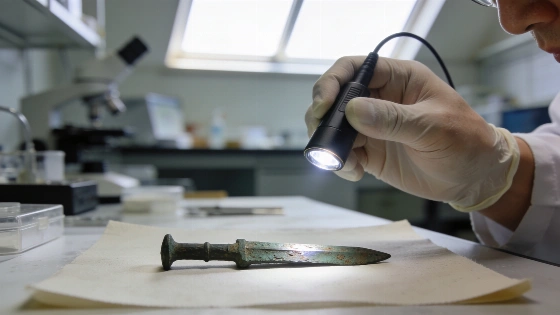
A bronze hand cannon found during a trail safety survey in South Korea has passed X-ray and metallurgical tests. Identified as the Hwangja Hwatong after three years of analysis, it is regarded as Korea's earliest surviving firearm, although its 28-character inscription leaves two possible manufacturing dates.
A small bronze firearm recovered from Mount Geumseong in South Korea has become the earliest verifiable surviving firearm found in Korea. The Naju National Research Institute of Cultural Heritage confirmed the object as the Hwangja Hwatong, or "Yellow-Character Hand Cannon," after three years of examination. Its authentication rests on several independent lines of physical evidence: X-ray imaging, metallurgical analysis and a 28-character inscription pointing to production during the late Goryeo or early Joseon period.
The Hwangja Hwatong was found in Naju, about 280 kilometers south of Seoul, in 2023 during landmine detection and other safety surveys carried out before a new walking trail was built. Workers encountered the object by chance rather than during a targeted excavation. That circumstance means the find does not come with controlled stratigraphic context linking it securely to a particular soil layer or associated group of artifacts.
The absence of excavation context does not invalidate the object, but it changes the evidentiary burden. Authenticity and dating must be assessed through the cannon itself, its inscription and comparison with documented weapons from the proposed periods. In this respect, the Hwangja Hwatong differs from objects recovered in controlled excavations, where soil layers and associated finds can provide an independent chronological framework.
The weapon is approximately 23.75-25 centimeters long and weighs about one kilogram. Those dimensions identify it as a portable hand cannon rather than a heavy artillery piece. The scale is historically important because it indicates that gunpowder technology was being adapted for weapons that could be carried and handled individually, not only for fixed or large-caliber battlefield equipment.
Researchers examined the cannon with X-ray imaging and metallurgical methods. The barrel is made from an alloy of copper, tin and lead, with tin accounting for less than 10 percent of the composition. That relatively low tin content is treated as an important technological feature of early bronze weapon production because alloy proportions affect casting behavior, strength and resistance to fracture. Silver and sulfur were also detected, and the reported analysis considers these traces compatible with historical production rather than evidence of a modern reproduction.
The approach illustrates a broader principle of archaeometry: no single measurement proves an artifact's history. X-ray imaging can reveal internal structure and manufacturing irregularities without cutting into the object, while chemical analysis identifies the material recipe. Comparable non-destructive and materials-based approaches are used in conservation research at institutions such as MIT and the Max Planck Society. In reporting terms, the emphasis on uncertainty and independent evidence also follows the standards familiar from research published in Nature, although the Hwangja Hwatong's findings remain a museum and heritage assessment rather than a peer-reviewed laboratory trial.
The internal design supplies a second line of evidence. The firing chamber has a rounded form associated with early cannon construction. Later Joseon firearms incorporated changes such as wooden wads intended to improve propulsion, whereas this object retains an earlier configuration. That comparison supports its place in a formative phase of Korean firearms technology, but it cannot by itself establish the exact year of manufacture or prove that the cannon was ever fired.
Authentication is therefore not the same as a complete historical reconstruction. Metallurgy can identify a material recipe and aspects of manufacturing history, while form can be compared with later technological developments. Neither method can establish where the cannon was used, who handled it or whether it participated in combat. The analysis demonstrates that the object is genuine and technologically significant, but it does not reconstruct its entire biography.
The inscription records the weapon's identity and weight, names the official who supervised production and identifies a craftsman called Suk as its caster. It also describes production as taking place in a Jeongsa year. Researchers therefore narrow the possible manufacture to December 1377 or December 1437, two dates separated by the transition from Goryeo to Joseon.
The earlier possibility falls within a period when Goryeo created a state weapons agency under Choe Mu-seon in response to raids by Japanese pirates. The later date would place the cannon under King Sejong, when Joseon was developing and standardizing artillery and other gunpowder weapons. Both historical settings fit the technological significance of the object, which is why the inscription is valuable even before its date is resolved.
The inscription supplies unusually specific administrative information for a surviving early firearm. It connects the object to state-directed production and identifies separate supervisory and casting roles. That evidence can illuminate how weapons were classified and manufactured, but it cannot demonstrate that every firearm of the period was produced through the same system.
The director of the Naju National Research Institute of Cultural Heritage, Cho Mi-sun, described the artifact as having immense academic, historical and cultural value and as belonging to a crucial transitional period between late Goryeo and early Joseon, when material evidence for firearms is especially scarce. The institute's conclusion makes the Hwangja Hwatong a chronological anchor for studying Korean gunpowder technology, while preserving the distinction between what is directly observed and what remains historically inferred.
The artifact is scheduled to be shown at the National Palace Museum of Korea in Seoul from September 23 through November 22, 2026, according to the official museum listing. Its public presentation gives visitors access to a rare object from the transition between two dynasties, while conservation work allows researchers to document its alloy, structure and inscription without treating display as proof of every historical claim.
The significance of the Hwangja Hwatong lies precisely in the limits of the evidence. Archaeological provenance records where and how an object entered the ground and was recovered; authenticity asks whether the object is genuine. These questions are related but not interchangeable. The alloy, internal structure and inscription make a modern reproduction unlikely according to the reported analysis, while the accidental recovery limits independent evidence for its exact deposition history.
The result is a genuine and important artifact, but not a complete account of early Korean firearms. Its strongest contribution is precise: it provides an authenticated material anchor for studying how portable gunpowder weapons were made and administered during a crucial transition from late Goryeo to early Joseon. Whether it was cast in 1377 or 1437 remains unresolved, and that uncertainty is itself historically meaningful because the two dates belong to different dynasties and different phases of weapons administration.
Further interpretation will depend on comparing the inscription with contemporary records and other surviving weapons rather than on assigning a date from appearance alone. As the reported heritage assessment emphasizes, the object's value comes from the convergence of physical analysis, historical comparison and careful acknowledgment of what the evidence cannot yet show.