Archaeologists in Turkey have uncovered a 2,400-year-old stone sarcophagus near Aspendos containing a human skeleton and silver coins depicting wrestlers, offering new evidence for the role of athletics in Classical-period society while raising questions about individual identity
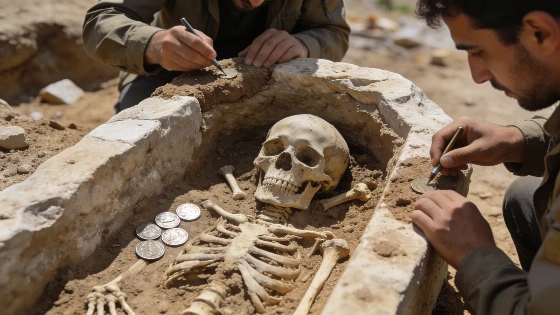
Archaeological excavations at a cemetery outside the ancient city of Aspendos in southwestern Turkey have revealed a stone sarcophagus burial dating to the Classical period, between approximately 475 and 300 BCE. The grave contained a human skeleton alongside several silver coins, some of which bear images of wrestlers, as well as other artifacts. The find provides a rare opportunity to examine the intersection of athletic culture, mortuary practice, and civic identity in a Greco-Roman urban context.
Excavation and Context
The burial was discovered during systematic excavations in one of the necropoleis surrounding Aspendos, a city established by Greek colonists in the fifth century BCE and later integrated into the Roman world. The sarcophagus, constructed from stone slabs in a box-like form, was found in situ within a cemetery area that has yielded additional graves of similar construction. The site lies roughly 16 kilometers inland from the Mediterranean coast, in a region known for its agricultural and trading significance during antiquity.
Within the sarcophagus, archaeologists recovered a single human skeleton in association with a group of coins and minor grave goods. The coins include examples of the Aspendos stater, a silver denomination minted locally for over a century, which is notable for its depiction of two nude male wrestlers engaged in combat. The presence of these coins in the burial context is consistent with the city's documented emphasis on athletic competition, particularly wrestling, which was celebrated in both civic iconography and public events.
Material Evidence and Interpretation
The skeleton, preserved in a relatively stable environment, offers potential for osteological analysis, though detailed results regarding age, sex, and health status have not yet been released. The association of wrestler-coinage with the burial has prompted suggestions that the individual may have participated in athletic activities, possibly as a wrestler. However, the interpretation remains provisional. Coins of this type were widely circulated and used for general transactions, and their presence in a grave does not by itself establish the deceased's occupation or social role.
Numismatic evidence indicates that Aspendos staters featuring wrestling motifs were produced from the fifth to the fourth centuries BCE, reflecting the city's investment in athletic culture. The city also possessed a large gymnasium and, by the second century CE, a stadium capable of seating thousands of spectators for athletic contests. While the grave goods are consistent with the broader civic emphasis on sport, further analysis of the skeleton-such as evidence for trauma, musculoskeletal markers of activity, or distinctive injuries-would be required to support a more specific identification.
Uncertainty and Comparative Context
At present, the evidence does not permit a definitive conclusion regarding the individual's involvement in wrestling or other athletic pursuits. Coins alone are insufficient to establish personal identity or occupation, as they were not exclusive to athletes and circulated widely in the local economy. Additional lines of evidence, such as healed fractures, distinctive joint wear, or craniofacial trauma, could provide stronger support for an athletic interpretation if present in the skeletal remains.
The ongoing excavation of the Aspendos cemetery is expected to yield further data on burial practices, population composition, and the relationship between grave goods and social identity in the region. Comparable discoveries elsewhere in Anatolia and the wider Mediterranean have shown that athletic imagery on coins and grave goods often reflects civic ideals rather than individual biography. Recent archaeological work in other urban centers, such as the multi-century stratified excavations in Kaliningrad's Far Forstadt district, has similarly highlighted the complexity of linking material culture to personal identity, as discussed in a recent Science Report analysis of urban life and artifact assemblages.
Chronology and Measurement
The Aspendos burial is dated contextually to between 475 and 300 BCE, based on the typology of the coins and the architectural style of the sarcophagus. The cemetery area has produced multiple graves of similar construction, but the number of burials with associated athletic iconography remains limited. The stadium at Aspendos, constructed in the second century CE, could accommodate up to 8,000 spectators, underscoring the city's later prominence as a center for public games. The staters recovered from the grave represent a well-documented numismatic type, with production spanning more than a century and distribution across the region.
Further laboratory analysis of the skeletal remains, including osteological and potentially biomolecular methods, may clarify the individual's age at death, biological sex, health status, and activity patterns. The preservation of the coins and associated artifacts is sufficient to support detailed typological and metallurgical study, which may refine the chronological placement of the burial within the Classical period.
In mortuary archaeology, the association of specific grave goods with individual identity is a subject of ongoing debate. While objects such as coins, weapons, or jewelry can reflect aspects of social role, status, or belief, their presence in a burial does not automatically indicate the deceased's occupation or achievements. Contextual analysis, including comparison with other graves and broader settlement patterns, is essential for interpreting the meaning of material associations in the archaeological record.