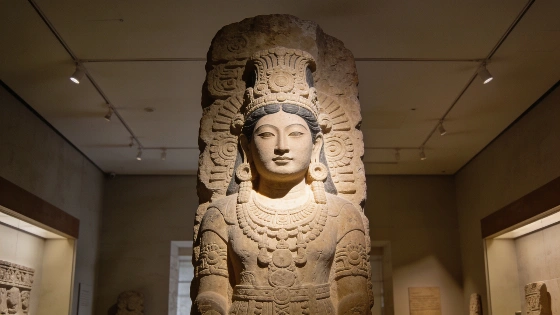
Archaeologists have reconstructed a monumental limestone stela from El Perú-Waka' in Guatemala, depicting Lady K'abel, a Maya ruler, and revealing new evidence about her political and military authority at the end of the seventh century CE
A limestone stela recovered from the ancient Maya site of El Perú-Waka' in northern Guatemala has provided new insight into the political and military roles of Lady K'abel, a prominent Maya ruler of the late seventh century CE. The monument, now held by the Cleveland Museum of Art, was originally erected in 692 CE and is believed to commemorate the end of a k'atun, a 20-year period in the Maya calendar. The stela's front face, reconstructed from more than 40 carved fragments, stands approximately 2.74 meters tall and weighs over 1,100 kilograms, making it one of the most substantial surviving examples of Maya royal portraiture.
Archaeological Context and Reconstruction
The stela was discovered at El Perú-Waka', a provincial Maya settlement in the Petén region, and was found in association with a similar monument depicting K'inich Bahlam II, Lady K'abel's husband. Unlike many Maya monuments that remain in situ, this stela entered the museum collection in 1967, and its original archaeological context was partially reconstructed through subsequent fieldwork. The monument's iconography and hieroglyphic inscriptions identify Lady K'abel as both "Water Lily Hand" and "Divine Woman of the Snake Polity," titles that connect her to the powerful Kaanul (Snake) dynasty. The stela's imagery and text emphasize her status as "Ix Kaloomte'," or "Lady Supreme Warlord," a title rarely attributed to women in Maya inscriptions.
Lady K'abel is depicted in elaborate regalia, including a headdress of quetzal feathers, a netted jade garment, and a belt featuring a fish-like creature's head. She holds a scepter and a circular shield, visual elements that reinforce her military authority. The lower left of the carving includes a figure with dwarfism, likely an attendant or courtier, a motif seen in other Maya royal monuments. The stela's scale and iconography suggest it was intended to assert Lady K'abel's legitimacy and power at a time of regional conflict and dynastic competition.
Dating, Interpretation, and Burial Evidence
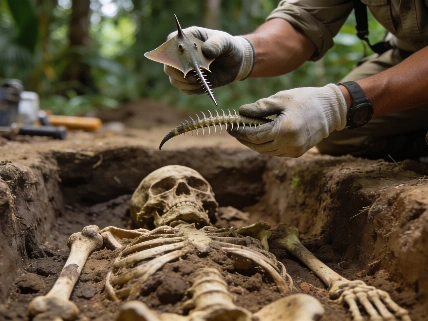
The stela's date of 692 CE is established through its hieroglyphic text, which records the completion of a k'atun. While the monument itself was acquired decades before systematic excavation at El Perú-Waka', later archaeological work has strengthened the association between the stela and Lady K'abel's burial. In 2012, archaeologists uncovered a royal tomb beneath a previously unknown staircase near the stela's original location. The tomb contained artifacts of jade, obsidian, and shell, including a bivalve shell placed on the pelvis of the skeleton-an object matching the shell depicted on Lady K'abel's stela portrait. A small alabaster carving inscribed with Lady K'abel's name was also recovered, providing strong, though not absolute, evidence that the tomb belonged to the same individual commemorated by the monument.
Interpretations of Lady K'abel's role are based on both the stela's iconography and the broader context of Maya political history. As a member of the Snake dynasty, she likely served as a military governor and may have led campaigns against rival cities such as Tikal. The depiction of Lady K'abel in the attire of the maize god or moon goddess suggests a deliberate association with themes of creation, renewal, and divine authority. However, the absence of direct written records beyond the stela and associated artifacts means that some aspects of her reign and identity remain open to interpretation.
Material Evidence and Limitations
The stela's reconstruction from more than 40 fragments highlights both the challenges and possibilities of working with incomplete archaeological material. While the front face preserves detailed carving and hieroglyphic text, the original monument was likely freestanding and may have included additional elements now lost. The stela's current location in a museum collection, rather than its original archaeological context, limits the ability to reconstruct its full spatial and ceremonial significance. Nevertheless, the combination of iconography, inscription, and associated burial evidence provides a rare opportunity to examine the intersection of gender, power, and political authority in Classic Maya society.
Numerical data from the site and monument are notable: the stela stands about 2.74 meters tall and weighs approximately 1,134 kilograms. The tomb associated with Lady K'abel contained a range of high-status artifacts, including jade beads, obsidian blades, and shell ornaments, supporting the interpretation of elite status. The discovery of a matching shell on both the stela and the skeleton's pelvis is a particularly strong line of evidence linking the monument to the burial.
Comparative research on monumental Maya sculpture and royal burials continues to refine our understanding of how rulers used material culture to assert authority. For example, recent studies of prehistoric Japanese pottery, such as the Jōmon fire-flame vessel, have shown how distinctive artifacts can illuminate social and ritual practices even when written records are absent. In the case of Lady K'abel, the stela and tomb together offer a rare convergence of iconographic, textual, and osteological evidence.
Understanding Maya Royal Monuments
Maya stelae are carved stone monuments that often combine hieroglyphic inscriptions with images of rulers or deities. These monuments served as public statements of authority, commemorating events such as period endings, accessions, or military victories. The iconography and text were intended to communicate legitimacy and divine sanction to both local and regional audiences. However, the interpretation of stelae depends on the preservation of both the monument and its archaeological context. When monuments are removed from their original setting, as with the Lady K'abel stela, some aspects of their meaning and function become more difficult to reconstruct. Ongoing research and the integration of burial, artifact, and inscriptional evidence remain essential for understanding the complex social and political dynamics of the Classic Maya world.
Archaeological provenance refers to the documented origin and context of an artifact or monument, including its location, stratigraphic association, and relationship to other finds. Secure provenance is critical for interpreting the function, meaning, and chronology of archaeological material. When objects are removed from their original context, as with many museum acquisitions from the mid-20th century, researchers must rely on a combination of surviving documentation, comparative analysis, and, when possible, new fieldwork to reconstruct their significance. The case of Lady K'abel's stela demonstrates both the potential and the limitations of reconstructing ancient lives from fragmentary and displaced evidence.