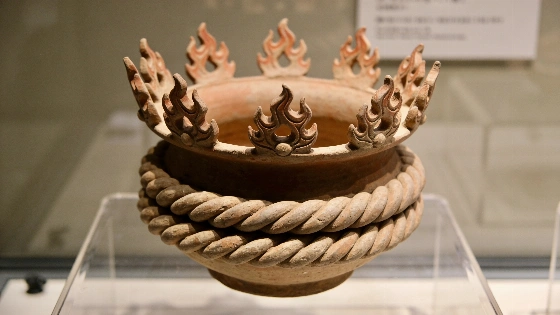
Archaeologists have examined a 4,500-year-old fire-flame vessel from Honshu, Japan, analyzing its elaborate ceramic construction and uncertain function to better understand the Jōmon period's material culture and social practices
A striking ceramic vessel from Japan's Jōmon period, known as a fire-flame vessel or ka'en doki, offers rare insight into prehistoric pottery technology and social life on Honshu around 2500 BCE. Characterized by dramatic, flame-like projections at its rim, this artifact stands out for both its size and preservation, yet its original purpose remains unresolved.
Material Evidence and Context
The vessel, now held by the Cleveland Museum of Art, measures approximately 61 centimeters in height and 56 centimeters in diameter. Notably, the base of the pot was reconstructed from a different vessel, suggesting that its original dimensions may have differed. Fire-flame vessels are most commonly associated with the Niigata region of Honshu and are dated to the Middle Jōmon period, a time when pottery production flourished among hunter-gatherer communities.
Jōmon ceramics are among the oldest in the world, with the tradition spanning from roughly 10,500 BCE to 300 BCE. The people who made these vessels left no written records, so their lives are reconstructed from archaeological remains. Settlements in this period typically consisted of small villages, often with populations around 100 individuals. The fire-flame vessel's elaborate form was achieved by building up coils of clay, then adding decorative elements and incising the surface before firing. The distinctive flame-shaped projections were applied last, requiring considerable skill and time investment.
Function and Interpretation
Despite their elaborate appearance, the function of fire-flame vessels is debated. Some examples show soot residues, indicating possible use in cooking or heating. However, the vessel's weight and the fragility of its rim projections make it unlikely that the handles were used for lifting. The wide mouth and narrow base suggest it may have been partially buried for stability during use, but the exceptional preservation and intricate decoration of the Cleveland example imply it was not an everyday household item.
One interpretation is that such vessels played a role in ceremonial or ritual contexts, perhaps serving as containers for offerings or as focal points in communal gatherings. The absence of direct evidence for their symbolic meaning, however, leaves this hypothesis unconfirmed. The vessel's context-recovered without secure stratigraphic association-limits the ability to link it to specific activities or social practices. This uncertainty is not unique; many prehistoric artifacts, including those from other regions such as the Berlin Gold Hat, challenge archaeologists to interpret meaning from form and context alone.
Technological and Social Implications
The sophistication of fire-flame vessels demonstrates that Jōmon communities possessed advanced ceramic technology long before similar developments elsewhere. The investment of labor in non-utilitarian pottery suggests that these societies valued aesthetic expression and possibly ritual display alongside practical needs. The vessels' distribution and stylistic variation may reflect regional identities or social networks, but without written records or direct contextual associations, these interpretations remain provisional.
Archaeologists continue to debate whether the flame motifs held symbolic significance-such as representing fire, transformation, or social status-or were primarily decorative. The lack of consensus underscores the challenges of reconstructing meaning in prehistoric material culture, especially when objects are removed from their original archaeological context.
Understanding the Jōmon fire-flame vessel requires attention to archaeological provenance. Provenance refers to the documented origin and recovery context of an artifact, which is essential for interpreting its function and significance. When objects are excavated in situ, their association with other finds, features, and stratigraphic layers can clarify how they were used and valued. In contrast, artifacts lacking secure provenance-such as those acquired through reconstruction or without detailed excavation records-present interpretive challenges. Without context, even the most spectacular objects may remain enigmatic, highlighting the importance of careful archaeological documentation.