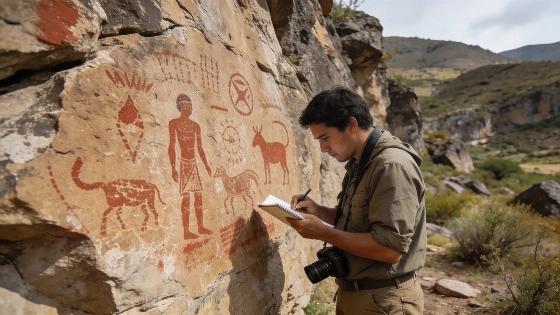
Archaeologists have identified 55 rock art scenes at 25 sites in Hidalgo depicting figures meeting the lord of the underworld. The findings offer new evidence for how ancient communities understood death and the supernatural.
Carved and painted images on rock faces across Hidalgo, Mexico, tell a story that may go back more than 1,500 years: the journey to meet the lord of the underworld. Recent research has documented at least 55 of these scenes at 25 archaeological sites, offering a rare look at how ancient Mesoamerican communities pictured death, ancestors, and supernatural forces. The National Institute of Anthropology and History (INAH) has led the work to record and protect these sites, part of its broader effort to safeguard cultural heritage.
Rock art and ritual narrative
Archaeologist Alfonso Torres Rodríguez of the INAH Hidalgo Centre has found that these images are not just isolated symbols. Instead, they form a repeating visual pattern-a kind of narrative. In many scenes, one or two human figures, often thought to be warriors, appear with a canid (dog or coyote) as they approach another figure. This destination figure is often linked to symbols of the moon, funerary bundles, or images suggesting descent underground. Researchers interpret this as the lord of the underworld.
Sites with these scenes include Huapalcalco, Xihuingo, Dahñé, and San Miguel de las Piedras. Most of the rock art dates from 350 to 750 CE, a period of major cultural change in central Mexico. The scenes are not spread randomly: pairs of figures are more common in the mountainous east and south, while single figures appear more often in the Mezquital Valley. This pattern has drawn attention from international researchers, including those from the Max Planck Society and Harvard University, who have stressed the value of spatial analysis for understanding ancient ritual landscapes.
Iconography and interpretation
Torres Rodríguez has identified three main iconographic groups in the rock art. The first, called the Tezcatlipoca-Huémac-Yaotl complex, shows warrior-like figures with snakeskin and broad hands. The second, the Otontecuhtli-Tlotli-Mictlantecuhtli complex, centers on a seated figure tied to Otomi divine traditions. The third group features pairs of ancestors, found in both mountain and valley settings.
Pairs or twins appear often, but they are not simple copies. The two figures usually differ in appearance, sex, or symbols, hinting at complementary roles. Researchers suggest that one may represent masculine, martial, and solar traits, while the other stands for feminine, sacrificial, and lunar qualities. This duality is more than a visual device-it may reflect broader Mesoamerican ideas about balance and transformation in death and the afterlife. Comparative studies in Nature have noted similar dual themes in ancient art across the Americas.
Continuity and cultural practice
The story of twins or pairs facing the ruler of the underworld may not be just ancient history. Torres Rodríguez points to modern therapeutic rituals practiced by Otomi bädi, or healers, in the region. In these rituals, a healer seeking contact with supernatural forces must have a "double heart" or dual soul, echoing the old images. The ritual starts with a confrontation with underworld forces, which can turn into an alliance-a relationship researchers see reflected in the rock art.
This link between ancient and modern ritual suggests the rock art is more than an artifact. It may preserve parts of a living tradition, connecting today's communities with their ancestors through shared beliefs about death, change, and the supernatural. Similar efforts to document and protect ancient rock art, such as at Cueva de las Monas in northern Mexico, have shown the importance of context and cultural continuity. The Cueva de las Monas conservation project, led by INAH from 2021 to 2026, focused on stabilizing, cleaning, and recording fragile images from 300 BCE to the 19th century, rather than preparing the site for tourism. This approach highlights INAH's focus on preservation and research over public access, a policy also seen at major sites like Chichén Itzá, where visitor numbers and hours are tightly controlled.
Evidence and uncertainty
Research presented at the 10th International Colloquium on History, Architecture, Sculpture, Urban Planning and Funeral Customs shows how complex it is to interpret ancient images. The scenes are rich in detail and symbolism, but their exact meaning is still debated. The presence of canids, the way figures are arranged, and the iconographic groups all point to a sophisticated story, but the lack of written records from the time makes firm conclusions difficult. Peer-reviewed journals such as Science and PNAS have stressed the need for multidisciplinary approaches-combining iconographic, ethnographic, and archaeological data-to build solid interpretations of prehistoric art.
What is clear is the scale of the evidence. At least 55 scenes across 25 sites make up a substantial dataset. The dating, from 350 to 750 CE, places the rock art in a time of cultural change. The geographic spread, with different patterns in mountains and valleys, suggests local differences in ritual and belief. The research also points to the emotional and cultural weight of funerary art, as discussed by INAH officials at the colloquium. Recent INAH outreach and education in central Mexico show the agency's ongoing commitment to archaeological management and public engagement.
As with all archaeological interpretation, caution is needed. Identifying figures as warriors, ancestors, or deities relies on iconographic analysis, not direct texts. The suggested link with modern ritual is plausible but not proven. Still, the rock art of Hidalgo is a rare record of how ancient communities thought about death, memory, and the supernatural.
Rock art preserves visual stories in durable materials like stone. Unlike portable artifacts, it is fixed in place and exposed to weather, vandalism, and environmental change. Its interpretation depends on context, iconography, and comparison with other archaeological and ethnographic evidence. Dating rock art is often difficult, relying on associated finds or stylistic parallels rather than direct methods. The meaning of ancient images can change as new evidence and perspectives appear.