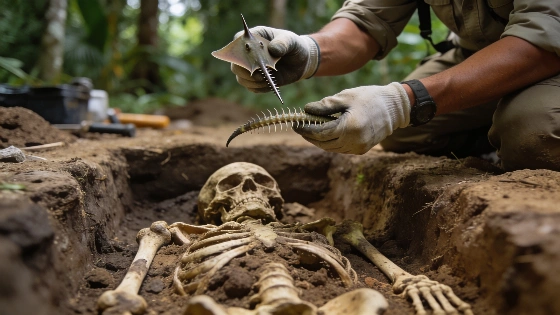
Archaeologists working near Tenosique, Tabasco, have recovered stingray barbs and a catfish spine from ancient Maya burials. Researchers are investigating whether these aquatic animal remains were used in ritual bloodletting or self-sacrifice practices
Stingray barbs and a catfish spine, recovered from ancient burials along the Maya Train construction corridor in southern Mexico, are now at the center of a new investigation into the ritual practices of pre-Columbian Maya communities. The presence of these sharp aquatic animal remains in funerary contexts has prompted researchers to reconsider how Maya elites may have used natural materials in acts of self-sacrifice and religious ceremony.
Excavations conducted in June 2021 near Tenosique, Tabasco, uncovered three stingray barb fragments and a single catfish spine within a three-hectare area associated with the Usumacinta River. All four specimens were found in direct association with human burials, raising the possibility that they served as implements for ritual bloodletting-a practice documented in Maya iconography and texts from at least the Late Preclassic period (c. 500 BCE) through the Postclassic (up to 1520 CE).
Evidence from the burials
The stingray barbs, each measuring several centimeters, display surface polishing and fractures consistent with both sediment pressure and possible handling. One barb fragment, approximately three centimeters long, was found with both ends broken, its surface abraded by contact with surrounding sediment. Another barb and the catfish spine were similarly fractured and polished, with sediment still adhering to their surfaces. The catfish spine, identified as belonging to the freshwater Ictaluridae family, was recovered from a burial containing the remains of an adult male. In contrast, the stingray barbs were identified as coming from saltwater Dasyatidae (whip ray) and Myliobatidae (eagle ray) families.
While stingray barbs are well documented as bloodletting tools in Maya art and archaeological contexts, the deliberate inclusion of a catfish spine is less common. Researchers note that the catfish spine's size and sharpness would have made it physically suitable for piercing skin, but its symbolic significance remains uncertain. The marine origin of the stingray barbs also suggests a connection to Maya beliefs about the underworld, as aquatic materials were often associated with supernatural realms.
Interpreting ritual use
Ritual bloodletting among the ancient Maya involved the controlled drawing of one's own blood, typically as an offering to supernatural beings or as a form of purification before major ceremonies. Iconographic and textual evidence indicates that elite individuals, including rulers and priests, performed these acts by piercing the tongue, penis, earlobes, or fingertips. Blood was sometimes collected on bark paper and burned, with the rising smoke believed to carry the offering to the gods.
The archaeological team, led by Marisol Arce Acosta and Said Amiel Luna Limón, is now analyzing the micro-wear and residue on the recovered spines to determine whether they were used as bloodletting implements or deposited as symbolic offerings. The context of their discovery-directly within burial layers-complicates interpretation, as post-depositional processes such as sediment pressure can mimic use-wear. However, the association of multiple aquatic spines with human remains in a relatively small area strengthens the case for intentional placement.
Material culture and environmental context
Beyond their possible ceremonial function, the aquatic spines highlight how ancient Maya communities exploited both marine and freshwater environments for more than subsistence. Rivers and coastal ecosystems provided not only food but also raw materials for objects with religious or social significance. The presence of both saltwater and freshwater species in the same burial contexts suggests long-distance exchange or the movement of materials across ecological zones.
In total, the four aquatic spines were recovered from a three-hectare area during salvage excavations along the 226-kilometer Section 1 of the Maya Train, which runs from Palenque, Chiapas, to Escárcega, Campeche. The ongoing analysis is part of a broader effort by Mexico's National Institute of Anthropology and History (INAH) to document and interpret archaeological finds made during large-scale infrastructure projects. As Claudia Curiel de Icaza, Secretary of Culture, has emphasized, such discoveries can continue to yield new information long after their initial recovery.
Comparable cases of animal remains in mortuary contexts have been reported elsewhere, including in Central Europe, where animal teeth and bones have been found in Neolithic and Bronze Age burials. For example, a recent find in Poland involved a necklace made from animal teeth, raising similar questions about ritual and symbolic use.
Uncertainty and ongoing research
Despite the suggestive context, researchers caution that the function of the aquatic spines cannot be established with certainty. The possibility remains that some or all of the objects were deposited as grave goods rather than used in bloodletting. Taphonomic processes, including sediment compaction and post-burial disturbance, may have altered the original position and condition of the spines, complicating efforts to distinguish intentional use from accidental association.
Further laboratory analysis, including microscopic examination and residue testing, is underway to clarify whether the spines bear traces of blood or other organic material. Until such evidence is available, the interpretation of these finds as bloodletting implements remains provisional. The case underscores the importance of careful contextual analysis and the limits of inferring ritual behavior from isolated artifacts.
As new discoveries accumulate along the Maya Train route, the challenge for archaeologists is to balance the need for rapid salvage with the demands of rigorous scientific interpretation. The recovery of aquatic animal spines in funerary contexts offers a rare opportunity to investigate the intersection of environment, ritual, and social identity in ancient Mesoamerica. However, without direct evidence of use, claims about bloodletting must remain cautious, grounded in the material record rather than speculation.
Understanding the role of aquatic animal remains in Maya mortuary practice requires attention to both archaeological context and taphonomic processes. Taphonomy refers to the study of how biological and environmental factors affect the preservation and condition of remains after burial. Sediment pressure, water movement, and chemical changes can fracture, polish, or displace objects, sometimes mimicking patterns produced by human use. Careful analysis of wear, residue, and stratigraphic association is essential for distinguishing intentional deposition from post-depositional alteration. Only by integrating taphonomic evidence with contextual data can archaeologists approach a reliable interpretation of ancient ritual behavior.