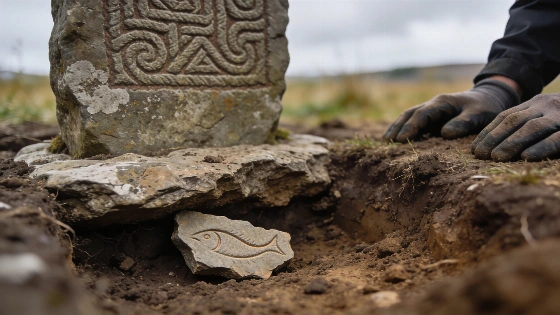
Excavation beneath Aberlemno III found a salmon-like carving reused under its base and a relief-carved human head in surrounding topsoil. Archaeologists also identified two possible earlier stone settings, but the sequence remains uncertain
An incised design interpreted as part of a salmon lay beneath the base stone of Aberlemno III, a Pictish monument in Angus, Scotland. Archaeologists from Historic Environment Scotland (HES) and AOC Archaeology found the fragment wedged beneath the monument, where it had been reused as packing or support material. HES announced the preliminary findings on 5 November 2026.
A separate relief carving depicting part of a human head was recovered from topsoil around the monument. HES described its form and appearance as strongly suggestive of an Early Medieval origin, while noting that further research is needed. The head does not appear to fit the surviving slab of Aberlemno III and has not been linked to a known Pictish monument in the area.
Different contexts
The two carved finds came from different archaeological contexts. The salmon fragment was built into the support beneath the monument, while the head came from surrounding topsoil. They therefore have not been established as parts of the same stone or monument. HES characterized salmon imagery as a recognizable motif in the naturalistic Pictish symbol tradition. The position of the reused fragment indicates that the stone it came from may already have been broken before it was incorporated beneath Aberlemno III; analysis of other excavation finds and samples is expected to help establish when the sequence took place.
The contrast between these find positions is also relevant to reports such as this Celtic burial study, where archaeological context informs interpretation.
Salmon motifs are among the recognizable naturalistic designs in Pictish art. The fragment's reuse provides evidence of an older carved stone being incorporated into a later support beneath Aberlemno III, although its original monument and the date of reuse have not been established. HES said analysis of associated finds and samples will help clarify the chronology.
Earlier positions
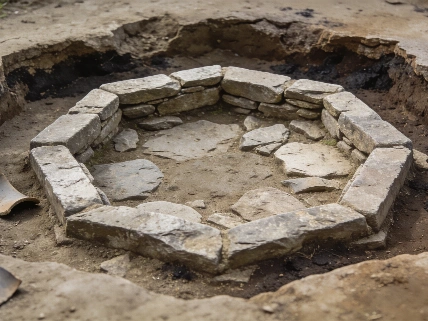
During the excavation, investigators from HES and AOC Archaeology also identified two features beneath the base stone that may have supported standing stones. One could mark an earlier position for Aberlemno III.
If so, the monument may once have stood on a north-south alignment facing Aberlemno Kirk, where another Pictish stone stands. HES's preliminary interpretation is that Aberlemno III probably remained in its original general location but may have fallen or been moved before a later base stone was installed. It may later have been set on an east-west alignment, the conventional orientation associated with Christian monuments. This reconstruction remains preliminary.
In its announcement of the excavation findings, HES said the older carved fragment had been used to prop up the monument. Its position beneath the base indicates that the fragment's original stone may already have been in pieces when the base was added.
Further examination
Stefan North-Sagrott, Senior Cultural Resources Advisor at Historic Environment Scotland, said the excavation raised new questions about both carved finds. He described the evidence as consistent with Aberlemno III remaining approximately in its original location before it fell or was moved and received its later base.
The base stone was transported to Edinburgh for detailed examination. A broken section of Aberlemno III remains embedded in it, and researchers are undertaking post-excavation analysis of the finds and samples to refine the sequence of repositioning and investigate how the older salmon-carved fragment came to be used beneath the monument. HES has also said it remains uncertain how the carved head relates to the monument or the other discoveries.