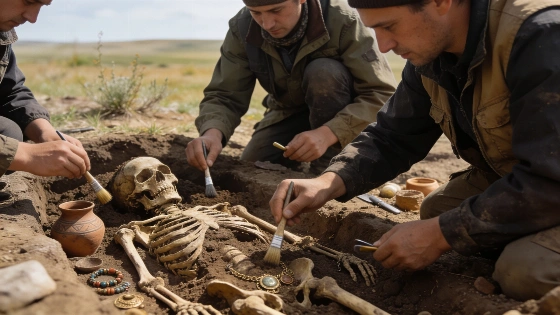
Recent excavations in Kazakhstan have uncovered Bronze Age and medieval burials, artifacts, and evidence of long-distance trade, offering new insight into the region's prehistoric communities and their connections across Eurasia
Archaeological research across Kazakhstan is providing new evidence for the complexity of prehistoric and medieval societies on the Eurasian steppe. Recent excavations have documented a range of sites, from Bronze Age burial grounds to medieval settlements, revealing patterns of social organization, ritual practice, and long-distance exchange.
Bronze Age Burial at Aleksejevka
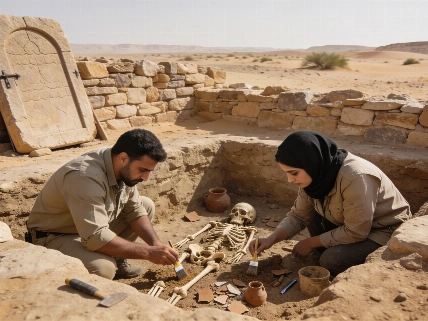
At the Aleksejevka archaeological complex near Rudny in the Kostanay region, researchers have excavated a burial ground, a sacrificial mound, and a settlement attributed to the Andronovo culture, dated to around 1500 BCE. Among the most notable finds is the burial of a tall adult individual, estimated to have stood nearly two meters in life, positioned at the center of the cemetery. Most other individuals recovered from the site measured between 1.30 and 1.40 meters in height. The central placement and associated grave goods, including jewelry of bronze, silver, and gold, suggest a person of significant social status, though the precise nature of that status remains uncertain.
Material from the burial was examined in Moscow, where a facial reconstruction was produced by anthropologist Mikhail Gerasimov. While such reconstructions can provide a sense of individual appearance, they remain interpretive and depend on both skeletal preservation and methodological choices. The Aleksejevka site also yielded a nine-meter-high mound containing traces of ritual food offerings, providing rare evidence for ceremonial practices and diet during the Bronze Age.
Monumental Earthworks and Medieval Trade
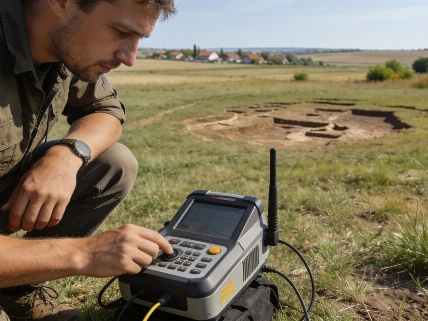
Elsewhere in the Kostanay region, archaeologists are documenting the Turgai geoglyphs-large-scale earthworks whose construction and function remain under investigation. The project involves digital mapping and recording, with the aim of nominating the sites for UNESCO World Heritage status. These efforts are part of a broader trend in Eurasian archaeology, where remote sensing and digital documentation are increasingly used to preserve and interpret monumental landscapes.
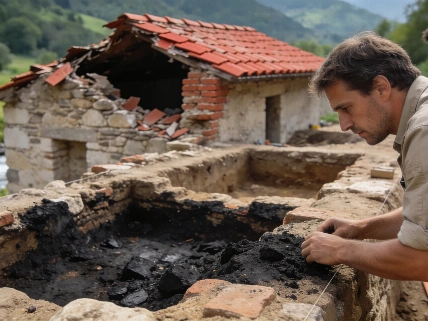
In the Akmola region, excavations led by Margulan University have uncovered fired brick fragments interpreted as possible remains of palatial or funerary architecture from the Golden Horde period, dating to the 14th and 15th centuries CE. The evidence is preliminary, and further analysis is needed to clarify the function and chronology of these structures.
Evidence for Long-Distance Exchange
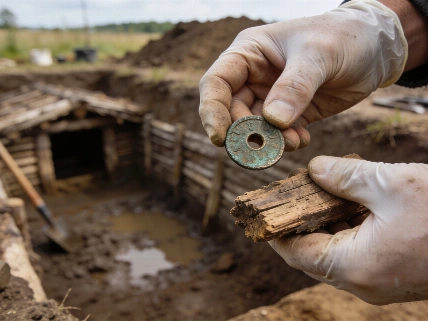
Several sites in Kazakhstan have produced artifacts indicating connections with distant regions. At some medieval contexts, cowrie shells originating from the Indian Ocean have been recovered, suggesting trade links between the Eurasian steppe and South Asia. On the Caspian Sea coast, the settlement of Karakabak has yielded more than 150 coins issued by the Byzantine Empire, the Sassanian Empire, and Imperial China, dating from the first to sixth centuries CE. The diversity of coinage supports the interpretation of Karakabak as a significant trading center, though its identification with the historically attested post of Aspabota remains unconfirmed.
These findings echo patterns seen elsewhere in Eurasia, where archaeological evidence demonstrates the movement of goods, people, and ideas across vast distances. For example, research at Qattarah Necropolis in the United Arab Emirates has shown that communal tombs were used over extended periods, with isotope and ancient DNA analysis clarifying population origins and burial practices (see related research on long-term tomb use in the UAE).
Integrating New Methods and Heritage Protection
The discoveries in Kazakhstan are part of a larger program combining traditional excavation with digital survey and documentation. This integrated approach aims to protect archaeological heritage while expanding the evidence base for understanding Eurasian prehistory and medieval history. Ongoing research will be needed to clarify the chronology, function, and broader significance of these sites, as well as to address questions of preservation, sampling bias, and interpretation.
Across the region, more than 150 coins, multiple burial grounds, and monumental earthworks have been documented in recent field seasons. The chronological range of the material spans from the Bronze Age (c. 1500 BCE) through the medieval period (up to the 15th century CE), with evidence for both local development and external connections. The scale and diversity of the finds highlight the importance of the Eurasian steppe as a zone of interaction rather than isolation.
Understanding the archaeological context of these discoveries depends on careful documentation of site stratigraphy, artifact association, and dating methods. Stratigraphy-the study of layered deposits-allows archaeologists to reconstruct the sequence of events at a site, distinguishing primary burials or constructions from later disturbance or reuse. Secure stratigraphic context is essential for interpreting the meaning of artifacts, burials, and architectural remains, and for establishing reliable chronological frameworks. Without it, the evidential value of even spectacular finds is limited, and interpretations must remain provisional.