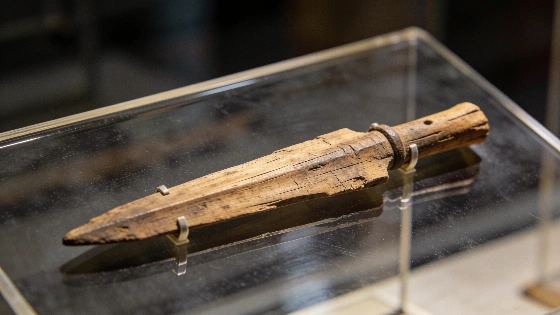
Archaeologists have identified several contenders for the world's oldest weapon, including wooden spears and stone points from sites in Africa and Europe. Careful analysis of context, material, and wear patterns helps distinguish weapons from other ancient tools
Archaeological research into the origins of weaponry has revealed a complex record stretching back at least 400,000 years, with several key finds offering insight into how early hominins hunted and interacted with their environment. The identification of the oldest weapons relies not only on the objects themselves but also on the context in which they were found, the materials used, and the traces of use preserved on their surfaces.
Clacton Spear and Early Wooden Weapons
One of the most securely dated early weapons is the Clacton spear, a worked yew wood point excavated in 1911 from Clacton-on-Sea, Essex, England. Measuring approximately 37 centimeters in length, this artifact is estimated to be over 400,000 years old based on stratigraphic context and associated fauna. The spear point is believed to be a fragment of a longer shaft, possibly broken during use or as part of a deliberate act. Its manufacture is attributed to either Homo heidelbergensis or Neanderthals, both of whom predate Homo sapiens. The Clacton spear is currently housed at London's Natural History Museum and is considered the oldest preserved wooden spear fragment yet recovered.
Analysis of the Clacton spear's shape and wear suggests it was designed for thrusting, likely used in cooperative hunting strategies. The absence of the complete shaft limits interpretation, but the artifact's context and craftsmanship provide strong evidence for its use as a weapon rather than a simple tool.
Schöningen Spears and Throwing Sticks
Further evidence of early weaponry comes from the Schöningen site in Germany, where between 20 and 25 wooden weapons-including complete spears and throwing sticks-have been excavated since 1992. These artifacts, made primarily from spruce and pine, are dated to between 200,000 and 300,000 years ago, with some recent studies suggesting a possible Neanderthal association. The Schöningen spears, averaging just over 2 meters in length, are the oldest completely preserved wooden weapons known. Their association with butchered horse remains supports their interpretation as hunting weapons, used for both thrusting and throwing.
The shorter throwing sticks from Schöningen, averaging around 65 centimeters, are interpreted as projectile weapons. The manufacturing process involved sharpening, hardening, and blackening the wood with fire, indicating a sophisticated understanding of materials and hunting tactics. The context of these finds demonstrates that early hominins adapted their weapon use to different prey and distances, reflecting complex behavioral strategies.
Kathu Pan 1 Stone Points and the Limits of Preservation
In southern Africa, the Kathu Pan 1 site has yielded stone points dated to approximately 500,000 years ago. These points show edge wear and base shapes consistent with hafting onto wooden shafts, suggesting their use as spear tips. However, no wooden components have survived, and the interpretation of these artifacts as weapons remains debated. Some researchers argue that the evidence is indirect or controversial, as the stone points could also have served as cutting tools. The age of the Kathu Pan 1 points predates both Neanderthals and Homo sapiens, raising questions about the technological capabilities of Homo heidelbergensis in this region.
The preservation of organic materials such as wood, sinew, and adhesives is rare in the archaeological record, especially for periods this remote. As a result, the earliest weapons may never be identified if they were made entirely from perishable materials. This preservation bias means that the archaeological record likely underrepresents the true antiquity and diversity of early weapon use.
Context, Interpretation, and Uncertainty
Archaeologists distinguish weapons from other tools by examining context, manufacturing traces, and use-wear patterns. Evidence such as butchered animal bones, residue analysis, and microscopic wear can support the interpretation of an object as a weapon. However, intent and function are not always clear, and alternative explanations must be considered. For example, the absence of associated wooden shafts at Kathu Pan 1 complicates the identification of stone points as spear tips.
Among the major contenders, the Clacton spear remains the most widely accepted example of the world's oldest preserved weapon, due to its secure context and direct evidence of manufacture. The Schöningen spears and Kathu Pan 1 points expand the range of possible early weapons but also highlight the challenges of preservation and interpretation. The archaeological record is shaped by what survives, and many early weapons-especially those made from organic materials-may have disappeared entirely.
Research into ancient weaponry continues to inform our understanding of early hominin behavior, cooperation, and technological innovation. The careful distinction between direct evidence and interpretation is essential, as demonstrated in other studies of ancient weapon use, such as the analysis of Iron Age burial practices involving swords and social roles at Bois Médor in France (see this related investigation).
Understanding the identification of ancient weapons requires familiarity with taphonomy-the study of how organic and inorganic materials decay and are preserved in the archaeological record. Taphonomic processes such as soil acidity, microbial activity, and environmental conditions can destroy wood, sinew, and other organic components, leaving only the most durable artifacts behind. This preservation bias means that the absence of evidence is not evidence of absence, and interpretations must always account for what may have been lost to time.