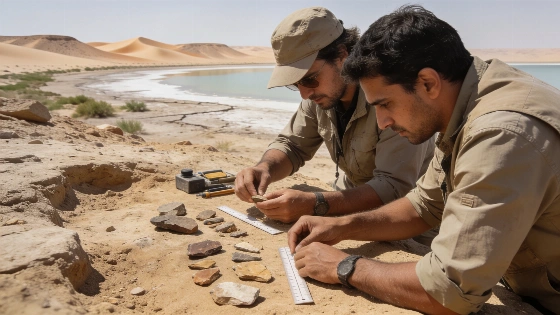
Archaeologists have identified stone tools from Jebel Katefeh-1 in Saudi Arabia's Nefud Desert that closely match Neanderthal technology, suggesting these hominins may have adapted to arid environments far south of their previously known range
Archaeological research at Jebel Katefeh-1 (JKF-1), a site beside an ancient lake in Saudi Arabia's Nefud Desert, has produced evidence that Neanderthals may have occupied the Arabian interior around 55,000 years ago. The study, published in Quaternary Science Reviews, centers on a collection of stone tools whose technological features align more closely with Neanderthal industries than with those of Homo sapiens. This finding challenges the long-standing view that Neanderthals were confined to colder, more temperate regions of Eurasia.
Identifying the Toolmakers
The JKF-1 assemblage includes hundreds of stone flakes and cores, many produced using the Levallois technique-a method associated with Neanderthals in Europe and western Asia. Researchers compared the JKF-1 tools with assemblages from Arabia, the Levant, and northeast Africa, where the makers' identities are better established. Using statistical models to analyze flake shape and production methods, the team found that the JKF-1 and nearby ALM-3 sites were far more likely to have been created by Neanderthals than by Homo sapiens.
No Neanderthal skeletal remains or ancient DNA have been recovered from Arabia, complicating direct attribution. Instead, the identification relies on technological signatures in the stone tools. The absence of bones is not unexpected, as the region's arid climate is unfavorable for the preservation of organic material. In this context, lithic analysis provides the primary window into past hominin presence.
Dating the Occupation
To establish the age of the JKF-1 occupation, researchers excavated a new trench and applied optically stimulated luminescence (OSL) dating to sand grains from the archaeological layer. OSL measures the last time sediment was exposed to sunlight, providing a direct date for the context in which the tools were found. The results indicate that the tools were deposited around 55,000 years ago, during a period when the desert was transitioning to a wetter phase and a nearby lake was refilling.
Previous work had placed the tools within a broader range of 90,000 to 50,000 years ago, but the new OSL dates narrow this window considerably. At this time, Neanderthals are thought to have been the only hominin group present in southwest Asia, strengthening the case for their involvement at JKF-1. However, the lack of skeletal evidence means the attribution remains provisional.
Environmental Adaptation and Uncertainty
The timing of the JKF-1 occupation coincides with a shift from arid to humid conditions in northern Arabia. This environmental change may have drawn grazing animals into the region, providing a resource base for mobile hunter-gatherers. The presence of Neanderthal-style tools in this context suggests that these hominins were capable of adapting to open, arid landscapes, not just the cold environments of Ice Age Europe.
Despite the compelling technological evidence, some archaeologists urge caution. The comparative sites used in the statistical model include surface collections, where artifacts may have accumulated over long periods rather than representing a single occupation. Without Neanderthal bones or DNA, the case for their presence in Arabia remains circumstantial. As with other discoveries based on material culture, alternative explanations-such as convergent technological development by Homo sapiens-cannot be entirely excluded.
Comparative Perspectives
The JKF-1 findings add to a growing body of research that places Neanderthals far beyond their traditional range. Previous discoveries have documented Neanderthal presence in Siberia and the Middle East, and now, potentially, in the Arabian Peninsula. This pattern of dispersal highlights the ecological flexibility of late Pleistocene hominins. For comparison, studies of ancient construction systems in North Africa, such as the analysis of carved marks on the Tauchira Gate at Ptolemais, Libya, have also relied on material evidence to reconstruct past behaviors and movements, as discussed in this investigation of Hellenistic building practices.
For now, the strongest evidence for Neanderthal activity in Arabia comes from stone tools, with the hope that future discoveries-perhaps of skeletal remains or preserved DNA-will provide more definitive answers. Until then, the JKF-1 assemblage stands as a significant, if provisional, marker of Neanderthal adaptability and range.
Understanding how archaeologists attribute stone tools to specific hominin groups requires careful analysis of manufacturing techniques, raw material selection, and flake morphology. The Levallois technique, for example, involves preparing a stone core in a way that allows the removal of flakes with predetermined shapes. While this method is strongly associated with Neanderthals in many regions, it was also used by some populations of Homo sapiens. As a result, technological attribution must be supported by robust comparative data and, ideally, by direct association with skeletal remains. In regions where organic preservation is poor, as in much of Arabia, lithic analysis remains the primary tool for reconstructing hominin presence and behavior.