Archaeologists have uncovered a 2,400-year-old iron sword placed beside a child's remains at the Bois Médor site in central France, offering new evidence about burial customs and social roles in Iron Age Gaul
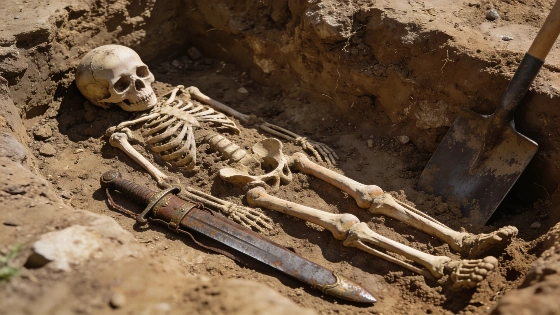
An Iron Age burial discovered at the Bois Médor site in Pithiviers, Loiret, central France, is providing archaeologists with rare evidence of how children were treated in Gaulish society more than 2,400 years ago. During excavations led by the French National Institute for Preventive Archaeological Research (Inrap), researchers identified a child's skeleton accompanied by an iron sword, a fibula, and possible shield fragments. The burial, dated to the late fifth century BCE based on stratigraphic context and associated material, stands out for its combination of age, grave goods, and location within a repurposed storage silo.
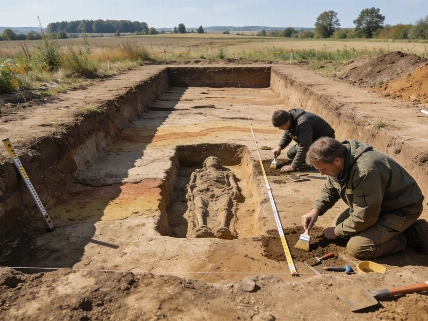
The excavation, conducted in 2010 ahead of infrastructure development, revealed a large settlement with multiple silos that had been reused as refuse pits and, in some cases, burial sites. Across three silos, archaeologists documented the remains of six individuals in four separate deposits. Several burials displayed unusual body positions or evidence of postmortem manipulation, including one individual with bound limbs and a separated skull. The child's burial, however, was notable for the presence of a complete iron sword in its scabbard, placed beside the legs rather than worn or held.
Burial Context and Material Evidence
The child, estimated to be under 15 years old at death, was found curled against the edge of the pit. The associated sword is of standard Iron Age form and size but is among the oldest such weapons recovered from the Loiret region. Its undecorated scabbard is atypical for the period, as most contemporary examples feature ornamentation. The presence of a fibula and possible shield fragments further complicates interpretation, as these items are rarely found with juvenile burials in Iron Age contexts.
In total, the site yielded six individuals from three silos, with the child's grave representing the only case where a weapon was included. The sword's placement-beside the legs rather than as if worn-raises questions about its intended meaning. The absence of other weapons and the plain scabbard have led researchers to consider whether the sword was a symbolic object, a marker of intended social role, or a reflection of incomplete martial training due to the child's age.
Interpretation and Uncertainty
Burials of children with weapons are exceptionally rare in Iron Age Europe, even in formal cemeteries. The combination of a juvenile skeleton, military equipment, and an unconventional burial setting within a former storage silo makes this case particularly unusual. While the inclusion of a sword might suggest the child was viewed as a potential or actual warrior, the evidence does not confirm the individual's social status or role. The undecorated scabbard and lack of additional weaponry may indicate a symbolic rather than practical association with martial identity.
Alternative interpretations remain possible. The sword could have served as a grave offering unrelated to the child's personal status, or it may reflect broader ritual or social practices within the community. The manipulation of other bodies at the site, including prone positioning and binding, suggests a complex mortuary landscape that resists simple explanation. Without direct evidence of cause of death or social identity, the meaning of the burial remains open to further investigation.
Chronology and Research Status
The Bois Médor site is dated to the fifth and fourth centuries BCE, with the child's burial assigned to the end of the fifth century BCE based on stratigraphic association and artifact typology. No direct radiocarbon dates for the individual or associated materials have been reported in the available documentation. The excavation forms part of Inrap's broader research into Iron Age Gaul, with ongoing analysis aimed at clarifying the social and ritual significance of such burials. As reported by HeritageDaily, the find highlights the diversity of funerary practices and the challenges of interpreting isolated cases within broader archaeological frameworks.
In mortuary archaeology, the context of a burial-including body position, associated objects, and location-provides critical information for interpreting past social roles and beliefs. However, the presence of weapons in a child's grave does not automatically indicate achieved status or occupation. Archaeologists must consider the possibility of symbolic offerings, community-level ritual, and the limitations imposed by preservation and sampling. The Bois Médor burial underscores the importance of context and the need for cautious interpretation when reconstructing the lives and identities of individuals in the archaeological record.