Archaeologists analyzed a 3,400-year-old wooden folding chair from a Danish burial mound using material analysis and contextual dating, revealing its role as a rare status object in Bronze Age Europe
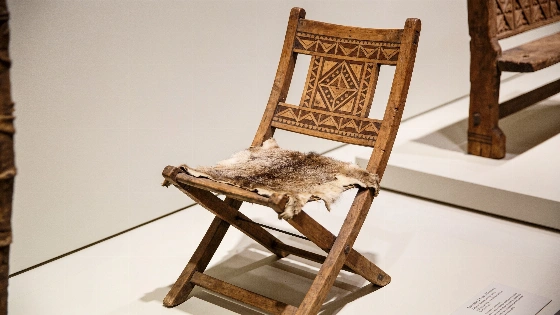
When the Guldhøj burial mound in southern Jutland was excavated in 1891, archaeologists encountered an anomaly: a wooden folding chair, remarkably intact after more than three millennia underground. Unlike the fragmentary remains typical of organic artifacts from this period, the Guldhøj chair survived as the only completely preserved wooden folding chair from Bronze Age Europe, offering a rare opportunity to examine elite material culture in direct archaeological context.
The Guldhøj Burial Context
The chair was recovered from a burial identified as that of a high-status adult, interred within a hollowed oak trunk and wrapped in cowhide. The individual was dressed in woolen garments, including a cloak, two hats, mittens, and leather shoes, and accompanied by grave goods such as a bronze axe, a bronze dagger, two decorated wooden bowls, and a wooden box. The folding chair, however, stands out for both its preservation and its interpretive significance.
Material analysis determined that the chair's frame was constructed from ash wood, with a seat originally made from otter skin-only a small fragment of which survived. The wooden frame, measuring approximately 33 centimeters in height, was decorated with geometric patterns inlaid with a black, tar-like substance. When assembled, the chair would have stood about 24 centimeters off the ground, functioning as a low seat or stool. The original construction likely used bronze nails, though these may have been removed before burial.
Evidence for Status and Exchange
Folding chairs of this type are rare in the archaeological record of northern Europe, but similar forms are known from Bronze Age Egypt and Greece, where arid conditions favor organic preservation. The Guldhøj chair's design closely parallels Mediterranean examples, suggesting that ideas and possibly objects circulated between distant regions through trade or gift exchange. The presence of such a chair in a Danish burial indicates that the object was not merely utilitarian but carried symbolic weight, likely marking the deceased's social position.
Other fragmentary folding chairs have been recovered from elite burials in Denmark and northern Germany, and a rare metal folding chair was found in an early medieval grave in Germany. However, the Guldhøj chair remains unique for its completeness and preservation. Researchers have argued that folding chairs in this context functioned as status symbols, reserved for individuals of high rank and possibly used in ceremonial or ritual settings.
Preservation and Analytical Limitations
The survival of the Guldhøj chair is exceptional given the acidic soils and humid climate of northern Europe, which typically destroy organic materials. Its preservation is attributed to the waterlogged conditions within the oak coffin, which created an anaerobic environment that slowed decomposition. This rare preservation allows for detailed study of woodworking techniques, decorative practices, and the selection of animal skins for seating, but it also highlights the limitations of the archaeological record: most similar objects have not survived, and interpretations must be cautious about generalizing from a single find.
Chronological placement of the burial relies on typological dating of associated bronze objects and comparative analysis with other Early Bronze Age graves in the region, placing the chair's manufacture and deposition around 1400 BCE. No direct radiocarbon date for the chair itself has been published, but the context is consistent with the broader pattern of elite burials from this period.
The Guldhøj chair's significance is amplified by its rarity and the insight it provides into Bronze Age social structures. As with the reported earlier discovery of a gold diadem in Crimea, the presence of distinctive grave goods in elite burials can illuminate patterns of status, exchange, and cultural connection across ancient Europe. However, the interpretive value of such finds depends on secure archaeological context and careful analysis of preservation bias.
The Guldhøj folding chair demonstrates that Bronze Age elites in northern Europe participated in broader networks of symbolic and material exchange, adopting and adapting objects that signaled authority and distinction. While the chair's Mediterranean parallels suggest long-distance connections, the evidence does not establish direct contact or the movement of people. Instead, it points to the selective adoption of prestigious forms, filtered through local traditions and available materials. The chair's survival is a product of both ancient choices and rare taphonomic luck, reminding us that the archaeological record is shaped as much by preservation as by past behavior.
Understanding the preservation of organic artifacts like the Guldhøj chair requires attention to taphonomy-the study of processes affecting remains after deposition. Waterlogged environments, such as those created by oak coffins in burial mounds, can exclude oxygen and inhibit microbial decay, allowing wood, leather, and textiles to survive for millennia. However, such conditions are exceptional, and most organic materials from the Bronze Age have been lost. This preservation bias means that our knowledge of ancient furniture, clothing, and other perishable objects is fragmentary, and interpretations must account for what is missing as well as what is found.