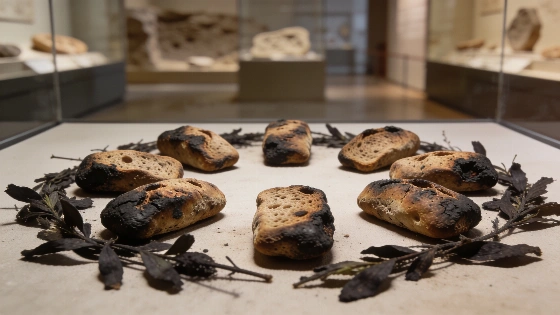
A collapsed shelf left eight carbonized loaves beside wheat and lentils in a burned room at Seyitömer Mound. Their context offers evidence of food storage around 5,000 years ago
Eight carbonized loaves lay between the supports of a collapsed shelf in a room with an oven at Seyitömer Mound in Türkiye. Wheat and lentil remains were scattered nearby, preserving a small but unusually clear record of food kept inside the building before a fire destroyed it.
The finds date to the first quarter of the Early Bronze Age, around 5,000 years ago. Their position helps archaeologists reconstruct how food may have been stored, though it cannot establish exactly how the loaves were made or what ingredients they contained.
Food beneath the shelf
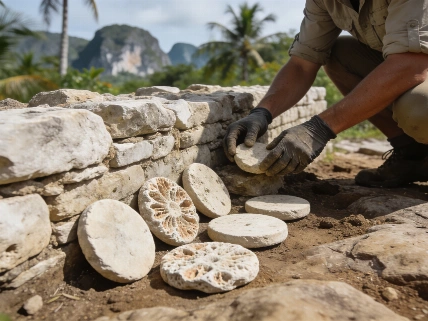
The room was uncovered during rescue excavations in Kütahya Province led by Sevgi Gürdal, director of the Kütahya Museum. Investigators found an oven and traces of shelving along a wall. The eight loaves were among the remains between the shelf supports, with wheat and lentils around them. Gürdal described finding the charred bread in the oven area, between the shelf supports, and reported wheat and lentil remains nearby in an Anadolu Agency interview.
Gürdal's account of the excavation links the bread and crops to storage on the shelf, possibly in sacks or bags. The interpretation fits the collapsed shelving and the distribution of the finds. It remains a reconstruction: the material does not reveal the containers' exact form or prove how each item was used.
Fire destroyed the room but also carbonized some of its organic contents. Carbonization can make plant material less vulnerable to biological decay, allowing remains that would ordinarily disappear to survive in the archaeological record. Here, the bread and crops were preserved together in the room where they had been stored.
What the remains show
Plant remains can identify foods present at a site, while the loaves add evidence that bread had been prepared. Their association with wheat and lentils shows these foods were present in the same space when the building burned. It does not, by itself, establish the community's broader diet or how often people ate them.
Substantially preserved loaves can potentially retain clues about ingredients, grain processing and preparation. The excavation account does not report detailed analyses of the Seyitömer bread, so those questions remain open. The finds establish the presence of bread alongside wheat and lentils in the room.
Other archaeological finds can offer different kinds of evidence about past communities. Science Report has covered how Black Sea shell ornaments at Kostenki 14 may point to connections across Eastern Europe.
Site and collection
Seyitömer Mound lies about 26 kilometers from central Kütahya. Its archaeological deposits extend back to approximately 3000 BC. The mound was about 26 meters high, 140 meters wide and 150 meters long before excavation.
Rescue excavations began in 1989 because lignite reserves lay beneath the site. The Eskişehir Museum Directorate initially carried out the work, followed by the Afyonkarahisar Museum Directorate between 1990 and 1995. Kütahya Dumlupınar University's Department of Archaeology excavated there from 2006 to 2014; the Kütahya Museum Directorate took responsibility in 2019. The longer excavation history provides the backdrop to the later work on Early and Middle Bronze Age layers, including the room where the bread was recovered.
A 2023 report said the loaves and associated plant remains were on display at the Kütahya Archaeology and Mining Museum. The bread, wheat and lentil remains have also been reported as exhibited together. More than 17,000 artifacts from earlier excavations at Seyitömer Mound had also been transferred to the museum.