NASA has awarded five teams a combined $650,000 for proposed food systems designed to support 15 astronauts across 500 Martian sols while reducing dependence on meals shipped from Earth.
NASA has selected five proposed food systems for a Mars mission scenario in which astronauts would need more than a year of surface meals without relying entirely on supplies launched from Earth. The winning concepts treat food as an integrated life-support operation rather than a collection of separate technologies.
The winning designs
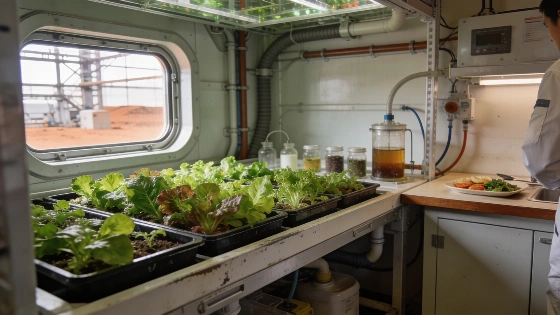
The top award of $300,000 went to Chinyere Ukeje of Philadelphia for Adaptive Nourishment Infrastructure, or ANI. The concept combines controlled-environment agriculture, fermentation, fungi cultivation and closed-loop nutrient recycling through bioreactors with a limited stock of Earth-provided food.
ANI is designed to produce 50% of the crew's food away from Earth while preparing fresh meals daily. Its proposed operating model also accounts for interruptions involving power, water, equipment or crew time. That is a systems-engineering claim rather than a demonstration that the design is ready for deployment.
Cislune of Rosemead, California, received the $200,000 second-place prize for Fresh, Ferment, Reserve. Its proposal would grow selected crops, convert part of the harvest into familiar foods using instrumented culture cassettes and keep an Earth-loaded reserve for biological variability, utility restrictions or rejected batches.
A mission built around scarcity
The challenge used a demanding scenario: a crew of 15 astronauts operating on Mars for 500 Martian sols, equivalent to about 513 Earth days. Teams submitted a design layout, meal plan, concept of operations and walkthrough video, forcing them to connect production, processing, storage and crew workload in one operational picture.
That scenario exposes why conventional space meals cannot simply be scaled up for Mars. Astronaut food is currently cooked, packaged and sent largely from NASA's Space Food Systems Laboratory at Johnson Space Center to the International Space Station. A one-way journey to Mars would take at least nine months, while shelf stability and mass limits make a fully packaged diet a poor default for a long surface mission.
The practical challenge is therefore not merely growing plants. A Mars food system would have to deliver variety, nutrition and safety while operating with restricted resources and limited crew attention. The proposals address that problem at the architecture level, but the available material provides no test results showing how any design performs in a Mars-like environment.
Research connected to NASA's broader deep-space food effort illustrates the same emphasis on resource efficiency. A recent report describes NASA-backed "µBites" cookies made using plastic waste as an exploratory approach to supplying nutrients in resource-limited missions and other extreme environments; it remains a research direction, not evidence that plastic waste can already provide a complete astronaut diet. The concept is discussed in a recent science report.
Five awards and one international winner
NASA judged 113 submissions from teams in 33 countries and 28 U.S. states and awarded $650,000 across five winning teams. Alongside ANI and Cislune, Ohā Kanu of Hilo, Hawaii, received the $50,000 Applied Frameworks Award for ʻOhā Kanu: An Ahupuaʻa-Inspired Food System for Mars. Orbital Health Systems, Inc. of Evansville, Indiana, won the $50,000 Mission Simulation Award for New Lunar Settlers Cookbook (Mars Edition).
Autonomic Resilience Collective of Bentonville, Arkansas, received the $50,000 Human-Centered Design Award for Adaptive Endurance and Growth through Integrated Sustenance, or AEGIS Mars. NASA also recognized Astrofood of Ellezelles, Belgium, for Food Resilience Ecosystem for Space Habitats, or FRESH, as the international winner.
The competition launched in January 2026 as a follow-on to NASA's earlier Deep Space Food Challenge, conducted with the Canadian Space Agency. The earlier program emphasized prototyped food-production methods, whereas the Mars-focused round shifted attention to complete operating systems. That distinction matters: a promising crop or fermentation process does not by itself solve storage, failures, crew scheduling or meal planning. In the same way that NASA transport planning must account for more than a rocket, food architecture must account for the full mission chain.
What the designs show
NASA program manager Jennifer Edmunson said the challenge was intended to identify ingenuity for future space food systems, while head judge Dr. Alexander Meyers emphasized the complexity of integrating them. Those assessments describe the purpose of the competition, not independent validation of the winning concepts.
The strongest result is the reframing itself. Feeding a Mars crew is a logistics problem, a biological production problem and a human-factors problem at once. The five concepts give NASA structured options for studying those interactions, but they remain proposed designs rather than operational hardware, tested mission systems or proof that half of a crew's food can be produced reliably on Mars.
NASA manages Mars to Table through Centennial Challenges at Marshall Space Flight Center, with support from several agency divisions and subject-matter experts at Johnson and Kennedy. The Methuselah Foundation and Floor23 Digital support administration of the challenge. Its immediate value is exploratory: it turns an unavoidable Mars-mission constraint into specific system architectures that can be evaluated, refined and tested.
The scientific questions extend beyond crop yield. Researchers would need to characterize microbial contamination, nutrient stability, plant stress, fermentation control and the effects of repeated processing under altered gravity and radiation conditions. Findings published in journals such as Nature and Science could help establish benchmarks for biological performance, but the challenge announcement itself does not report peer-reviewed experiments, sample sizes, statistical significance or confidence intervals for the proposed systems.
A Martian food system is not validated by an attractive meal plan or a clever biological component; it is validated by sustained performance under resource failure, contamination risk, maintenance limits and crew pressure. On the evidence provided, NASA's awards identify credible directions for that engineering work, not a finished solution. That is still a meaningful outcome because long-duration exploration will require food production to be designed as mission infrastructure rather than treated as cargo.
In this context, a Martian sol is a local day used to describe surface operations on Mars, and the challenge's 500-sol scenario is a planning framework rather than a report of an actual mission. The equivalent 513 Earth days shows the duration of the food burden the concepts were asked to address. It does not establish that any winning system can yet operate for that period. The distinction between a mission scenario and a demonstrated system is central to judging what NASA's announcement actually shows.