A humanoid robot called GEAIR 2.0 has been demonstrated in Beijing performing autonomous hybrid pollination of tomato flowers. The system aims to reduce manual labor in crop breeding by combining robotics, AI, and gene editing in real greenhouse conditions.
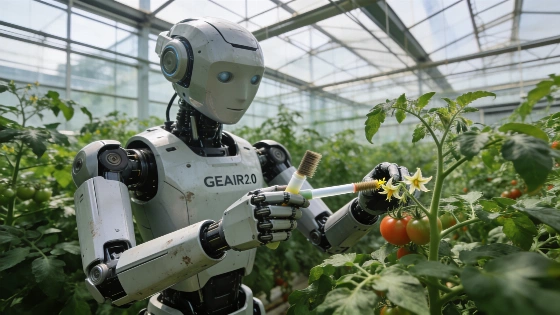
At the 33rd China Beijing Seed Industry Conference, held September 5-9, 2026, the humanoid robot GEAIR 2.0 was shown pollinating tomato flowers on its own. The robot was developed by the Institute of Genetics and Developmental Biology at the Chinese Academy of Sciences, led by Xu Cao. GEAIR 2.0 is part of a push to bring robotics and artificial intelligence into crop breeding. The event featured more than 600 agrotechnology solutions, and official reports say over 90% of breeding operations in Beijing now use AI-driven tools.
GEAIR 2.0 uses a dual-arm design, replacing the earlier flexible manipulator setup. With two arms, the robot can hold a pollen tube in one hand and a pollination brush in the other, making the process more efficient. During the demonstration, GEAIR 2.0 reached a stigma-recognition accuracy of 92.8%, up from 85% in previous versions, according to official and party media. Each pollen brush load was enough for about 50 pollinations before needing a refill, and the robot completed each pollination in under ten seconds per flower. These results were achieved in a real greenhouse, not just in a lab.
The approach, described in Chinese government and university publications as "crop-robot co-design," involves genetically modifying plants so their reproductive organs are easier for robots to access. This means the robot does not need to open petals by hand and can move through crop rows, avoid leaves and branches, and target exposed stigmas with precision. Xu Cao said GEAIR 2.0 was built to handle obstacles like foliage and flowers facing different directions, allowing it to work around the clock and find pollination targets on its own. The project follows global trends in agricultural robotics, with similar research at places like MIT and in journals such as Nature and Cell.
Hybrid pollination is usually labor-intensive and must be done quickly, often requiring large teams. Automating this step with GEAIR 2.0 could help address labor shortages and improve consistency in large-scale breeding. In Beijing, the robot's efficiency was compared to manual pollination and found to be similar in controlled trials. However, it is not yet clear how much human oversight is needed for long-term use or how reliable the system is with different crops. The demonstration did not include peer-reviewed field trial data, and moving from prototype to regular use will require more testing, as is standard in agricultural robotics research published in journals like Science and PNAS.
China's broader plan to modernize agriculture with AI and robotics is tied to its food production goals, with grain output reaching 715 million tons in 2025 and more growth planned by 2030. GEAIR 2.0 shows that automating hybrid pollination is technically possible, but wider adoption will depend on consistent performance, clear safety protocols, and how well the system fits into existing breeding routines. Other efforts to automate complex farm tasks have faced similar hurdles, as discussed in previous Science Report coverage of mobile robots in unpredictable environments.
Robots working in agriculture face different challenges than those in factories. Greenhouses and fields are unpredictable, with changing light, irregular plant shapes, and unexpected obstacles. For GEAIR 2.0, perception means using cameras and sensors to find flowers, locate small reproductive organs, and plan precise movements. Leaves can block the view, sensors can pick up noise, and the environment can change quickly, so the system needs strong computer vision and adaptive controls. Reliability depends on both the hardware and software, as well as how much human supervision is involved and how well the robot can handle problems in the field. For more on the state of agricultural robotics, see this Nature Plants review.