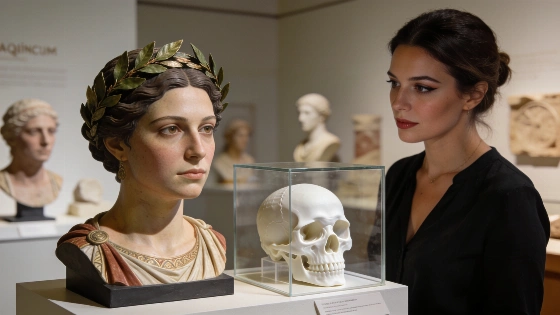
Researchers used DNA analysis, 3D-printed skulls, and forensic modeling to reconstruct the faces of 16 individuals buried near the Roman frontier city of Aquincum, offering new insights into population diversity and daily life nearly 1,700 years ago
Sixteen individuals who lived near the Roman frontier city of Aquincum, in present-day Budapest, have been the focus of a new exhibition that combines archaeological, genetic, and forensic evidence to reconstruct their faces. The project, hosted at the Aquincum Museum, draws on high-resolution CT scans, 3D-printed replicas of excavated skulls, and ancient DNA analysis to create scientifically informed models of people who died nearly 1,700 years ago. These reconstructions, which include men, women, and a child, aim to bridge the gap between skeletal remains and the lived experiences of individuals from the Roman period in the region.
Archaeological and Genetic Evidence
Aquincum was a significant settlement on the Danube frontier of the Roman Empire, inhabited from the first to the fourth centuries CE. Archaeological excavations in and around the city have uncovered cemeteries containing well-preserved human remains, along with associated grave goods such as clothing, sandals, and personal items. Genetic and archaeological analyses indicate that the population was diverse, with ancestry components linked to present-day Italy, Scotland, Syria, Sarmatian groups from the Eurasian steppe, and local Celtic communities predating Roman rule. Ancient DNA analysis has provided additional information about probable pigmentation, including likely eye, hair, and skin color, though these reconstructions remain approximations rather than exact portraits.
The process of facial reconstruction begins with a CT scan of the original skull, followed by the creation of a 3D-printed replica. Forensic specialists then use these models to build up facial features, sometimes producing hyperrealistic silicone faces finished with human hair and other details. This approach allows researchers to work without repeated handling of fragile ancient remains and incorporates the latest advances in imaging and genetic analysis. The exhibition features six hyperrealistic silicone models and ten additional reconstructions, each representing a different individual from the Roman-era population.
Burial Contexts and Social Diversity
Among the reconstructed individuals is a young woman buried with a laurel wreath, elaborate clothing, and distinctive cork sandals. Her grave also contained a spindle for weaving and a painted male portrait, possibly representing a relative. The preservation of her skeleton allowed for detailed facial reconstruction, though the soft tissues had decayed. Other individuals include a young girl who died in childhood, a woman interpreted as a nurse or healer buried in a children's cemetery, a construction worker, a military officer, and a blacksmith. Two women were found buried face down with their legs bound, a treatment interpreted by some as evidence of punitive burial, though the precise circumstances remain uncertain. Interpretations linking these burials to accusations of witchcraft or poisoning are based on historical context rather than direct evidence from the graves themselves.
Analysis of the skeletons suggests that many individuals experienced strenuous physical labor, periods of nutritional stress, and chronic inflammation. These findings are consistent with the lives of people from lower social strata, whose experiences are rarely documented in written sources. The exhibition's focus on ordinary individuals provides a counterpoint to the elite narratives often preserved in Roman history.
Reconstructing the Past and Its Limits
Facial reconstructions offer a tangible connection to the people behind the bones, but they remain interpretive. While DNA can inform likely pigmentation, features such as hairstyle, facial expression, and many aspects of appearance are speculative. The reconstructions are grounded in current scientific methods, yet they cannot recover the full individuality or lived experience of the deceased. The project highlights both the potential and the limitations of reconstructing ancient faces, emphasizing the importance of context and the distinction between evidence-based features and interpretive elements.
Projects like this one at Aquincum are part of a broader trend in bioarchaeology and museum practice, where advances in imaging and genetic analysis are used to explore the diversity of past populations. Comparable approaches have been applied to other burial populations, such as the use of isotope and DNA evidence to trace the origins of individuals buried on St. Helena after the transatlantic slave trade, as discussed in recent research on St. Helena burials.
Understanding Facial Reconstruction
Facial reconstruction in archaeology combines anatomical knowledge, forensic modeling, and, increasingly, genetic data to estimate the appearance of individuals from the past. The process typically starts with a detailed scan of the skull, which provides the foundation for modeling soft tissue thickness and facial features. While certain aspects, such as bone structure, can be reconstructed with reasonable confidence, others-like skin tone, hair style, and expression-are more interpretive. Ancient DNA can sometimes inform pigmentation, but the results are probabilistic rather than definitive. Reconstructions are best understood as informed approximations that help visualize the diversity of ancient populations, rather than as exact portraits of individuals.