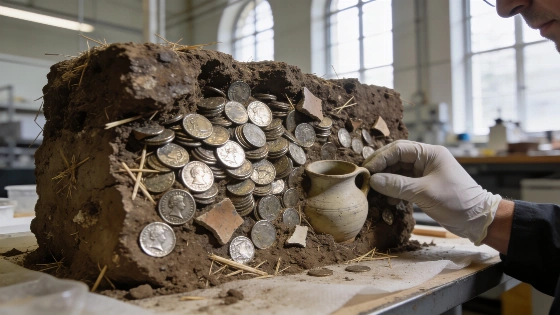
A legally reported discovery near Wesseling has yielded 934 Roman silver denarii weighing 3.1 kilograms. The coins offer evidence of wealth, monetary circulation and deliberate concealment in the Rhineland during the second century CE.
A block of soil removed from a field near Wesseling, south of Cologne, has yielded 934 Roman silver denarii weighing 3.1 kilograms. According to the regional heritage authorities, the find is the largest hoard from the reign of Emperor Hadrian yet discovered in Germany; only four larger hoards from the same period are known worldwide. The discovery has now moved from fieldwork into museum conservation and research, and the find was presented at the LVR-LandesMuseum Bonn on 22 September 2026, as reported in a museum update.
The hoard was first recognized by Oliver Riedl during metal-detecting on a field near Wesseling. After recovering 15 coins and receiving further signals from the ground, he stopped digging and notified the authorities rather than continuing independently. Archaeologists from the Rhineland Regional Association's Office for Archaeological Heritage Management then excavated the concentration under controlled conditions.
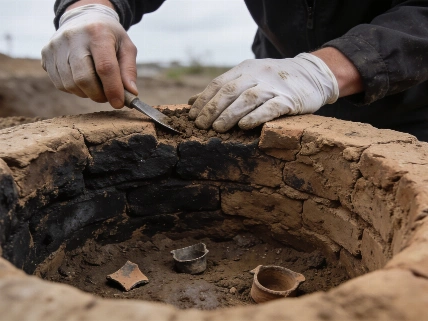
That decision preserved more than the coins themselves. The surrounding soil contained fragments of a ceramic vessel and traces of straw, indicating that the denarii were probably placed in a straw-lined pot. Agricultural activity had damaged the container and dispersed some coins, but the excavation recovered the hoard in full.
The recovery method matters because the arrangement of coins and associated material can establish how a deposit was formed. Individual removal in the field would have destroyed much of that evidence. In archaeological terms, the soil matrix is part of the find: it records the relationship between the coins, vessel fragments and organic remains, not merely the objects' final inventory.
The latest coin was minted in 124 or 125 CE during Hadrian's reign from 117 to 138 CE. That date places the concealment in the second quarter of the second century CE but does not identify the exact year or the person who buried the money. Most of the denarii are older and date to the Flavian dynasty, which ruled from 69 to 96 CE.
The oldest specimen was struck in 148 BCE during the Roman Republic. It had remained in circulation for more than 270 years before the hoard was deposited. Researchers therefore suggest that the money may have been accumulated around 100 CE and hidden several decades later. The coins provide a latest possible date for burial rather than a record of when every piece entered the owner's possession. The dating framework and the reported coin count are summarized in the regional archaeological report.
As with the earlier workshop study from the German Rhineland region, this discovery is most useful when material evidence is kept separate from broader historical interpretation. The hoard shows that a substantial quantity of Roman currency reached this landscape. It does not by itself identify the owner's occupation or social rank.
The total of 934 denarii represented considerable purchasing power in the Roman Empire. A legionary typically earned about 300 denarii annually, although around half could be deducted for food and equipment. On that comparison, the available remainder would have required roughly six years of saving to match the hoard's value.
The calculation is an illustration rather than a modern price conversion. Roman wages and deductions varied by circumstance, and the purchasing power of silver cannot be translated directly into a present-day sum. Even so, the comparison places the deposit well beyond an incidental handful of coins.
The owner remains unknown. Archaeologists consider a Roman estate in the surrounding countryside one possible setting for the wealth, but the evidence does not establish whether the money belonged to an individual household, landholder, trader or another member of the local community. The most cautious interpretation is that someone intended to protect a valuable reserve and never returned for it.
The LVR State Museum in Bonn examined the soil block with X-ray imaging before specialists separated and conserved the coins. The imaging helped reveal the dense silver concentration and guided the removal of the material without losing the relationship between coins, vessel fragments and straw. This is a conservation workflow rather than a conventional experimental study: it has no clinical sample, control group, p-values or confidence intervals.
That distinction is important when interpreting the discovery. Unlike a CERN detector analysis or a NASA mission dataset, the evidence here is primarily contextual and typological. Nor does the find constitute a peer-reviewed laboratory study of the kind commonly published in Nature. Its strength lies instead in the completeness of the documented deposit and in the convergence of numismatic dating, excavation data and conservation imaging.
Riedl's conduct also shaped the scientific result. North Rhine-Westphalia requires authorization for metal detecting together with landowner permission and appropriate training through specialist organizations. Because he reported the find instead of continuing to excavate it alone, archaeologists were able to document the deposit and recover the entire group. Under the state's monument protection law, the hoard belongs to North Rhine-Westphalia, while Riedl is eligible for a reward because the discovery was made and reported legally.
The hoard has been presented at the LVR-LandesMuseum Bonn and at the annual conference of the West and South German Association for Archaeological Research. Further public display is expected after restoration. Its value is not limited to rarity: the coins provide a controlled case for studying monetary circulation, wealth storage and the reuse of older currency in the northern Roman provinces.
The Wesseling hoard is therefore strongest as archaeological evidence for a large concealed reserve rather than as a solved biography. Numismatic dating identifies when the latest coin could have been buried but cannot establish the owner's identity or motive. The ceramic and straw remains strengthen the reconstruction of storage, while the disturbed soil shows why excavation context is essential. That combination of scale and restraint is what makes the discovery important: it documents Roman wealth in the Rhineland without pretending that 934 coins can answer every question about the person who hid them.