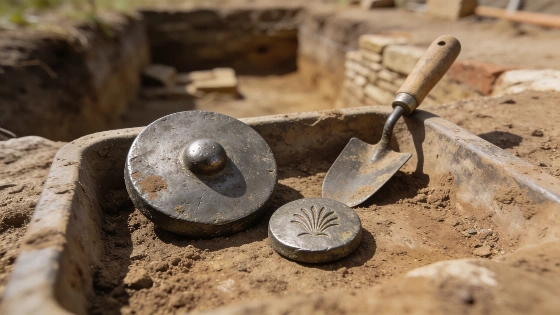
Two reported Roman lead pan weights from Bedford Roman Villa illustrate how measured mass may have structured work on a rural estate, while the limits of current verification caution against assigning them a specific trade or commodity.
A pair of Roman lead weights has brought the economic machinery of Bedford Roman Villa into sharper focus. Recovered during the reported 13th year of the community excavation in England, the objects are small but potentially direct evidence for measuring goods on a rural estate.
The finds do not identify a single transaction or prove exactly what was weighed. They do show, if the reported identification and measurements are confirmed by the excavation archive, that standardized mass mattered at the site and that the villa's inhabitants handled material that required more than informal estimation.
Independent search results currently do not provide a fresh official statement from the excavation team, a museum, an archaeological service or a university specifically confirming these Bedford weights. Nor do they independently verify the reported masses, their interpretation in Roman ounces, or the claim that they demonstrate trade. This does not overturn the reported discovery; it defines its present evidential status and the questions that formal archaeological documentation should answer.
Two calibrated objects
The larger weight is described as a solid lead disc with a raised central boss. It weighs 50.48 grams, close to the theoretical Roman standard of approximately 54.6 grams for two unciae, or Roman ounces. The denomination was also known as a duella. Its form is consistent with use alongside a Roman balance scale, where the boss could have made the disc easier to lift from a pan.
Its slightly low surviving mass does not by itself show that the object was inaccurately made. Corrosion and damage from cultivation and ploughing could have removed material over almost 2,000 years. A further possibility is that weights used on individual estates were adjusted to the particular scales in service there. Those explanations are archaeological hypotheses, not measurements independently established in the available search results.
The dished form and raised rim may have provided another practical advantage. If the cast disc emerged too heavy, a small amount of lead could have been scraped away until it balanced against a reference weight. That interpretation remains functional rather than certain because the object's use is inferred from its shape and mass rather than documented by a written label.
The second weight is reported as close to one Roman uncia. It weighs 28.56 grams against a theoretical standard of approximately 27.3 grams. Although it has roughly the same diameter as the larger disc, it is about half as massive, and its solid body differs from the recessed form of the two-ounce example.
Roman mass systems were not simply abstract lists of units. Their practical value depended on repeatable comparison between a counterweight and the material placed in a pan. In that sense, the Bedford objects would belong to a wider technology of administration: small, durable standards that could support the division of food, raw materials, workshop products or agricultural output.
A mark with several meanings
One face of the smaller weight carries an incised design resembling a palm branch, or palma. Across the Roman world the palm was associated with victory, success and good fortune, and it appeared on objects such as coins and jewelry.
On a weighing instrument the mark could have been practical, administrative or symbolic. It might have identified ownership, indicated verification or expressed a convention that archaeologists cannot yet reconstruct. The surviving mass suggests a deliberately calibrated object, but the palm does not establish who controlled it or what commodity it measured.
The distinction matters. A trade weight can document the need for standardized measurement without revealing whether it was used for agricultural produce, wool, rations or higher-value goods. Those possibilities fit the working character of a large rural villa, which was not simply a residence but an agricultural and manufacturing estate. They remain possible uses rather than demonstrated assignments for these particular discs.
That caution is important in archaeology because an object's function and its social meaning are separate questions. The shape and mass support a weighing function; the palm motif adds evidence of marking or decoration, but not a secure explanation of the owner's identity or the object's route through the estate.
Comparable regional archaeological recording also shows why classification matters. In Britain's Historic Environment Record system, Roman weights and loomweights can be registered as distinct categories of find, allowing researchers to separate objects used in weighing from those associated with textile production. A regional HER record illustrates this administrative approach, although it does not independently confirm the Bedford discovery.
Evidence from the excavation
The two weights were reported as found during the 2026 excavation season, which is scheduled to continue into October. Their value lies partly in appearing together after the team had reportedly waited years to recover an example. The pairing allows the objects to be compared directly rather than treated as an isolated curiosity, provided their stratigraphic records and catalogue entries are made available.
Their archaeological significance is also narrower than a claim about the whole Roman economy. They provide material evidence for measurement at Bedford Roman Villa, not a complete account of production, exchange or labor. The excavation has not established which buildings housed the scales, whether the weights were used simultaneously or how often goods moved beyond the estate.
This kind of evidence complements other archaeological work in which interpretation depends heavily on context. The difference between a measured object recovered through excavation and a detached antiquity is substantial; provenance determines whether an artifact can be connected to a place and to activities conducted there. Readers familiar with earlier cave-art reporting will recognize the same basic principle: the claim depends not only on the object but on the archaeological setting that gives it meaning.
The Bedford discoveries therefore deserve attention without being inflated. They connect a Roman villa to the practical work of weighing goods, distributing supplies and potentially preparing estate products for exchange. That is a more useful conclusion than treating the palm-marked disc as a mystery: the physical evidence supports an organized system of measurement while leaving its exact transactions and administration unresolved.
Why mass matters
Roman weights were intended to work within a system of mass units, but surviving objects do not always match theoretical standards exactly. Casting variation, later trimming, corrosion, impact and agricultural damage can all affect the measurement recorded by archaeologists. For that reason, the Bedford figures are best read as close comparisons rather than proof of perfect standardization.
Modern science uses the same distinction between a nominal standard and a measured object. Work associated with CERN, MIT and the journal Nature routinely separates instrument calibration, uncertainty and interpretation; archaeology faces an equivalent problem when a corroded artefact is compared with an ancient unit. The analogy does not prove the Bedford weights' accuracy, but it explains why a gram-level difference should be reported alongside the condition of the object and the method used to weigh it.
A robust publication would ideally state whether the discs were cleaned before weighing, which balance or analytical scale was used, how many repeat measurements were taken, and whether uncertainty intervals were recorded. It should also provide dimensions, lead-alloy analysis, photographs, find-spot data and a catalogue reference. Without those details, the numerical comparison remains informative but provisional.
The same limitation applies to interpretation of the palm. A design can signal ownership or inspection, yet it can also be decorative or incidental. Without additional weights, associated scales, residues or a clearer depositional context, the mark cannot identify a particular commodity or institution.
What the excavation has reportedly recovered is still substantial: two measured lead objects that anchor discussion of Bedford Roman Villa in routine economic practice. Their combined evidence supports a working estate where material was quantified and managed. It does not support a more elaborate story than the finds can carry, and that restraint is precisely what makes them valuable archaeological evidence.