Ernst & Young (EY) has deployed an on-premises quantum computer in Canada, aiming to process sensitive enterprise workloads while addressing regulatory and data sovereignty requirements for sectors including finance and healthcare
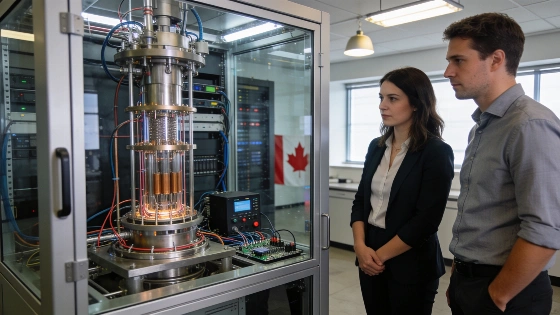
Ernst & Young (EY) has announced the installation of an on-site quantum computer at its Canadian operations, marking a shift from exclusive reliance on cloud-based quantum access to a dedicated hardware footprint within national borders. The system is intended to support enterprise workloads that require strict data residency and privacy controls, particularly for clients in regulated sectors such as financial services, energy, government, and healthcare. By hosting quantum hardware locally, EY aims to provide clients with greater assurance over where sensitive data is processed and how access is governed, in line with evolving data sovereignty regulations.
Hardware Integration and Control
The quantum computer forms part of EY's broader $3 billion global investment in artificial intelligence and advanced computing infrastructure. While the company has not disclosed the specific hardware platform, the deployment is positioned as a testbed for developing and validating quantum algorithms and hybrid quantum-classical workflows. The on-premises system allows EY to control the physical environment, calibration, and access protocols, which is critical for applications involving confidential or regulated data. This approach contrasts with cloud-based quantum services, where data may be transmitted and processed outside the client's jurisdiction.
Enterprise Applications and Validation
EY's deployment is underpinned by its "Client Zero" methodology, in which quantum algorithms are first developed and tested internally before being offered to clients. This internal validation process is designed to identify practical limitations, error sources, and integration challenges in real-world enterprise settings. Targeted applications include financial portfolio optimization, fraud detection, data protection, and large-scale risk management-domains where quantum computing is expected to offer potential speedups or new solution strategies, but where regulatory compliance and data privacy are non-negotiable.
Integration with AI and Commercial Strategy
The quantum initiative is integrated with ey.ai The Reimagination Engine, EY's AI-led platform that combines machine learning models with quantum computing resources. The company's leadership frames the move as a step toward transitioning quantum computing from experimental pilots to operational enterprise tools, though the current deployment remains a testbed rather than a production-scale system. EY has also filed quantum-related patents and is using the Canadian installation to explore scalable solutions for its global network. The focus on in-house hardware reflects a broader industry trend toward hybrid quantum-classical architectures and secure, jurisdiction-specific deployments. Similar efforts to integrate quantum hardware with enterprise infrastructure have been reported elsewhere, such as the EPB Quantum Network's integration of trapped-ion and photonic nodes for regional research and workforce development.
Technical and Regulatory Challenges
While the installation of an on-site quantum computer addresses certain regulatory and data residency concerns, significant technical and engineering challenges remain. The company has not released details on the number of physical qubits, gate fidelities, coherence times, or error rates achieved by the system. As with most current quantum hardware, noise, calibration drift, and limited circuit depth are likely to constrain the range of practical applications. The system's ability to deliver measurable advantage over classical methods for enterprise-scale problems has not been independently verified, and the transition from prototype to scalable, fault-tolerant operation remains a substantial hurdle. The deployment's primary value at this stage lies in enabling controlled experimentation and compliance with data governance requirements, rather than in delivering immediate computational breakthroughs.
Quantum computers operate by manipulating quantum bits, or qubits, which can exist in superpositions of states and become entangled with one another. Unlike classical bits, qubits are highly sensitive to noise and environmental disturbances, leading to errors that accumulate during computation. Achieving practical quantum advantage requires not only increasing the number of high-fidelity qubits but also implementing error correction and maintaining coherence over the duration of complex algorithms. Most current systems are classified as noisy intermediate-scale quantum (NISQ) devices, which are valuable for exploring hybrid workflows and benchmarking, but remain limited in their ability to solve large-scale, real-world problems without significant error mitigation or correction. The distinction between physical and logical qubits, and the engineering required to bridge that gap, is central to the future utility of quantum computing in enterprise and scientific contexts.