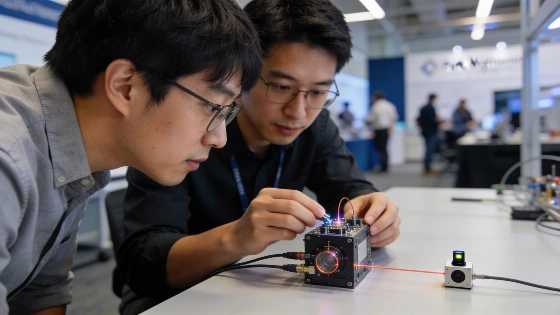
Four South Korean quantum startups are using KIST's Global Bridge Program to explore U.S. market pathways through Wisconsin and Illinois research networks, venture groups and manufacturing infrastructure.
Four South Korean quantum startups have taken their U.S. commercial strategy beyond the conference floor and into the Midwest's research and manufacturing network. Following Quantum World Congress (QWC) 2026, TruPixel, OptiQ-Labs, QRENS and Elixir joined the Global Bridge Program led by the Korea Institute of Science and Technology (KIST), with meetings across Wisconsin and Illinois.
The delegation's significance is practical rather than experimental. Available reporting describes meetings with gener8tor, the Wisconsin Economic Development Corporation (WEDC), the Chicago Quantum Exchange (CQE), the Bloch Quantum Tech Hub, mHUB and the Illinois Quantum and Microelectronics Park (IQMP). It reports no new processor demonstration, qubit benchmark, fidelity measurement or quantum-advantage claim, and it does not document completed contracts or commercial shipments.
The program sits within South Korea's Deeptech Incubator Project for Startups (DIPS). DIPS is overseen by the Ministry of SMEs and Startups and administered by the Korea Institute of Startup & Entrepreneurship Development, while KIST directs the quantum-technology domain. That structure gives the visit a defined institutional role: it is a market-entry and partnership effort rather than evidence that any one startup has reached commercial deployment.
In Milwaukee, the startups presented their companies to venture platform gener8tor and met with WEDC. The discussions were tied to preparations for an official Wisconsin trade-delegation visit to South Korea, creating a two-way channel rather than a one-off promotional stop.
That distinction matters in quantum technology. A promising device still requires financing, specialized suppliers, fabrication access, packaging, control electronics and technically informed customers. None of those requirements can be inferred from a pitch session alone, but the Milwaukee meetings placed them inside the commercial conversation.
The four companies also represent different layers of the quantum-technology stack. TruPixel develops single-photon avalanche diode (SPAD) sensors for quantum communications and measurement; SPADs convert individual-photon detections into electrical signals through avalanche multiplication. OptiQ-Labs develops narrow-linewidth lasers and equipment for ion-trap systems, where stable optical fields are used to manipulate and read trapped ions. QRENS offers the QubitSquare software platform and Q-Vista simulator, while Elixir is pursuing hybrid quantum-classical approaches for medical and pharmaceutical applications. These descriptions identify intended technology areas, not independently verified performance levels.
Chicago offered a different set of connections. The delegation met leaders from CQE, the Bloch Quantum Tech Hub, hard-tech innovation center mHUB and the 128-acre IQMP. Startup executives presented their technical frameworks to Dr. David Awschalom, founding director of CQE, while coordinating with the Illinois Economic Development Corporation.
The Illinois discussions focused on regional microelectronics packaging and manufacturing infrastructure. That is a more consequential test for quantum startups than a polished presentation alone because quantum systems depend on interfaces between specialized devices and conventional hardware that controls, reads and packages them. For ion-trap platforms, for example, optical sources, vacuum systems, electrodes, timing electronics and calibration software must work as one instrument. For photonic sensing, detector efficiency, timing resolution, optical coupling and noise management can determine whether a laboratory component is useful in a communication or measurement system.
The Midwest setting also gives the program a broader institutional context. As an earlier analysis explained, quantum technology cannot be judged by hardware counts alone; architecture, control and error management determine whether a system can support a useful workload. The same discipline applies to commercial expansion. A regional ecosystem may provide access and expertise, but it does not substitute for validated performance.
Research programs at institutions such as MIT and CERN illustrate why the field requires coordinated hardware, software and measurement engineering rather than a single headline metric. The broader literature in Nature likewise treats scalability, noise, calibration and error correction as interlocking engineering problems. A MIT quantum program provides a useful institutional example of this systems-oriented approach, but the existence of comparable research infrastructure does not validate the four startups' products.
During QWC 2026, KIST reportedly established a bilateral relationship with D-Wave that could allow participating Korean companies to access D-Wave quantum annealing through application programming interfaces and related infrastructure. Quantum annealing is a computational approach designed around energy minimization and is technically distinct from the gate-based circuits used in many quantum-computing benchmarks. Access to an external platform can support experimentation and software development, but it does not establish that a startup has produced an independent commercial result or achieved quantum advantage.
OptiQ-Labs was also reported to be planning a physical regional office on the U.S. East Coast in November 2026. The report described the planned site as the first permanent North American operating base among DIPS startups. This remains a stated plan rather than confirmation that the office has opened or begun operations.
The delegation's itinerary documents engagement with accelerators, research institutions, economic-development bodies and hard-tech manufacturing centers. It does not establish independent testing, customer deployment, manufacturing readiness or a completed technology transfer. No figures are provided for funding, revenue, device yield, operating temperature, qubit count, gate fidelity, coherence time, detector efficiency or error rate.
The measurable scale reported here is organizational and geographic: four South Korean startups traveled through Wisconsin and Illinois after QWC 2026, and Chicago's IQMP covers 128 acres. Those figures describe the program's reach and the infrastructure available for discussion. They say nothing by themselves about the performance of the companies' quantum systems.
This is why the Global Bridge Program should be read as connective infrastructure. KIST is helping startups move from a national incubator into a U.S. ecosystem where venture capital, quantum research and microelectronics manufacturing sit in closer contact. The immediate result is a set of meetings, a reported route to D-Wave platform access and possible market-entry pathways, not proof that the underlying technologies are ready for routine industrial use.
For readers tracking the quantum industry, that is still a meaningful development. Quantum companies need more than laboratory concepts and more than raw qubit claims; they need durable links to packaging, manufacturing, research talent and buyers who can evaluate technical evidence. KIST's Midwest push addresses that commercial gap directly, but the evidence currently supports a partnership-building milestone rather than a technology milestone. In quantum hardware, that is the correct verdict: ecosystem access can accelerate credible development, yet only measured performance and repeatable deployment can establish whether these startups have crossed from promise into product.
The central concept here is the difference between a technology ecosystem and a working quantum system. An ecosystem supplies institutions, capital, fabrication capacity and specialized expertise, while a quantum device must still demonstrate controlled operation under defined conditions. Meetings with CQE, mHUB, WEDC or IQMP can create routes toward that evidence, but they do not provide it. The Midwest initiative therefore matters as infrastructure for testing and commercialization rather than as a demonstration of quantum capability itself.