SEALSQ has closed a $10 million PIPE investment in WISeSat.Space, linking post-quantum chips, digital identity and PKI services with a planned low-Earth-orbit satellite infrastructure for protected space-connected IoT.
SEALSQ is putting $10 million behind a space-based cybersecurity buildout designed to protect satellite-to-terrestrial IoT links against future quantum decryption risks. The investment gives WISeSat.Space capital for its planned low-Earth-orbit constellation while assigning SEALSQ a role across the chips, identity and public-key infrastructure layers that would secure data moving through it.
The transaction is an infrastructure commitment, not a report of a quantum computer breaking an existing satellite network. Its stated purpose is to prepare satellite, ground and user systems for future cryptographic threats associated with the development of sufficiently capable quantum computers.
The PIPE financing closed on October 1, 2026, at the same time as WISeSat.Space's business combination with Columbus Acquisition Corp. The combination had been approved by Columbus shareholders on September 30, and WISeSat.Space began trading separately on Nasdaq under the ticker SAIQ on October 2. The transaction was based on a November 9, 2025, business-combination agreement and subsequent amendments.
SEALSQ Corp. (NASDAQ: LAES) received 1,040,478 ordinary WISeSat.Space shares and 1,040,478 Class F shares in exchange for SpaceAIQ shares. The original financing terms also describe the investment at $10.79 per share, while both companies operate within the wider WISeQey Corp. (NASDAQ/SIX: WQEY) ecosystem.
The agreement gives SEALSQ price protection rather than simply fixing the economics at closing. If WISeSat.Space's 10-day volume-weighted average price falls below $10.79 on the 60th calendar day after closing, the company may issue up to 1,073,216 additional ordinary shares. The PIPE shares remain subject to customary lock-up provisions. These terms describe the financing mechanism and should not be interpreted as evidence of satellite deployment or operational security performance.
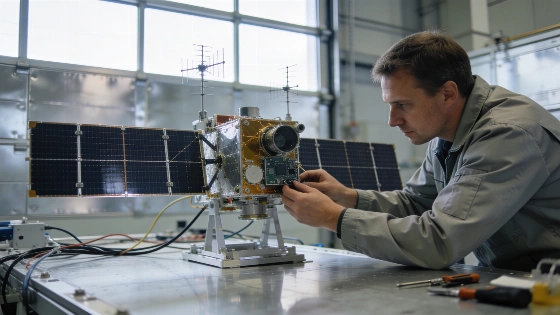
WISeSat.Space is expected to supply satellite capacity and associated space and ground infrastructure. SEALSQ is intended to provide post-quantum chips, digital identity solutions and PKI services across the space, ground and user segments. The proposed architecture therefore treats security as a chain extending from orbital equipment through ground stations and network services to end-user devices.
That systems approach resembles the broader cryptographic migration problem studied by standards bodies and security researchers. The NIST post-quantum program describes the need to evaluate algorithms, implementation risks and transition plans rather than merely selecting a replacement cipher. In satellite networks, migration also has to account for limited onboard processing, constrained bandwidth, long service lifetimes and the difficulty of physically upgrading equipment after launch.
Post-quantum cryptography is designed to run on conventional computing infrastructure while resisting attack methods that a sufficiently capable fault-tolerant quantum computer might use against some current public-key systems. Shor's algorithm is relevant to the long-term risk because it offers a theoretical route to breaking widely used public-key schemes based on integer factorization or discrete logarithms. Grover's algorithm presents a different, roughly quadratic search speedup, which is generally addressed through appropriate symmetric-key parameters rather than by replacing public-key cryptography with a single universal solution.
Quantum-resistant security is also broader than the cryptographic algorithm itself. PKI binds keys to digital identities, certificate authorities establish trust relationships and devices must correctly validate, rotate and revoke credentials. A satellite link can be mathematically protected yet operationally exposed if identity provisioning, firmware updates, key storage or ground-segment access controls are weak. Research and engineering programs at NASA, ESA and CERN illustrate why long-lived scientific and space systems typically require layered assurance, lifecycle management and careful validation of hardware and software interfaces.
WISeSat.Space's stated technology model separates the roles of the orbital platform and the security-service provider. WISeSat.Space is responsible for satellite capacity and related space and terrestrial infrastructure, while SEALSQ is expected to apply quantum and post-quantum services across that infrastructure. The result is intended to cover the satellite, ground and user segments rather than treating the satellite as a standalone secure endpoint.
The financing is intended to fund deployment of WISeSat.Space's next-generation LEO constellation and the integration of post-quantum cryptography into satellite, ground and user systems. The available transaction materials do not provide a launch schedule, constellation size, satellite specifications, operating data or measured cryptographic performance. They therefore support a financing and integration story rather than a demonstrated in-orbit security result.
The technical questions are substantial. A future evaluation would need to report at least algorithm and implementation details, processor and memory overhead, message sizes, link latency, energy consumption, key-establishment reliability, certificate-management behavior and resilience to intermittent connectivity. It would also need to distinguish laboratory measurements from flight-tested results. No sample size, p-value, confidence interval or independently reviewed in-orbit benchmark is provided in the transaction disclosures.
The architecture also sits within a wider migration problem. As an earlier analysis of quantum-resistant certificate infrastructure showed, the difficult work is not limited to selecting an algorithm. Organizations must connect cryptographic protection with identity, certificate management, devices and operational networks. The SEALSQ and WISeSat.Space arrangement applies that same systems problem to links that extend beyond terrestrial infrastructure.
The scientific literature, including work discussed in Nature, has emphasized that post-quantum transition planning must consider implementation security and interoperability as well as theoretical hardness. For satellite operators, the transition may be especially important because spacecraft and embedded devices can remain in service for years, while sensitive data intercepted today could be stored and decrypted later if future quantum capabilities become practical.
The transaction creates a direct financial and technical link between semiconductor supply, public-key infrastructure and satellite capacity. That is strategically coherent because protecting an IoT connection requires more than a chip alone: identities must be established, keys managed and credentials transported across endpoints and networks. The announcement does not yet establish that the combined architecture has been deployed, tested in orbit or independently evaluated.
Its significance is therefore specific rather than sweeping. SEALSQ is funding a route toward post-quantum protection for space-connected data while WISeSat.Space supplies the planned orbital platform and now operates as a separately listed public company. Until the constellation and security stack produce operational measurements, the strongest conclusion is that this is an infrastructure commitment with a defined technical direction, not proof that post-quantum satellite cybersecurity has already been delivered.
In this setting, a physical chip is only one component of a post-quantum system. PKI binds cryptographic keys to digital identities while satellite and ground infrastructure must carry those credentials through real links and devices. The announcement gives no fidelity metric, benchmark or in-orbit test because it reports a financing and collaboration framework rather than an experiment. That makes the $10 million investment meaningful as a commitment to build infrastructure, but insufficient evidence of a working space cybersecurity network.