A Kazakhstan project is fitting free-roaming cats with tiny cameras and GPS trackers while computer vision searches their footage for missing pets hidden beyond easy human reach.
A cat slipping beneath a porch or through dense bushes may be invisible to a human search team yet still lie within another cat's daily route. In Kazakhstan, a project called GdeKotBot is using that possibility to collect neighborhood footage and have artificial intelligence scan it for missing pets.
The system is not turning cats into autonomous investigators. It combines animal-borne cameras and GPS trackers with a Telegram-based reporting service in which people submit photographs, locations, and details about missing animals. The software then compares new images and video with the missing-pet database and sends a possible location to the owner for follow-up.
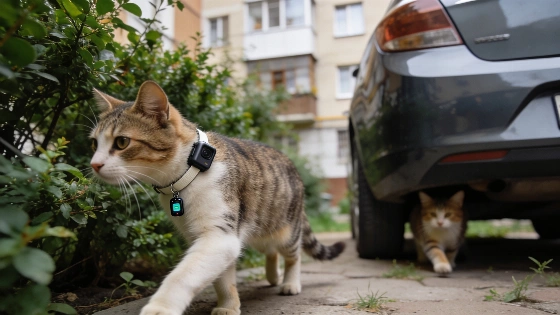
The camera stage is part of the "Кись-кись, найдись!" campaign, initiated by the Ogency and JAM agencies with support from Whiskas. Participating cats wear safety-release collars equipped with miniature cameras and GPS trackers. They continue their ordinary roaming behavior rather than receiving controlled search assignments, so the resulting footage reflects natural movement through the neighborhood.
Materials about the initiative refer to the camera-equipped animals as True CATectives. Their recordings are transferred to the system for comparison with missing-pet listings. This design resembles a distributed sensing network: many low-cost, imperfect observations can be combined with location data and human verification instead of relying on one specialized search device.
That logic is consistent with established computer-vision practice. A model can rank visual similarity between a newly captured frame and reference photographs, but its output is affected by pose, lighting, occlusion, camera motion, image resolution, and the presence of similar-looking animals. The result is therefore a probability-based lead, not an identification certificate. Research communities at MIT and in Nature Machine Intelligence routinely distinguish model performance on curated image datasets from reliability in uncontrolled environments such as streets, courtyards, and vegetation.
Owners of free-roaming cats in areas with many missing-pet reports can volunteer their animals. Recruitment initially focused on four Almaty districts: Auezov, Turksib, Bostandyk, and Almaly. During ordinary outings, the cats record animals they encounter, while GPS data helps associate a possible sighting with a place and time.
The broader network also operates through people. A resident who spots a cat can upload a photograph and its location without owning a camera-equipped animal. In Almaty, campaign information was additionally distributed through district digital screens, urban navigation systems, and 2GIS. The cat-based network is therefore an additional observation layer rather than a replacement for human reporting or human judgment.
GdeKotBot began in Almaty in 2025. According to reports attributed to the creators, the service has since been expanded across Kazakhstan, although independent official confirmation of nationwide coverage was not found in the available material. The project says that more than 28,000 users have joined and that 407 pets have returned home. Those figures are presented as creator-reported metrics and have not been independently audited.
The technical workflow is straightforward. A missing animal generates a reference record containing photographs and disappearance details. A new sighting supplies an image or video frame together with location data. Computer vision can rank visual similarities while the location narrows the area that an owner needs to search.
The hardware does not give the system a reliable view of every hiding place. A camera mounted on a moving cat may point away from a potential sighting or capture an animal only briefly. Bushes, vehicles, porches, poor angles, and low-quality footage can obscure identifying features. Similar-looking cats can create false positives, while a genuine match may be missed entirely.
Those limitations matter because image matching produces a lead rather than proof. An alert still requires a person to inspect the location, determine whether the animal is the missing pet, and bring it home safely. The system's usefulness depends on that human chain remaining active from the first report to the final reunion.
The reported reunion total covers the broader GdeKotBot service. The available account does not separate matches generated by camera-equipped cats from those produced by photographs and locations submitted by human users. It also does not provide a measured detection rate, false-positive rate, false-negative rate, confidence interval, p-value, sample size for a controlled trial, or comparison with conventional searches.
That makes the project a practical community experiment rather than a validated autonomous search platform. Its value may come from accumulating many imperfect observations across a neighborhood, but the available material does not establish how often feline footage identifies a missing animal or how much additional coverage it contributes. A rigorous evaluation would need predefined outcomes, a documented denominator of searches, independent adjudication of matches, and performance estimates under different lighting and terrain conditions.
The project nevertheless uses AI in a more grounded way than many technology demonstrations. The software performs a constrained visual-comparison and location-linked alerting task. The cats supply mobile sensing in places people may struggle to inspect. Neither component demonstrates general intelligence, and neither removes the need for residents to report sightings or owners to verify them. As with scientific instruments developed by NASA or CERN, usefulness depends not only on collecting data but also on calibration, uncertainty estimates, and transparent validation.
Missing cats often remain close to home while avoiding people. A frightened animal may hide under a car, inside vegetation, beneath a porch, or in another sheltered space. A familiar roaming cat can pass through some of those areas without changing its normal behavior, giving the network access to observations a human searcher might not obtain.
The arrangement also exposes a central engineering trade-off. More footage can create more chances to find a useful clue, but it can also produce ambiguous images and extra alerts that people must check. GPS information can narrow the search area but does not confirm the identity of the animal. AI can prioritize possible matches but cannot turn uncertain visual evidence into certainty.
Computer vision in this setting means statistical pattern matching over images and video rather than human-like recognition. A model can assign a similarity score between a sighting and a stored photograph, but that score remains sensitive to lighting, angle, occlusion, image quality, and the appearance of similar animals. The distinction is important in science communication: a model's confidence value is not automatically the same as a measured probability that the identification is correct.
GdeKotBot's strongest contribution is not proof that cats make dependable search robots. It is a modest deployment pattern in which ordinary local activity generates useful sensor data and software helps people sort it. The reported results remain unaudited, and the camera initiative's separate effect is unknown, so the project should be judged as an experimental aid rather than a proven replacement for human searches.