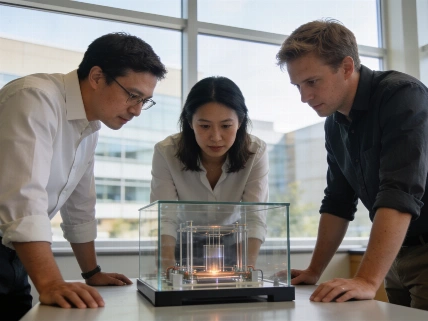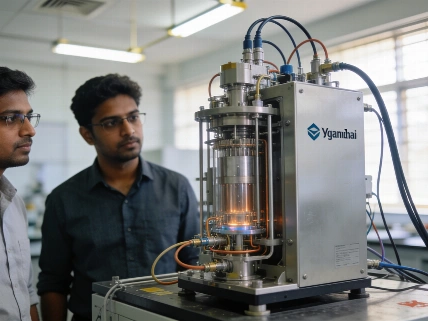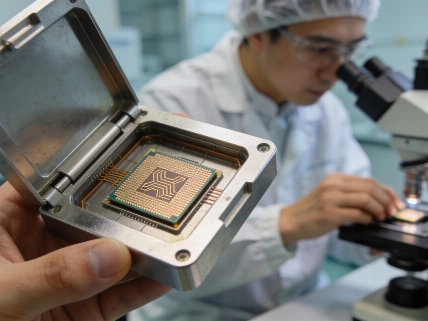
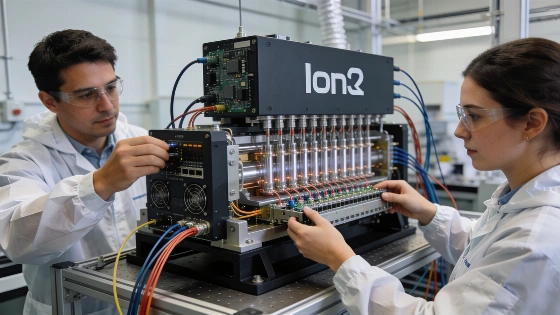
EPB is deploying an IonQ Forte Enterprise quantum computer on its Quantum Network, aiming to integrate trapped-ion hardware with photonic networking for regional research and workforce development in energy, logistics, and defense applications
EPB has announced the installation of an IonQ Forte Enterprise quantum computer on its Quantum Network, marking a step toward integrating trapped-ion quantum hardware with a photonics-based network infrastructure. The initiative is part of EPB's participation in the Southeastern Quantum Collaborative (SQC), a regional partnership focused on coordinating quantum research and workforce training across the southeastern United States. The collaboration aims to accelerate the transition of quantum technologies from laboratory research to industrial applications, particularly in sectors such as energy management, logistics, and defense.
Trapped-Ion Computing Meets Photonic Networking
The IonQ Forte Enterprise system is designed to provide commercial access to trapped-ion quantum computing, a platform known for high-fidelity qubit operations and long coherence times under cryogenic or ultra-high vacuum conditions. According to EPB, the deployment will enable users to interact with both the trapped-ion processor and a photonic quantum network, allowing for experiments in distributed quantum computing and secure communications. The system is being integrated with existing infrastructure developed in partnership with Oak Ridge and Los Alamos National Laboratories, where previous work has focused on quantum-resilient communication protocols for power grid management.
While the company has not disclosed detailed device specifications, IonQ's trapped-ion platforms typically operate with a small number of physical qubits—often in the range of 20 to 30—with single- and two-qubit gate fidelities reported above 99%. The photonic network component is intended to support the distribution of quantum states between nodes, but the practical distance, loss rates, and entanglement fidelity achievable in this deployment remain to be independently characterized.
Network Integration Creates Major Engineering Challenges
The integration of these two architectures is a technical challenge, as it requires precise synchronization, low-loss optical interfaces, and robust error mitigation to maintain quantum coherence across the network.
EPB's approach reflects a broader trend in the quantum industry toward hybrid systems that combine different physical qubit types and networking strategies. The company positions its Quantum Network as a testbed for both academic and industrial users, with the goal of supporting research into quantum algorithms, secure communication protocols, and workforce development.
However, the transition from laboratory demonstration to reliable, scalable, and commercially useful quantum networking remains a significant engineering hurdle. As seen in other recent efforts to expand quantum hardware capabilities—such as the addition of new molecular beam epitaxy systems for quantum dot lasers in optical interconnects, described in this related report—the integration of advanced quantum devices into operational infrastructure is a complex, multi-stage process.
Research and Training Remain the Network's Primary Value
At present, the EPB Quantum Network's primary value lies in providing a platform for experimental research and skills development rather than delivering immediate quantum advantage or fault-tolerant computation. The company has not claimed that the system will outperform classical computers on practical tasks, nor has it demonstrated error-corrected logical qubits or large-scale entanglement distribution.
Independent benchmarking, reproducibility of results, and long-term operational stability will be critical for assessing the system's scientific and commercial significance as deployment progresses.
Physical Qubits Remain Far From Fault-Tolerant Computing
Understanding the distinction between physical and logical qubits is essential when evaluating quantum computing platforms. A physical qubit is a single controllable quantum system, such as an ion or photon, that can be manipulated and measured. However, physical qubits are prone to errors from environmental noise, imperfect control, and decoherence.
Logical qubits encode information across multiple physical qubits using error-correcting codes, allowing for the detection and correction of certain errors. Achieving reliable logical qubits with low logical error rates is a major milestone on the path to fault-tolerant quantum computing, but current commercial systems—including those based on trapped ions—primarily offer access to physical qubits with limited error mitigation.
The gap between laboratory demonstrations and practical, error-corrected quantum computation remains a central challenge for the field.